
GMP & Pharmaceutical Manufacturing Expert
✓ Reviewed by: Pankaj Sharma - Quality Control Specialist
Reviewed for Quality Control accuracy, laboratory practices, analytical methods, and technical relevance
📅 Last Updated: November 9, 2026
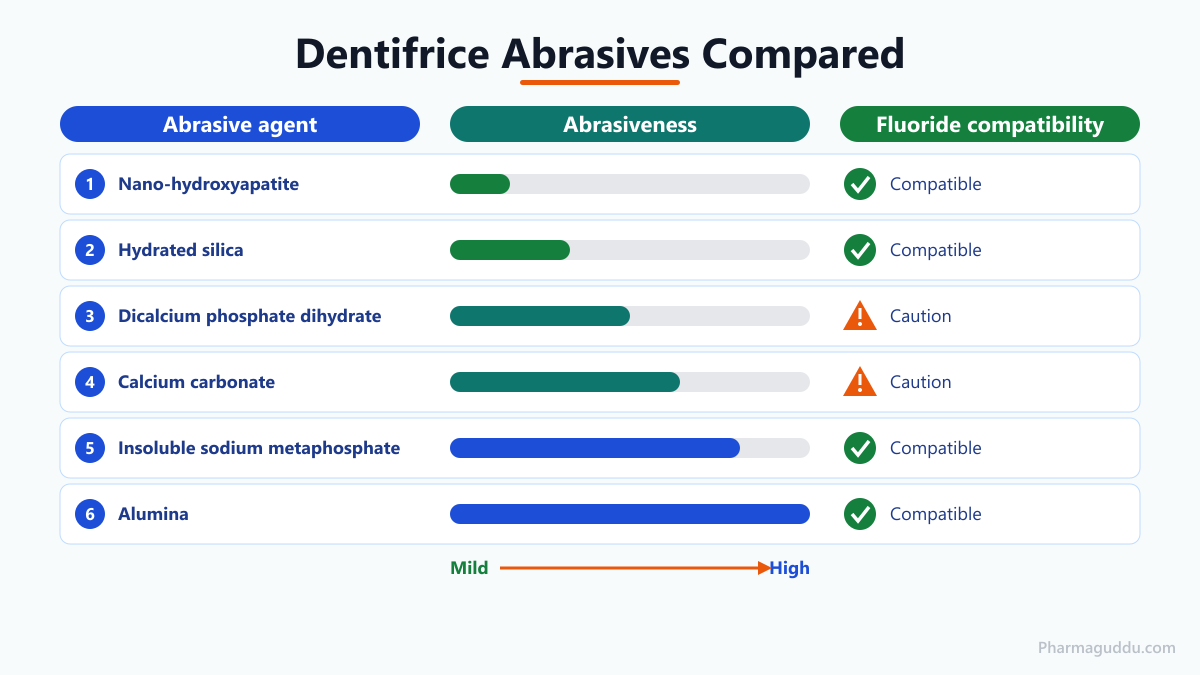
Abrasives in dentifrices are fine, water-insoluble solid particles that remove plaque, food debris and surface stain from teeth and leave a smooth, polished surface. The common agents are calcium carbonate, dicalcium phosphate, hydrated silica, alumina, insoluble sodium metaphosphate and, in some markets, nano-hydroxyapatite. Selection depends on the relative dentin abrasivity (RDA) of the finished dentifrice, which is set by particle size, shape, hardness and the share of abrasive in the formula. Compatibility with fluoride and the available mixing equipment also influence the choice.
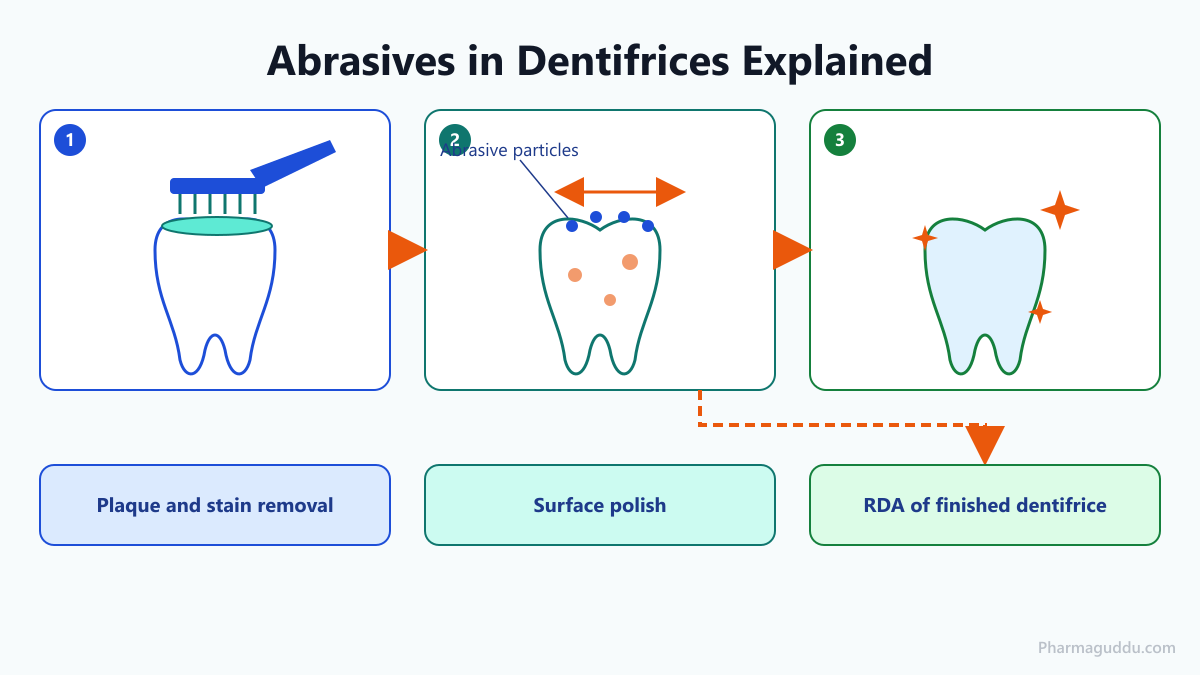
What are abrasives and polishing agents in dentifrices?
An abrasive is a solid, insoluble powder added to a dentifrice to loosen and remove deposits from the tooth surface by mechanical action. A polishing agent is the same type of material, used in a finer particle size, to smooth the surface and give it luster. In practice, one ingredient usually performs both functions. The particle size decides which effect dominates.
Dentifrices are produced as tooth powders and as toothpastes. Both contain an abrasive as the main solid component. For the full overview of dentifrice types, formulation and evaluation, see Dentifrices; Types, Formulation, and Evaluation.
Each agent is taken one by one below and linked to the abrasiveness test, so that the choice of agent can be justified. Patent literature lists many options, including precipitated, fused and hydrated silica, aluminium silicate, alumina, calcium carbonate, anhydrous dicalcium phosphate, dicalcium phosphate dihydrate, insoluble sodium metaphosphate, zirconia, perlite and pumice. The list shows the range of materials that can be used. Only a few are common in commercial products.
How do abrasives clean and polish teeth?
Abrasives act by rubbing. During brushing, the particles are carried by the bristles across the tooth surface and remove the pellicle, plaque and extrinsic stain. Finer particles then smooth the scratches left by coarser ones, and the surface becomes more reflective.
The same action can wear tooth tissue. Dentin is softer than enamel, so the exposed root surface is the more sensitive site. For this reason, abrasivity is measured separately for the two tissues.
Relative dentin abrasivity (RDA) is a score for the wear of dentin caused by a dentifrice, compared with a reference abrasive. The reference is calcium pyrophosphate, which is assigned a value of 100.
Relative enamel abrasivity (REA) is the same type of score for enamel.
Abrasivity testing of dentifrices is covered by the standard ISO 11609 (Dentistry: Dentifrices, requirements, test methods and marking). RDA is generally determined by a radiometric method on irradiated dentin. Profilometry, which measures the depth of the scratch on a polished surface, is generally used for enamel. The test is run on the complete dentifrice, so the RDA of the finished dentifrice is the value that matters, not a “grade” printed on the raw material specification.
This is why the test links to the choice of abrasive. An agent is selected, a prototype formula is made, and the RDA of that formula is measured. If the value is too high or too low, the particle size, the grade or the level of abrasive is adjusted, and the test is repeated. ISO 11609 sets an upper limit for the RDA of a dentifrice, and a value of 250 is commonly cited.
Which factors set the abrasiveness of a dentifrice?
Abrasiveness depends on the material and on how it is used in the formula, and four factors listed below are mainly responsible for it.
- Particle size. Within one material, abrasiveness generally rises as the particle size increases. A published radiometric study of silica and calcium carbonate in dentifrices (J. Cosmet. Sci., 2001) reported this trend for both materials.
- Hardness. A harder particle cuts more readily than a softer one. Alumina is harder than calcium carbonate, which is harder than the phosphates in most grades.
- Particle shape. Angular or fractured particles cut more than rounded or spherical particles of the same size.
- Share of abrasive in the formula. More abrasive per gram of dentifrice gives more contact with the tooth surface, so the RDA generally rises.
The same study reported that silica gave a higher RDA than calcium carbonate at a similar particle size, so two abrasives of equal particle size are not equally abrasive and particle size alone cannot be used to compare different materials.
Silica grades can be engineered to cover a wide range. Supplier and patent literature describes low-abrasion grades (RDA of roughly 90 or less) and medium grades (roughly 110 to 150). Exact values depend on the manufacturer, the test method and the formula, so these figures serve only as an orientation.
Which abrasives are used in dentifrices?
Exact values depend on the manufacturer and the grade, and the RDA must always be measured on the finished formula.
Calcium carbonate
Calcium carbonate is used as ground chalk or as a precipitated grade. Precipitated calcium carbonate has a more controlled particle size and is preferred in dentifrices. It is a classical abrasive of tooth powders and is also used in pastes.
It cleans well and gives a good polish at a low cost. Its abrasiveness is moderate and depends strongly on the particle size. It is alkaline and reacts with acid, so the pH of the formula must be controlled, and calcium ions can also react with some fluoride sources, which may reduce the available fluoride. A fluoride dentifrice with calcium carbonate therefore requires a compatible fluoride system and stability data.
Dicalcium phosphate dihydrate and anhydrous
Dicalcium phosphate dihydrate is a mild abrasive with good polishing action and is widely used in pastes and powders. The anhydrous form is harder and more abrasive. It is generally used with a humectant such as glycerol or sorbitol, and the dihydrate is generally stabilised, because it can lose its water of crystallisation and then harden the paste. The dihydrate also reacts with sodium fluoride, so fluoride compatibility needs the same attention as with calcium carbonate.
Hydrated silica
Hydrated silica (precipitated or gel type) is the main abrasive in many modern pastes. It is chemically inert and compatible with fluoride and with most flavours and active ingredients. Because the pore structure and particle size can be engineered, grades are available from low to medium abrasivity, and some grades also thicken the paste. The cleaning level is high for a given RDA. The grade chosen allows the formulator to meet an RDA target.
Alumina
Alumina (including hydrated alumina) is a hard abrasive. It gives strong cleaning and is generally used at a low level, often in combination with a softer agent, for stain removal. Its hardness means that it needs careful control of particle size.
Insoluble sodium metaphosphate
Insoluble sodium metaphosphate is a moderately abrasive polishing agent. It contains no calcium, so it is compatible with fluoride. It is generally used in pastes where fluoride stability matters.
Hydroxyapatite
Hydroxyapatite is the mineral form of calcium phosphate found in teeth. Nano-hydroxyapatite is used in dentifrices mainly for its mineral-replacing function, and it also contributes a mild polishing effect. In the EU, its use is restricted by regulation, as described under regulatory points below.
| Agent | Abrasiveness (general) | Main role | Fluoride compatibility |
|---|---|---|---|
| Calcium carbonate | Low to medium, rises with particle size | Cleaning and polish, tooth powders | Needs a compatible fluoride system |
| Dicalcium phosphate dihydrate | Low to medium | Mild polish, pastes and powders | Needs attention |
| Dicalcium phosphate anhydrous | Medium to high | Cleaning | Needs attention |
| Hydrated silica | Low to medium, adjustable | Main abrasive in modern pastes | Compatible |
| Alumina | High | Stain removal, low level | Generally compatible |
| Insoluble sodium metaphosphate | Medium | Polish | Compatible |
| Nano-hydroxyapatite | Mild | Mineral replacement, mild polish | Not in the research |
How do tooth powders and pastes differ in abrasive load?
A tooth powder is mostly dry solid, so the abrasive forms a large part of the formula. A toothpaste carries the abrasive in a liquid phase of humectant and water, together with a binder and a detergent, so the abrasive share is lower in a paste and the finer, softer grades are preferred.
The process also differs. A powder is blended dry, so dust control and homogeneity are the main concerns, and the equipment is similar to that described in Types of Blenders used in Pharmaceuticals. For a paste, the powder must be wetted out in the liquid phase and deaerated, so the main concerns are dispersion and air removal. Powder handling in general is covered in Powders; Types, Advantages, and Disadvantages.
How are abrasives incorporated into a toothpaste?
The steps below describe the general sequence. Mixer types and viscosity limits depend on the formula and on the equipment manufacturer.
- The liquid phase (humectant, water and binder solution) is prepared and charged to the mixer.
- The abrasive powder is charged. Sub-surface powder induction or charging under controlled dust extraction should be used, because both avoid fish-eyes (dry lumps with a wet skin) and limit operator exposure to dust.
- The powder is wetted out and dispersed with a high-speed disperser or high-shear mixer. According to a technical report by ROSS, such mixers handle this stage up to a viscosity of about 50,000 cP.
- The detergent and flavour are added according to the batch manufacturing record, and the detergent should be added with care because it increases foaming.
- The paste is finished under vacuum in a multi-shaft or double planetary mixer. The same ROSS report gives 70,000 to 100,000 cP for the finished paste at this stage.
- The paste is deaerated under vacuum. Powders carry entrained air, and the detergent makes foaming worse, so air must be removed before filling. The vacuum level and the hold time must be recorded in the batch manufacturing record (BMR).
- The paste is transferred to the filling machine and filled into tubes.
For a tooth powder, the abrasive is sifted and blended with the other solids, and then the flavour is added.
What controls and limits apply to abrasives?
Controls start with the incoming abrasive and continue to the finished paste. The abrasive specification normally includes particle size distribution, moisture and identity. A change of supplier or grade should go through change control, because the RDA of the finished dentifrice can shift, and this can alter the cleaning and wear behaviour of the product.
In-process control (IPC) during manufacture normally covers the following checks.
| Check | Purpose |
|---|---|
| Fineness or grit | Detects coarse particles and undispersed lumps |
| Density | Shows whether air is still present |
| Viscosity | Shows the state of dispersion and the stability of the paste |
| pH | Important for calcium carbonate and phosphate formulas |
| Vacuum and hold time | Confirm the deaeration step |
The finished dentifrice is tested for abrasiveness (RDA, and REA where required), pH, particle size and the other evaluation tests listed for dentifrices. The mixer must be qualified, and the process validated, before commercial batches. Process validation is described in 4 Types of Process Validation in Pharmaceutical and Protocol.
The BMR should contain the abrasive lot number and the quantity charged. The mixer speed and time should also be entered, and so should the vacuum and hold time and the IPC results.
What problems occur with abrasives and how are they corrected?
Gritty feel
Possible causes: coarse particles, undispersed agglomerates or insufficient milling of the abrasive.
Corrective actions: check the particle size of the incoming lot, extend the high-shear dispersion time, and use sub-surface induction to avoid lumps.
Hardening or separation in the tube
Possible causes: loss of water from dicalcium phosphate dihydrate, an unsuitable humectant level or poor binder hydration.
Corrective actions: use a stabilised dihydrate, adjust the humectant, and review the binder hydration time.
Air bubbles and low density
Possible causes: air carried by the powder and foam from the detergent.
Corrective actions: extend the vacuum deaeration, check the vacuum level and record the hold time.
Loss of fluoride activity
Possible causes: calcium-containing abrasives reacting with the fluoride source.
Corrective actions: use a compatible fluoride system or an abrasive without calcium, and confirm with stability data.
RDA outside the target
Possible causes: a change in particle size, grade or abrasive level.
Corrective actions: return to the approved supplier grade, re-test the RDA and manage the change through change control.
Wear on equipment
Hard abrasives in a wet slurry can erode mixer blades, mill parts and filling parts over time. Engineering staff should inspect them at planned intervals. The cleaning procedure must also remove all abrasive residues at changeover, so that the next batch is not contaminated by material left from the previous one.
What are the regulatory points for abrasives?
In the EU, toothpaste is regulated as a cosmetic product under Regulation (EC) No 1223/2009. In the US, a toothpaste that contains fluoride is regulated as an over-the-counter (OTC) drug.
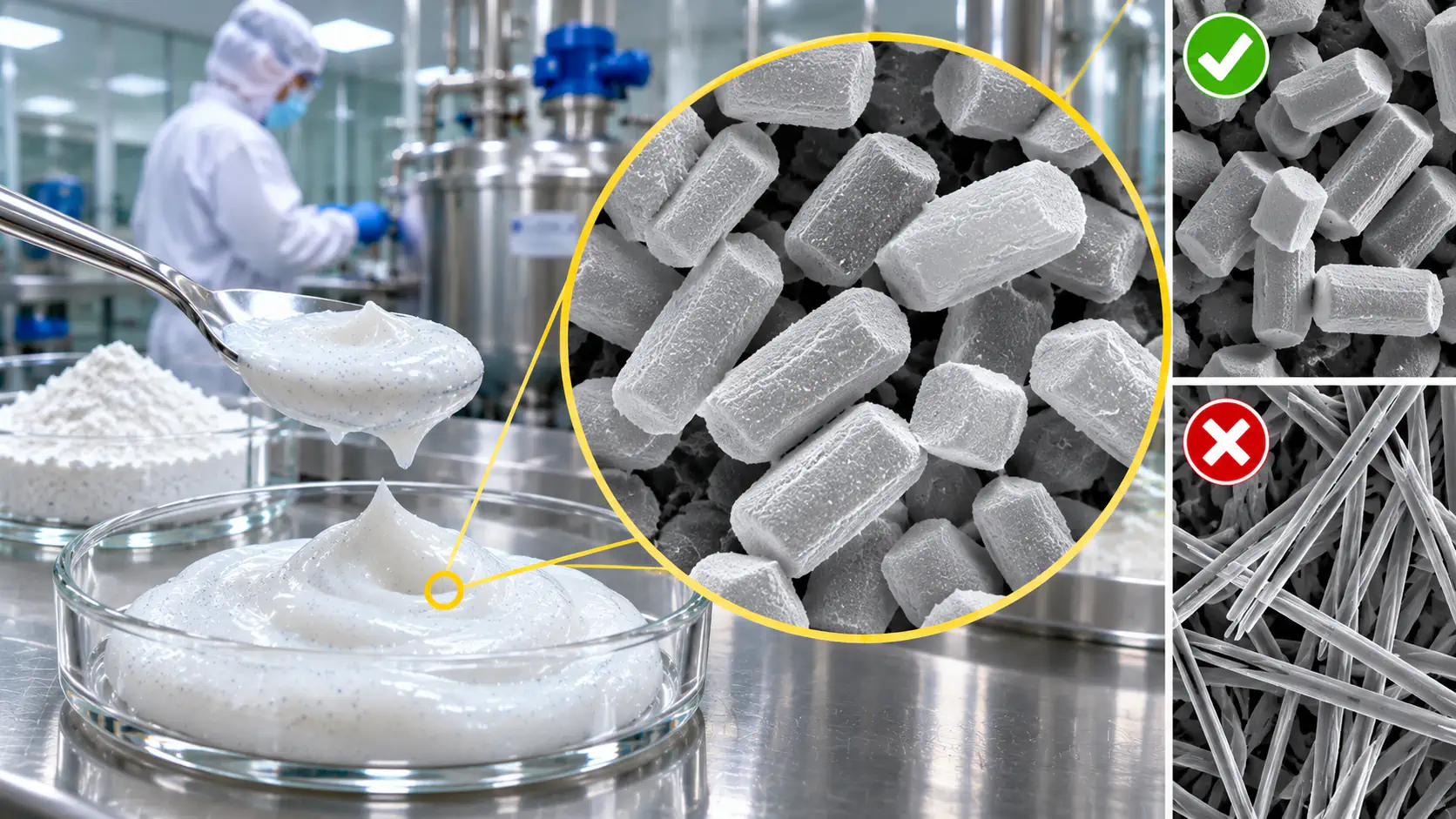
Nano-hydroxyapatite is a specific EU case. The Scientific Committee on Consumer Safety (SCCS) opinion SCCS/1648/22 (adopted 21-22 March 2023) states that “the SCCS considers hydroxyapatite (nano) safe when used at concentrations up to 10% in toothpaste”. The opinion applies only to rod-shaped, uncoated particles. At least 95.8% (by particle number) must have an aspect ratio below 3, and the rest not above 4.9. Needle-shaped particles are outside the opinion.
Commission Regulation (EU) 2024/858 of 14 March 2024 amends Annexes II and III of Regulation (EC) No 1223/2009 and restricts hydroxyapatite (nano) to a maximum of 10% in toothpaste and 0.465% in mouthwash. It does not allow uses that may expose the lungs to the nanoparticles by inhalation.
Frequently Asked Questions
RDA stands for relative dentin abrasivity. It compares the dentin wear caused by a dentifrice with the wear caused by a calcium pyrophosphate reference, which is set at 100. A higher number means more abrasion. The value belongs to the finished dentifrice, so two pastes made with the same abrasive can have different RDA values.
Within the same material, abrasiveness generally rises with particle size. Shape, hardness and the share of abrasive in the formula also matter. A hard, angular particle of moderate size can therefore be more abrasive than a larger, soft, rounded one.
At a similar particle size, a published radiometric study found that silica gave a higher RDA than calcium carbonate. However, silica grades can be engineered from low to medium abrasivity, so a low-abrasion silica can be gentler than a coarse calcium carbonate.
Yes, within limits. Regulation (EU) 2024/858 restricts it to a maximum of 10% in toothpaste, and the SCCS opinion applies only to rod-shaped, uncoated particles that meet the stated aspect ratio. Needle-shaped particles are not covered.
References
- Opinion on Hydroxyapatite (nano), SCCS/1648/22, European Commission SCCS
- Commission Regulation (EU) 2024/858, EUR-Lex
- In-vitro oral care abrasivity, Intertek
- Spherical silica particle size for RDA control, US11285088B2, Google Patents
- Oral cavity cleaning composition, method, and apparatus, US 12064495, USPTO
- Abrasiveness evaluation of silica and calcium carbonate used in the production of dentifrices, J. Cosmet. Sci. 52, IPEN repository
- ISO 11609, Dentistry: Dentifrices, requirements, test methods and marking, International Organization for Standardization
- Cosmetics Science and Technology, textbook

Naresh Bhakar is the Founder and Author at Pharmaguddu.com, bringing his extensive expertise in the field of pharmaceuticals to readers worldwide. He has experience in Pharma manufacturing and has worked with top Pharmaceuticals. He has rich knowledge and provides valuable insights and data through his articles and content on Pharmaguddu.com. For further inquiries or collaborations, please don’t hesitate to reach out via email at [email protected].