
Quality Control Specialist | Industry Experience
✓ Reviewed by: Satpal Singh - Quality Assurance & Regulatory Specialist
Reviewed for GMP compliance, quality systems, and regulatory accuracy
📅 Last Updated: November 7, 2026
Quality control tests for pharmaceutical aerosols confirm that the propellant, valve, container and finished product perform as registered. The main tests are flammability (flame projection and closed drum), vapor pressure by pressure gauge, density, moisture by Karl Fischer titration, propellant identity by gas chromatography (GC), foam stability, net contents, spray pattern, particle size and valve delivery. Fill weight, crimp and leak checks are performed in process. Acceptance limits are taken from the registered specification and the current pharmacopoeia, not from fixed universal values.
What are the quality control tests for pharmaceutical aerosols?
Quality control (QC) tests for aerosols are the laboratory and line checks that show whether a pressurised pack delivers the right product in the right form. An aerosol is a container with a propellant, a concentrate and a valve. The tests cover all three. For the full overview of aerosol types, containers and components, see Aerosol in Pharma (Aerosols); Types, Container, Advantage, and Disadvantage.
Each test is described at method level: what is measured, which apparatus is used and what the result tells the QC analyst. Household-type and topical aerosols are determine mainly on flammability, foam and spray pattern. Pressurised metered dose inhalers (pMDI) are decided mainly on dose, particle size and leak rate.
What does each aerosol test measure?
Each test links a physical property of the pack to its performance. Vapor pressure reflects the propellant blend. It decides how hard the product is expelled. Density and net contents show whether the correct quantity of concentrate and propellant was filled, and moisture affects both the corrosion of the container and the stability of water-sensitive formulations.
Flammability describes the safety hazard of the spray. Spray pattern, particle size and foam describe how the product reaches the patient or the surface. Valve delivery and delivered dose describe how much product leaves the pack at each actuation. Leak rate shows whether the seal keeps the propellant inside during shelf life.
Every result is compared with the registered specification and the current pharmacopoeia. Limits differ by product and by market. A figure from one product is never carried over to another. The valve and propellant background is covered in Aerosol Valve, Actuator and Dip Tube: Components and Their Functions and Aerosol Propellants in Pharmaceuticals.
How are the physicochemical tests performed?
The table gives the apparatus and the reading of each test. The sections below explain the method.
| Test | What is measured | Apparatus | What the result shows |
|---|---|---|---|
| Flame projection | Flame extension beyond a flame | Flame source, scale | Flammability of the spray |
| Closed drum | Ignition inside a sealed drum | Sealed drum, ignition source | Explosion potential of the contents |
| Vapor pressure | Internal pressure at a set temperature | Pressure gauge, can-puncturing device | Correct propellant blend |
| Density | Mass per unit volume | Hydrometer or pycnometer | Correct fill composition |
| Moisture | Water content | Karl Fischer titrator | Corrosion and stability risk |
| Propellant identity | Components and ratio | Gas chromatograph | Right propellant, right blend |
| Foam stability | Persistence of foam | Graduated container, timer, rod | Foam quality for foam products |
Flammability
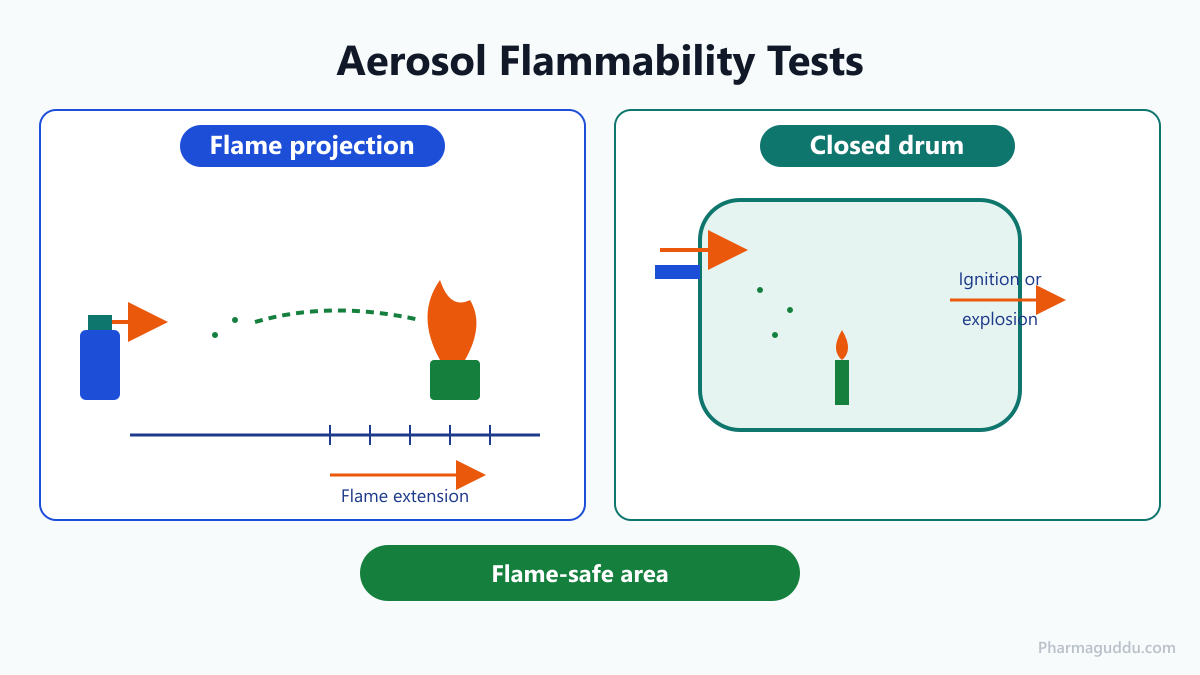
ASTM D3065 names the flame projection test and the closed-drum test for aerosol products. In the flame projection test, the product is sprayed toward a flame at a fixed distance, and the length of the flame extension is measured against a scale. A longer extension means a higher fire hazard.
In the closed-drum test, the product is sprayed into a sealed drum containing a burning candle. The analyst notes whether ignition or an explosion occurs. Flashback, where the flame travels back along the spray to the container, is observed during the flame test. Both tests are performed only in a flame-safe, ventilated area with trained staff.
Vapor pressure
Vapor pressure is measured by attaching a pressure gauge to the container through a can-puncturing device or a gauge adapter. The container is held at the test temperature stated in the specification (for example 21 °C or 25 °C), and the gauge is read after the pressure is stable. A reading above the specification suggests a wrong propellant ratio or excess propellant. A reading below it suggests loss of propellant, air in the can or a leak.
Density
Density is determined with a hydrometer or a pycnometer. The pycnometer gives the more exact value, because the volume of the vessel is known and the sample mass is weighed. The result is compared with the specification, which shows whether the concentrate and propellant were filled in the correct proportion.
Moisture by Karl Fischer titration
Moisture in the propellant is determined by Karl Fischer (KF) titration. United States Pharmacopeia (USP) 38 chapter <602> (Propellants) refers water determination to chapter <921>, with a gas dispersion tube and a specimen of 100 g. The propellant is passed into the titration vessel as a gas so that atmospheric moisture is not picked up.
Coulometric titration is chosen for very low water levels, and volumetric titration for higher levels. The analyst checks the instrument drift before the run and standardises the titrant (titer) with a water standard.
Propellant identity by gas chromatography
A gas chromatograph separates the propellant components, and the retention times are compared with a reference standard injected under the same conditions. The peak areas give the blend ratio. The system suitability check, for example repeat injections of the reference standard, is passed before sample results are accepted. A thermal conductivity or flame ionisation detector is commonly used.
Foam stability and rheology
Foam aerosols are assessed by visual rating and by time. A measured quantity is dispensed into a graduated vessel, and the time taken for the foam to collapse is recorded. In another method, the time for a rod or weight to penetrate the foam is measured. Rheology (flow behaviour) of a foam or cream concentrate is measured on a rotational viscometer at a stated shear rate and temperature.
How are the tests grouped by stage and by aerosol type?
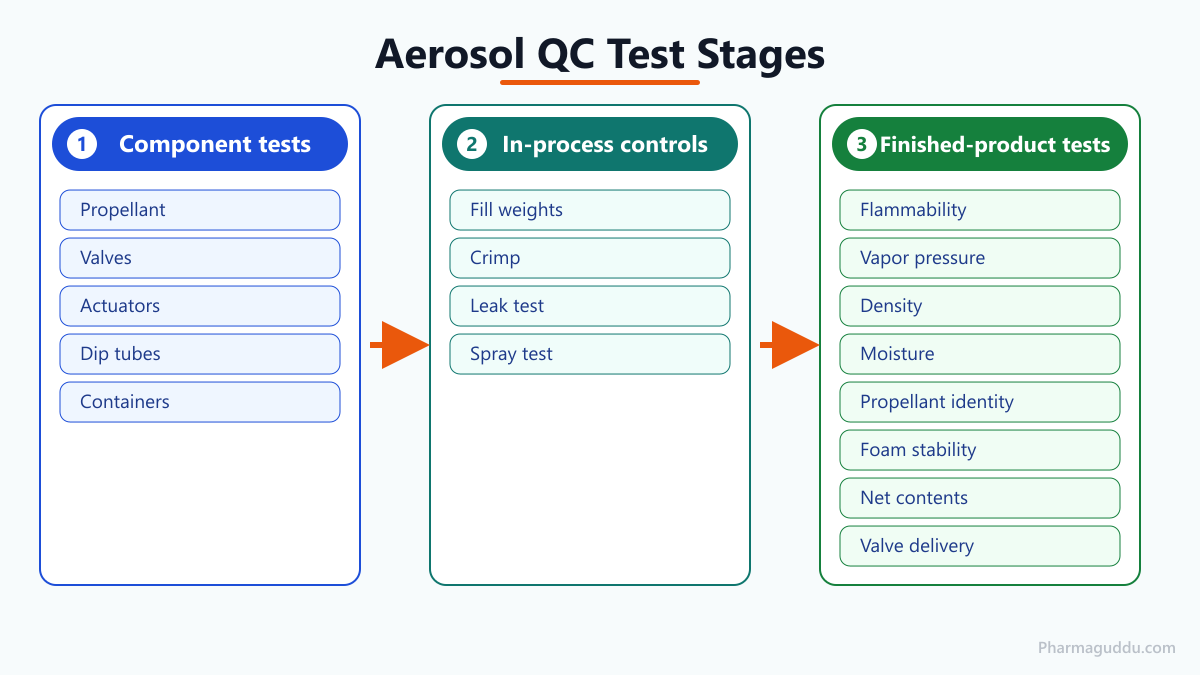
Aerosol testing is grouped in three stages: component tests, in-process controls (IPC) and finished-product tests.
Component tests cover the propellant, valves, actuators, dip tubes and containers.
IPC covers fill weights of concentrate and propellant, crimp checks, leak testing and spray testing.
Finished-product tests cover the physicochemical and performance tests above.
The tests also differ by system. A solution system (two-phase) and a suspension or emulsion system (three-phase) need different checks, because dispersed particles and foam behave differently from a clear solution. The formulation side is explained in Two-Phase vs Three-Phase Aerosol Systems.
How are valve, spray and dose performance tested?
Performance tests describe what leaves the pack at each actuation.
Net contents: The full container is weighed, the contents are discharged, and the empty container is weighed again. The difference is compared with the labelled quantity.
Valve delivery: Metered valves are fitted to test containers and actuated. The weight loss per actuation is divided by the density of the product to give the volume delivered. The limits depend on the valve and the registered specification.
Spray pattern: The product is sprayed on treated paper at a fixed distance, and the mark is examined. An irregular or off-centre pattern indicates a valve or dip tube defect.
Particle size and dose: USP chapter <601> (USP 38 text) covers delivered-dose uniformity with mechanical actuation of a minimum of 10 containers (20 determinations). It also covers aerodynamic particle size distribution by cascade impactor. Droplet size of nasal sprays is determined by laser diffraction. It is reported as D10, D50, D90 and span.
Automated shake-and-fire actuation reduces variation between analysts in delivered-dose testing, because the shaking and firing force are programmed instead of applied by hand.
Related topic: suspension aerosols
Related topic: aerosol particle size measurement
Which in-process controls and limits apply during filling?
Aerosols are filled by cold filling or by pressure filling. In cold filling, the concentrate and chilled propellant are filled and the valve is then crimped. In pressure filling, the valve is crimped first and the propellant is filled through the valve under pressure.
The production officer and the IPQA (in-process quality assurance) officer perform IPC at set intervals and record the results in the batch manufacturing record (BMR). The checks are concentrate fill weight, propellant fill weight, crimp dimensions, leak test and spray test.
A weight-loss leak test needs a stated storage temperature and a stated interval between the two weighings. The mass lost is converted to a leak rate. Any failed can is segregated. Immersion of filled cans in a water bath at a defined temperature is also used, where a stream of bubbles marks a leaking can. The European Medicines Agency (EMA) draft guideline on the pharmaceutical quality of inhalation and nasal products states that a leak rate test and limits should be included in the specification. It adds that manufacturing controls should include crimp dimensions and leak testing.
A reading outside the IPC limit is recorded in the BMR and handled as a deviation. Filling and testing of flammable propellants is done in areas classified for explosive atmospheres (ATEX in the EU), with the electrical equipment and earthing suited to that classification. For the leak test apparatus, see the Standard Operating Procedure (SOP) SOP on Operation, cleaning of Leak Test Apparatus.
Related topic: cold filling and pressure filling aerosols
What are the common test failures and how are they handled?
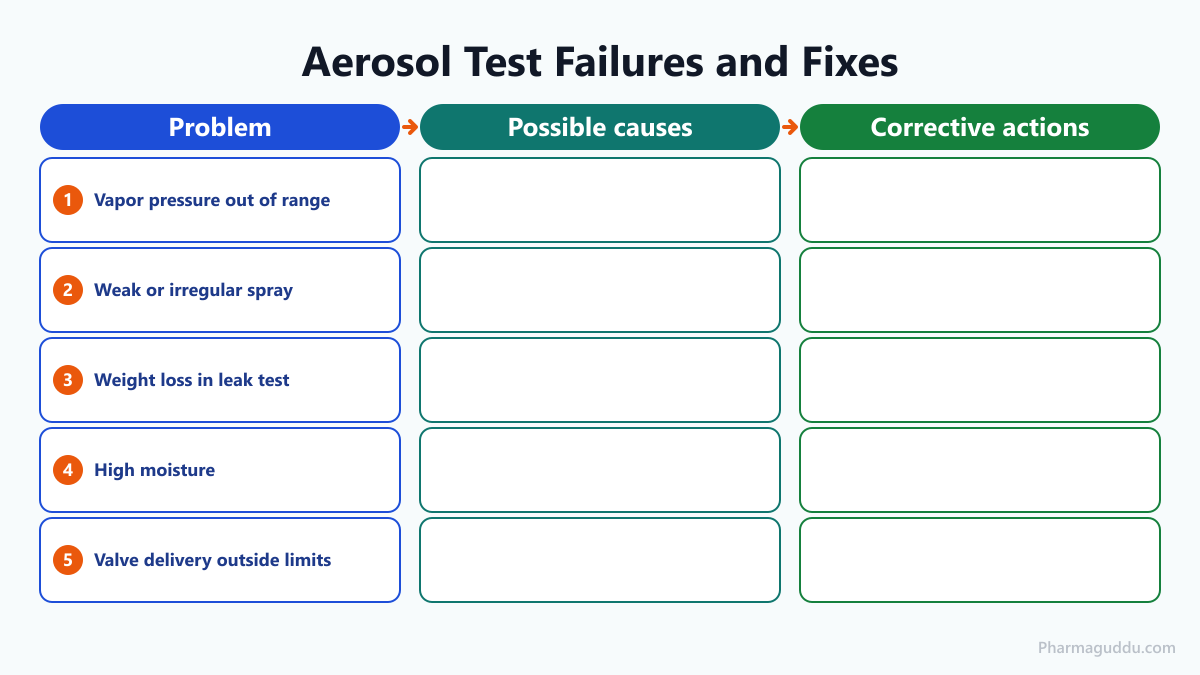
| Problem | Possible causes | Corrective actions |
|---|---|---|
| Vapor pressure out of range | Wrong propellant ratio, air in the can, leak, gauge error | Confirm the blend by GC, review fill records, check gauge calibration, hold the batch |
| Weak or irregular spray | Clogged valve or dip tube, low propellant | Repeat spray pattern test, inspect valve and dip tube, review filling records |
| Weight loss in leak test | Faulty crimp, damaged gasket | Check crimp dimensions, segregate failed cans, review the crimping station |
| High moisture | Wet propellant or concentrate, poor sample handling | Check KF drift and titer, repeat with a fresh sample, test the incoming material |
| Valve delivery outside limits | Worn valve, wrong metering chamber, viscosity change | Repeat on more valves, check the valve lot, review the concentrate |
A failed result is treated as an out-of-specification (OOS) result. The QC analyst reports it to the head of department (HOD), and the laboratory investigation checks the sample, apparatus and calculation before any retest. A result that passes but breaks the usual pattern is handled as described in Out of trend (OOT) results in Pharmaceutical Quality control. Instruments used for these tests are listed in List of Quality Control Equipment in Pharmaceuticals.
Which regulatory documents apply to aerosol testing?
EU GMP Annex 10, “Manufacture of Pressurised Metered Dose Aerosol Preparations for Inhalation”, is the GMP supplement for pMDI manufacture. It covers control of the propellant and leak testing. It is listed in EudraLex Volume 4 of the European Commission. GMP Annex 1, “Manufacture of Sterile Medicinal Products”, has been fully applicable since 25 August 2024 and is relevant only where the aerosol is sterile.
The European Medicines Agency (EMA) draft guideline on the pharmaceutical quality of inhalation and nasal medicinal products (EMA/CHMP/20607/2024) was adopted by the CHMP for consultation on 12 February 2024. As a draft, it is not yet binding. It lists shot weight and actuator orifice dimensions among the pMDI container closure tests. Leak limits are described in USP chapter <604> (Leak Rate).
What recent developments affect aerosol testing?
Copley launched the Vertus III+ and DecaVertus III platforms in January 2024. These automate shake-and-fire actuation and shot-weight measurement for MDI and nasal products, and the company states that they support 21 CFR Part 11 compliance.
In September 2026, Chiesi submitted EU applications for pMDIs that use the low global warming potential (GWP) propellant hydrofluoroalkane-152a (HFA-152a). Propellant changes of this kind affect filling, leak, dose and particle size results. The methods are re-evaluated for the new propellant.
Frequently Asked Questions
Vapor pressure shows whether the correct propellant blend was filled. It also controls how strongly the product is expelled and affects the spray quality, and a high value raises the safety risk at storage temperature while a low value gives a weak spray or an incomplete discharge. The test is performed on sampled cans from each batch.
Leakage in pMDIs is measured by weight loss. Filled cans are weighed, stored at a stated temperature for a stated period, and weighed again. The mass lost gives a leak rate. The EMA draft guideline states that a leak rate test and limits should be part of the specification for pMDI.
Droplet size of nasal sprays is measured by laser diffraction, as described in USP chapter <601>. The laser analyser records the scattered light of the spray plume and calculates the distribution. The result is reported as D10, D50, D90 and span, which shows both the median size and the width of the distribution.
Yes. Automated platforms such as the Copley Vertus III+ and DecaVertus III control the shaking and firing force by program and measure shot weight, and they are used for MDI and nasal products. The manufacturer states that they comply with 21 CFR Part 11, which covers electronic records.
References
- USP 38 <601> Performance Quality Tests, USP via drugfuture.com
- USP38-NF33 <602> Propellants, USP (third-party mirror)
- USP38-NF33 <604> Leak Rate, USP (third-party mirror)
- Draft Guideline on pharmaceutical quality of inhalation and nasal medicinal products, EMA
- EudraLex Volume 4, European Commission
- ASTM D3065 Flammability Testing for Aerosol Products, Infinita Lab
- New automated shake and fire platforms from Copley, News-Medical
- Chiesi advances carbon-minimal inhaler programme, European Pharmaceutical Review

Pankaj Sharma — Quality Control Specialist
Pankaj Sharma is a pharmaceutical QC professional who reviews our technical content for GMP accuracy, laboratory practices, and regulatory relevance.