
GMP & Pharmaceutical Manufacturing Expert
✓ Reviewed by: Naresh Bhakar
Reviewed for pharmaceutical accuracy
📅 Last Updated: November 9, 2026
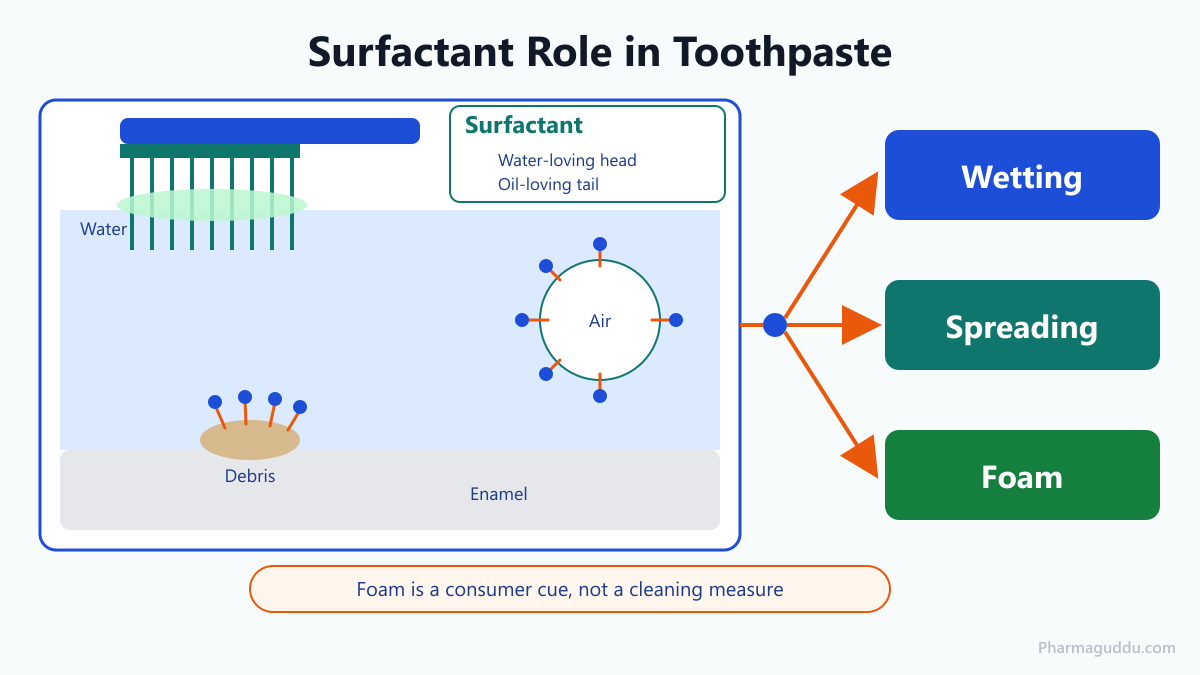
Detergents and foaming agents in toothpaste are surfactants, and sodium lauryl sulfate (SLS) is the best known. A surfactant lowers the surface tension of saliva and water, so the paste wets the teeth, spreads the abrasive and active ingredients through the mouth and produces foam. Sarcosinates, sulfosuccinates, taurates, glutamates and glucosides are used as alternatives. During manufacture the surfactant can trap air in the paste, so it is charged with care, usually under vacuum. Foam is measured as a development and comparison test, and it is a consumer cue rather than a measure of cleaning.
What are detergents and foaming agents in toothpaste?
Detergents and foaming agents in toothpaste are surface-active ingredients (surfactants) that give the paste its detersive and foaming action. According to a US patent on oral care compositions containing sodium lauroyl sarcosinate and betaine, surfactants also make the dentifrice more cosmetically acceptable and help to spread the abrasive and active ingredients through the mouth. For the full overview of dentifrice types, formulation and evaluation, see Dentifrices; Types, Formulation, and Evaluation.
The word “detergent” has two meanings in a pharmaceutical plant, and they must be kept apart. A surfactant is the foaming agent or detergent inside the formulation. A cleaning agent is the product used to clean the mixer, pump and filling line. Only the second meaning is covered by the terms “detergents” or “cleaning agents” in the Pharmaceutical Inspection Co-operation Scheme (PIC/S) document PI 006-3 and in the Parenteral Drug Association (PDA) notes on Annex 15.
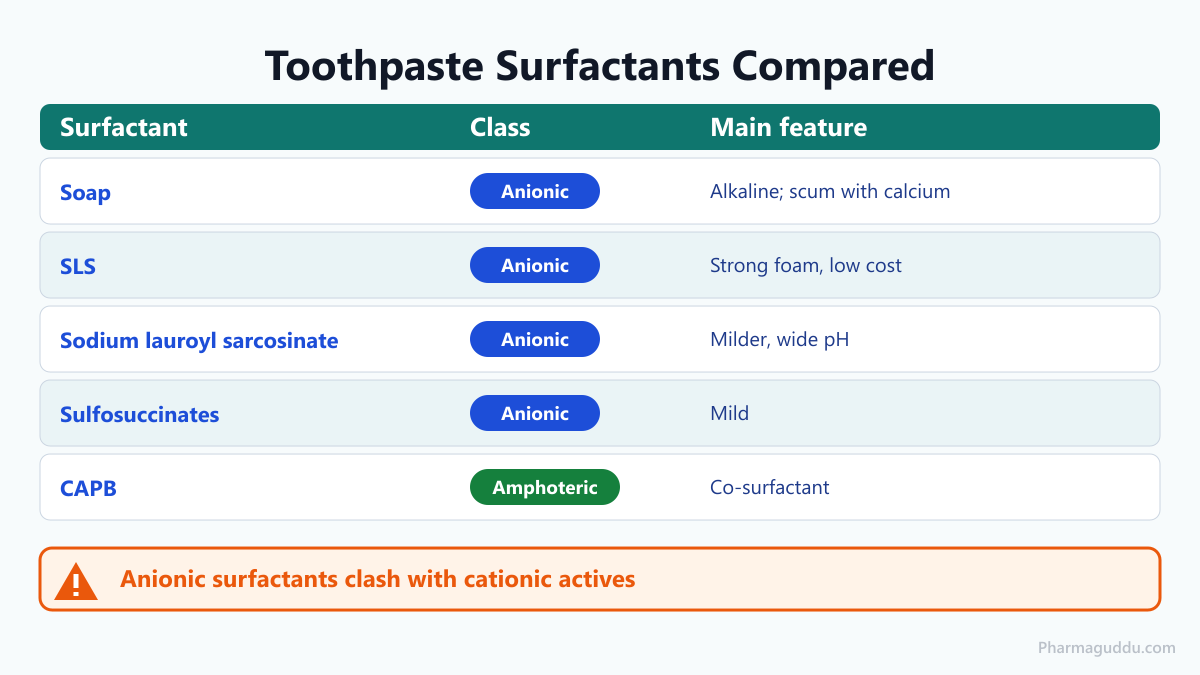
Most dentifrice surfactants are anionic. This means the active part of the molecule carries a negative charge. Amphoteric co-surfactants such as cocamidopropyl betaine (CAPB) are listed in the same patent as additional options.
How does a surfactant work in a dentifrice?
A surfactant molecule has a water-loving head and an oil-loving tail. It collects at the boundary between water and air, or between water and oily debris, and lowers the surface tension at that boundary. The paste therefore wets the enamel and the plaque layer more easily when it is mixed with saliva during brushing.
The same property produces foam. Brushing pulls air into the diluted paste, and the surfactant film stabilises the bubbles. Foam helps to keep the slurry in the mouth and gives the user a clear sign that the paste is working. It does not remove plaque by itself, because the cleaning action comes mainly from the abrasive and the mechanical action of the brush.
The foam volume of a paste is therefore not the best measure of quality. The KRÜSS application report AR279 on the foam behaviour of toothpaste notes that the highest foam volume is not automatically the best product. In that report, a paste based on CAPB gave more foam than two pastes based on sodium dodecyl sulfate (SDS, the same compound as SLS), and the decay rates were similar.
Anionic surfactants also react with positively charged ingredients. Cationic actives such as cetylpyridinium chloride lose activity when an anionic surfactant is present in the same paste, so the formulator must choose the surfactant and the active together.
Which equipment and process steps influence foaming?
Foaming is controlled mainly in the mixing stage. The surfactant is the ingredient most likely to create foam and trapped air, so the equipment and the point of addition both matter.
Toothpaste production uses several equipment types, and the choice depends on the viscosity of the material:
| Equipment type | Typical use in toothpaste | Viscosity figure given by the OEM |
|---|---|---|
| High-speed disperser | Dispersions and slurries | Up to about 50,000 cP |
| High-shear mixer with powder-injection (SLIM) manifold | Wetting and dispersing powders | Water-thin up to about 10,000 cP |
| Multi-shaft mixer | Intermediate and finished paste | Not stated |
| Double planetary mixer | Finished paste | Finished toothpaste about 70,000 to 100,000 cP |
Viscosity depends on the product and on the measuring method, so a site must set its own specification. Exact values depend on the manufacturer and model, and the manual of the Original Equipment Manufacturer (OEM) and the site Standard Operating Procedure (SOP) must always be followed.
In toothpaste manufacturing: colour and flavour are added first and the surfactant is added last, under slow-speed mixing to minimise foaming. Mixing is usually done under vacuum because the powders and the detergent bring in air. This order and these conditions are practice, not an official requirement, and they vary by manufacturer. Some formulations add the surfactant earlier or as a ready-made solution, so the approved batch manufacturing record (BMR) defines the order for each product. Flavour handling is described in Organoleptic Agents (Coloring, Flavoring and Sweetening agents).
A vendor demonstration by Silverson and Holiferm in 2026 used a laboratory high-shear mixer to make a natural toothpaste with a sophorolipid biosurfactant. The companies report that high shear disperses silica agglomerates with little aeration. This is a supplier statement and not independent efficacy data.
Which surfactants are used in toothpaste, and how do they compare?
Several surfactant types have been used. Each has a different balance of foam, mildness and compatibility, and the table below compares them.
| Surfactant | Class | Main features | Points to consider |
|---|---|---|---|
| Soap (sodium or potassium salts of fatty acids) | Anionic | Early toothpaste foamer | Alkaline, soapy taste, forms scum with calcium and hard water |
| Sodium lauryl sulfate (SLS) | Anionic alkyl sulfate | Low cost, strong foam, compatible with common abrasives such as silica and chalk | Irritant to skin and mucosa in some users |
| Sodium lauroyl sarcosinate | Anionic, amino-acid derived | Milder than SLS, stable over a wide pH range | Higher cost than SLS |
| Sulfosuccinates | Anionic | Mild, used as SLS alternatives; dioctyl sodium sulfosuccinate is a wetting agent | Foam level depends on the grade |
| Cocamidopropyl betaine (CAPB) | Amphoteric | Used as a co-surfactant | Listed in patent literature with anionic surfactants |
All anionic types in the table are incompatible with cationic actives.
Soaps are rarely used now because their alkalinity and taste are poor and they react with calcium, while SLS remains the reference surfactant because it is inexpensive and foams strongly. Some manufacturers therefore offer SLS-free pastes, after reports of mucosal irritation.
Other alternatives come mainly from supplier and patent sources. Croda markets sodium methyl cocoyl taurate (Adinol CT95, 95% active) as a mild anionic surfactant for oral care. According to Croda, it works in acidic and alkaline conditions and does not chelate metal ions such as strontium, which suits sensitivity pastes. A US patent on oral care compositions gives an example in which sodium cocoyl glutamate combined with lauryl glucoside foamed about like SLS, but that result comes from one formulation and cannot be taken as general.
How is the surfactant charged and the batch managed?
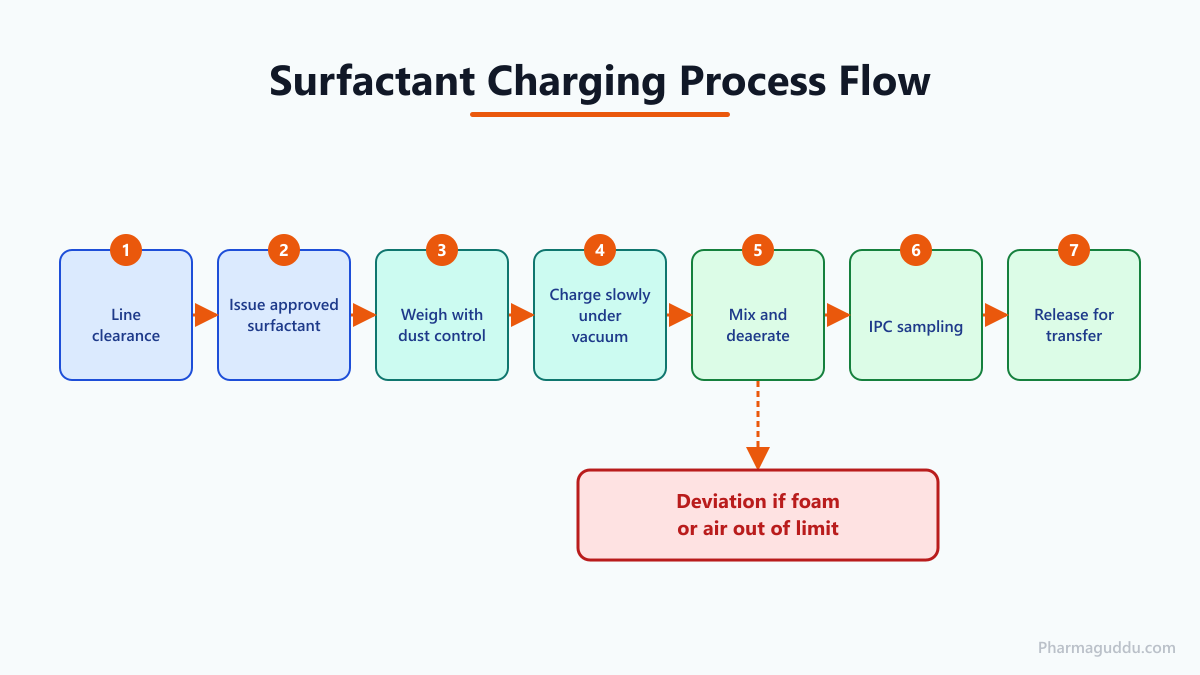
The surfactant step is performed under the approved BMR and the site SOP. The sequence below is the common practice for a vacuum mixer, and the exact order and settings differ between products.
- The production officer and the Quality Assurance (QA) officer complete line clearance. All materials, labels and records of the previous product are removed, and the cleaning status of the mixer is checked.
- The store officer issues the surfactant with its approved grade, supplier and batch number. Grades from different suppliers can behave differently, so a change of supplier or grade must go through change control.
- The operator weighs the surfactant in the dispensing booth. SLS powder is dusty and irritates the eyes, skin and airways, so operators must wear gloves, goggles and a dust mask, and the booth extraction must be running.
- The earlier phases (gel, abrasive slurry and humectant) are completed and checked before the surfactant is added.
- The surfactant is charged slowly, after colour and flavour, while the mixer runs at low speed under vacuum. Adding it quickly or above the liquid level causes foam.
- Mixing and deaeration continue for the time stated in the BMR. The operator records the surfactant batch number, the weight, the mixing time, the vacuum and the temperature.
- The Quality Control (QC) analyst samples the bulk for in-process control (IPC), and the bulk is released for transfer only after the results meet the specification.
A deviation is raised when foam or trapped air is above the limit in the BMR, when the surfactant is charged out of sequence, or when the recorded mixing time or vacuum is outside the approved range.
Cleaning the equipment after foaming pastes
Surfactant paste leaves residue that foams during rinsing, so the cleaning method must be written and followed exactly. A visual check shows that the equipment is visually clean, but it does not show that cleaning is validated. Validation needs defined limits and analytical methods.
The cleaning agent used on the equipment is a separate material from the surfactant in the paste. According to PIC/S PI 006-3 (25 September 2007), section 7.9, the removal of cleaning agent residues should be evaluated and acceptable limits defined. Ideally, no residue is detected. The manufacturer should know the composition of the cleaning agent and should be notified by the supplier of any critical change. The APIC cleaning validation guidance adds that a cleaning agent is not part of the process, so it should be easy to remove. If it is not, a different agent should be chosen.
The Canadian Cleaning Validation Guidelines (Health Products and Food Branch, 2000) ask for validation under worst-case conditions, such as minimal cleaning agent concentration and minimum contact time. At least three consecutive successful applications are required, and testing until the equipment is clean is not acceptable. The parameters to control are time, action, chemistry (including concentration), temperature, water quality and rinsing, as listed in the FDA cleaning validation training by LeBlanc (2004). The same Canadian guidelines note that raw materials from different suppliers can have different properties, which should be considered when a cleaning procedure is designed.
Which controls and limits apply to the paste?
The limits for each paste come from its approved specification. The IPC checks below are common practice for surfactant-containing pastes. No source gives numerical limits for them.
| IPC or test | What it shows | Note |
|---|---|---|
| Density (specific gravity) | Air entrapment after deaeration | A low value points to trapped air |
| Viscosity | Structure and consistency of the paste | The spindle, speed and temperature must be fixed in the method |
| pH | Stability of the surfactant and the actives | Compared with the specification range |
| Appearance and visible air | Foam, bubbles and homogeneity | Recorded before transfer |
| Foam test | Foaming behaviour of the finished paste | Used for development and comparison |
Two foam methods appear in the sources. KRÜSS describes a dynamic foam analyser method. A paste of 2.5 g is stirred in 60 mL of water for 5 minutes, sonicated for 5 minutes and made up to 250 mL (10 g/L at 25 °C). A volume of 50 mL is then foamed with a two-blade stirrer at 4,000 rpm for 40 seconds, and the foam is followed for 900 seconds in total.
A US patent on aqueous surfactant compositions describes a simpler method for surfactant solutions. A volume of 200 mL of a 1% solution is blended for 10 seconds at low speed and poured into a 500 mL cylinder, and the foam height is read every 10 seconds up to 80 seconds. It is a solution test and not a test for finished paste. Neither method is an official dentifrice test, so the site must define its own conditions and acceptance criteria.
What are the common problems with surfactants in toothpaste and how are they fixed?
Excess foam and trapped air in the bulk
Possible Causes:
The surfactant was charged too fast, the mixer speed was too high at the addition step, or the vacuum was lost during mixing.
Corrective Actions:
Add the surfactant more slowly, lower the mixer speed, restore the vacuum and extend the deaeration time. The density result is then rechecked against the specification.
Low foam in an SLS-free paste
Possible Causes:
Mild surfactants often foam less than SLS when used alone. The paste may also lack a co-surfactant.
Corrective Actions:
The formulator can test a combination of surfactants, such as the glutamate and glucoside example in the patent literature. Low foam is not always a defect, because foam volume alone does not show product quality.
Batch-to-batch variation in foam
Possible Causes:
Surfactant from another supplier or another grade, a change in mixing time or vacuum, or a different order of addition.
Corrective Actions:
Confirm the supplier, grade and batch number in the BMR, and compare the mixing records of the good and poor batches. The supplier should notify the manufacturer of changes in composition, and any change must be handled through change control.
Loss of activity of a cationic ingredient
Possible Causes:
An anionic surfactant reacts with a cationic active in the same paste.
Corrective Actions:
Select a surfactant system that is compatible with the active at the formulation stage. This cannot be corrected by mixing changes at batch level.
Surfactant foam during equipment rinsing
Possible Causes:
Residual paste in the mixer, pump or filling line foams during the rinse, and a high-foam cleaning agent adds to the problem.
Corrective Actions:
Follow the validated cleaning method for time, action, concentration, temperature and rinsing. Rinse until the validated residue limits are met, and do not repeat cleaning and sampling until a result passes.
What are the recent developments in non-SLS surfactants?
Suppliers are widening the choice of non-SLS surfactants. Croda promoted Adinol CT95 for oral care in July 2025, and the claims are the supplier’s own. In October 2026 Silverson and Holiferm showed a natural toothpaste made with a sophorolipid biosurfactant. Holiferm states that the sophorolipid supports anti-biofilm action, solubilises peppermint oil and contributes foam. Both items are supplier information, and no independent comparison with SLS is cited.
Frequently Asked Questions
A 2019 systematic review of crossover trials on recurrent aphthous stomatitis reported fewer ulcers with SLS-free toothpaste. The trials were few and small, and some had a high risk of bias, so the evidence is limited and the review does not show that SLS-free paste suits every user.
No. Foam is a sensory cue for the consumer, and the KRÜSS foam study notes that the highest foam volume is not automatically the best product. Decay of the foam, cleaning performance, taste and mildness also contribute to the quality of the product.
Not always. One US patent example shows sodium cocoyl glutamate with lauryl glucoside foaming about like SLS. That result comes from a single formulation. A formulator usually has to test the combination, the pH and the other ingredients before accepting the foam level of an SLS-free paste.
Yes, in some processes. The mixer guide describes late addition under vacuum, but a formulation may add the surfactant as a ready-made solution or at another stage. The approved BMR fixes the order for each product, and any change must be validated and approved through change control.
References
- Foam behavior of toothpaste, Application Report AR279, KRÜSS
- Silverson and Holiferm explore the next step in natural toothpaste formulation, Cosmetics Business, 2026
- Adinol CT95, Croda, 2025
- Effect of sodium lauryl sulfate on recurrent aphthous stomatitis: A systematic review, J Oral Pathol Med, 2019
- Oral care compositions containing sodium lauroyl sarcosinate and betaine, US patent, USPTO
- Oral care compositions and methods for the same, US patent, USPTO
- Aqueous surfactant compositions, US patent, USPTO
- ISO 11609 Dentistry, Dentifrices, Requirements, test methods and marking, ISO
- Is It a Cosmetic, a Drug, or Both? (Or Is It Soap?), US FDA, 2024
- 21 CFR Part 211, Current Good Manufacturing Practice for Finished Pharmaceuticals, eCFR
- PIC/S PI 006-3, Recommendations on Validation Master Plan, Installation and Operational Qualification, Non-Sterile Process Validation, Cleaning Validation, 25 September 2007, section 7.9 (Library page 24)
- Cleaning Validation Guidelines, Health Products and Food Branch Inspectorate, Canada, Spring 2000, sections 4.6 to 4.10 (Library)
- Cleaning Validation Guidance, APIC, section 8.7 (Library)
- Cleaning Validation, LeBlanc, FDA Basic Drug School, February 2004 (Library)

Naresh Bhakar is the Founder and Author at Pharmaguddu.com, bringing his extensive expertise in the field of pharmaceuticals to readers worldwide. He has experience in Pharma manufacturing and has worked with top Pharmaceuticals. He has rich knowledge and provides valuable insights and data through his articles and content on Pharmaguddu.com. For further inquiries or collaborations, please don’t hesitate to reach out via email at [email protected].