
GMP & Pharmaceutical Manufacturing Expert
✓ Reviewed by: Naresh Bhakar
Reviewed for pharmaceutical accuracy
📅 Last Updated: November 19, 2026
The percolation method for syrup is a cold process (percolation) in which purified water is passed slowly through a bed of coarse crystalline sucrose held in a cylindrical percolator over a cotton pledget. The sucrose dissolves as the liquid trickles through, and the percolate is returned through the bed, if necessary, until all the sucrose has dissolved. No heat is applied, so sucrose inversion and caramel colour are avoided and heat-labile ingredients are protected. The method is slow, so it suits with smaller batches. The percolate is then adjusted to final Q.S. By weight and assayed before filling.
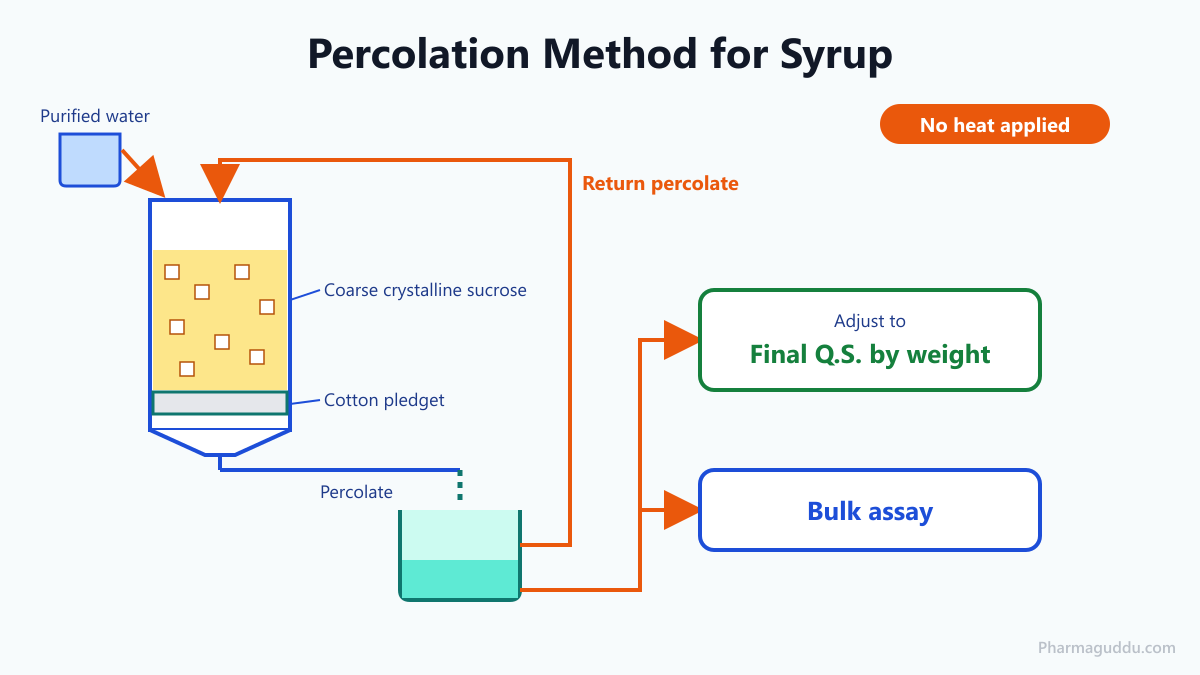
What Is the Percolation Method for Syrup?
Percolation is a method of syrup preparation in which the solvent passes through a bed of solid sucrose instead of the sucrose being stirred into hot water. It is called the cold process because the liquid stays at ambient temperature. It is chosen for syrups that contain heat-labile or volatile ingredients.
For the full overview of syrup types and methods, see liquid syrup. Only the percolation method is covered here, and the strength and sucrose basis of the finished product are described in simple syrup concentration.
How Does Percolation Dissolve Sucrose?
Each small portion of water meets fresh sucrose crystals while it moves down the bed. The water becomes more concentrated as it passes. The liquid leaving the percolator is therefore a strong sucrose solution, and this happens because the contact time is long and the bed always presents undissolved crystals to the liquid.
The cotton pledget in the neck holds back undissolved crystals so that only dissolved sucrose leaves, and the flow through it must be a steady drip. The same bed-and-solvent logic is used for plant materials, as described in extraction in pharmaceutics.
What Are the Parts of a Percolator and the Process Steps?
The percolator is a cylinder with a short conical base. The main parts are the cylindrical body and the conical neck with a cotton pledget. The others are the sucrose bed and the receiving vessel for the percolate. Product-contact surfaces must not be reactive, additive or absorptive, according to 21 CFR 211.65(a).
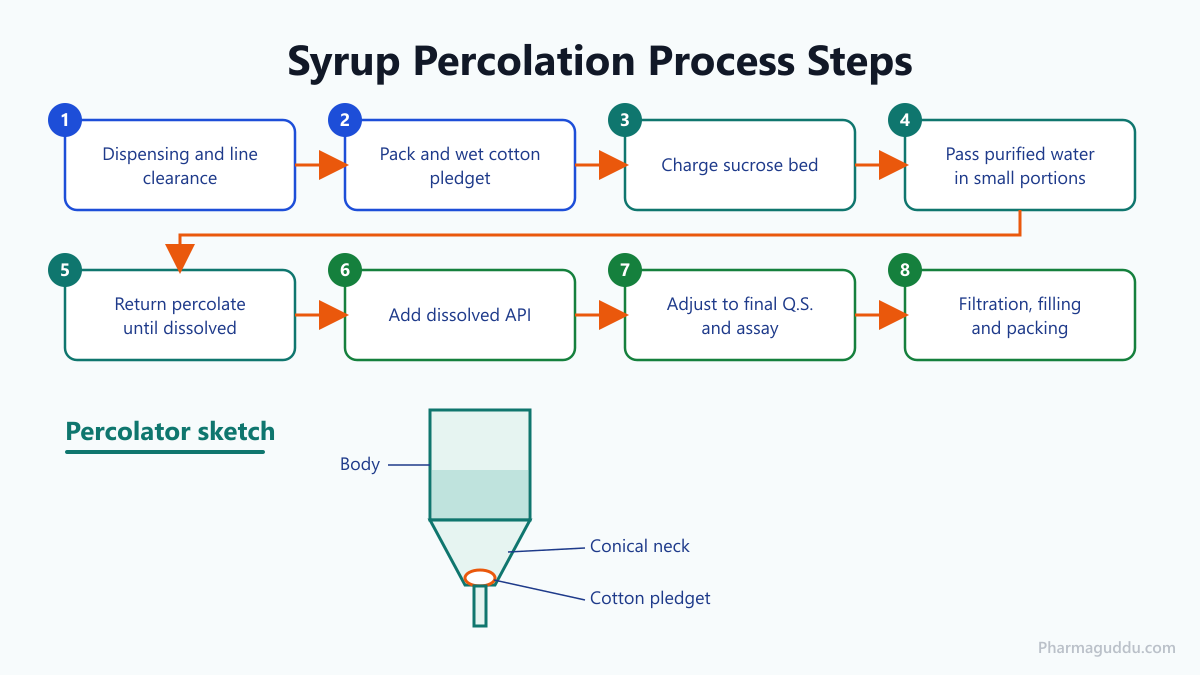
The process runs in this order:
- After taken line clearance, Operator (store/production) Dispense the material in presence of QA person against the batch manufacturing record (BMR).
- Packing and wetting of the cotton pledget.
- Charging of the sucrose bed.
- Passing of purified water in small portions at a steady drip.
- Return of the percolate through the bed, if necessary, until the sucrose has dissolved.
- Addition of the dissolved active pharmaceutical ingredient (API) and other excipients.
- Adjustment to final Q.S. by weight, in-process control (IPC) and bulk assay.
- Filtration, filling and packing.
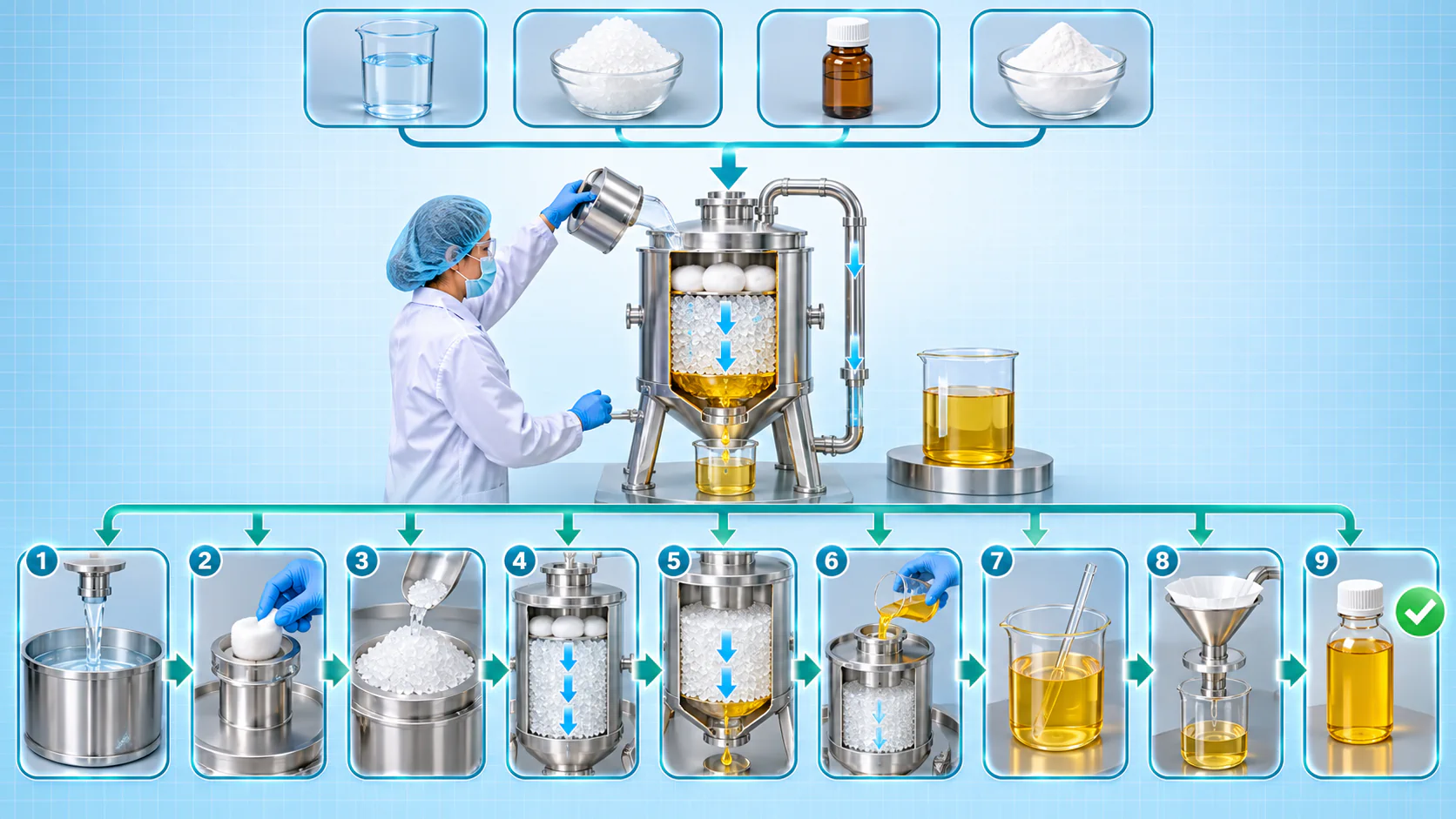
How Does Percolation Compare with Other Syrup Methods?
Three routes are used for syrups. Percolation must not be confused with cold dissolution by agitation, which is a different cold method.
| Feature | Cold process (percolation) | Cold dissolution with agitation | Solution with heat (hot process) |
|---|---|---|---|
| Heat applied | None | None | Yes |
| Speed | Slow | Faster than percolation | Fastest for stable ingredients |
| Scale | Small batches, lab and pharmacy | Plant scale in a stirred vessel | Plant scale |
| Best suited for | Heat-labile or volatile ingredients | Heat-sensitive flavours | Stable, non-volatile ingredients |
| Microbial load | Not reduced by heat | Not reduced by heat | Heat can reduce it |
Plant-scale syrup is made in stirred vessels, and percolation is generally less common there because it is slow and needs attention to the flow rate. Plain agitation at ambient temperature is also slow, so industrial dissolvers speed it up with high-shear mixers or mild warming (about 35 °C). These values vary by manufacturer. Production should plan the batch time accordingly.
READ ALSO
Liquid Syrup Types and Manufacturing Process
Liquid syrup types and manufacturing process explained: simple, medicated and flavoured syrup, preparation methods, formulation.
How Is a Syrup Batch Percolated on the Floor?
First, take line clearance from the QA officer and check that the percolator and hoses carry a “Under process” status label. Then pack fresh cotton into the neck so that the flow is a steady drip.
- Wet the cotton and put the coarse crystalline sucrose. Fine sugar compacts and blocks the bed.
- Pour the purified water over the bed in small portions. The operator adjusts the cotton, not the bed height, when the flow is wrong, and records the adjustment.
- Collect the percolate and, if necessary, return it through the bed until no undissolved sucrose remains.
- Add the API, dissolved separately, to the cold syrup after the sucrose syrup is made, so that no heat is applied. Preservatives such as parabens are hard to dissolve and may need heat, which complicates a purely cold process.
- Adjust to final Q.S. by weight on the batching tank, and send a bulk sample to quality control (QC).
- After the batch, remove and discard the cotton pledget, and clean the percolator per the validated cleaning procedure.
What Are the Critical Process Parameters?
| Parameter | Setting or range | Why it matters | How it is monitored |
|---|---|---|---|
| Process temperature | Ambient, no heat applied | Avoids inversion and caramel colour | Temperature record in the BMR |
| Sucrose grade | Coarse crystalline | Fine sugar compacts the bed | Raw material certificate, visual check |
| Cotton pledget packing | Neither tight nor loose | Sets the flow of the drip | Flow observation by the operator |
| Flow of percolate | Steady drip, validated for the batch size | Slow flow delays the batch; fast flow gives cloudy, weak percolate | Observation and timing in the BMR |
| Percolate strength | Per the product specification | Confirms full dissolution | Density, specific gravity or Brix |
| Final quantity | Q.S. by weight | Volumetric adjustment is inaccurate | Load-cell weight |
Common Problems and Fixes for Percolation?
Slow or no flow: the cotton is packed too tight, or fine sucrose has compacted. Loosen the cotton and use coarse crystals. Also record the adjustment.
Fast, cloudy percolate: the cotton is too loose, so the syrup is not saturated. Repack the cotton. Then return the percolate through the bed.
Subpotent first samples: undissolved material lies in a dead leg below the discharge valve, so the valve should be kept flush and sanitary hard-piped transfer lines should be used.
Microbial counts: no heat step kills organisms, so the water and equipment carry the whole control, and sanitised equipment must be used with holding and transfer times kept within the approved limit.
Frequently Asked Questions
A high sucrose concentration preserves the syrup because of its high osmotic pressure. It still depends on clean water and sanitised equipment, since the cold process does not lower the microbial load. Hot processing can do so, which is why FDA notes that some manufacturers rely on heat during compounding.
Yes. If the first percolate is weaker than needed, it is returned to the percolator until the sucrose has dissolved. The QC analyst or production officer then checks the density or Brix before the batch is adjusted to Q.S.
Without heating, the purified water is the main microbial control point. FDA expects microbiological testing of raw materials, including purified water, and of the finished product.
References
- Guide to Inspections: Oral Solutions and Suspensions, US FDA (August 1994)
- 21 CFR 211.65 Equipment construction, Cornell LII
- US Dispensatory: Syrupus (historic), henriettes-herb.com

Naresh Bhakar is the Founder and Author at Pharmaguddu.com, bringing his extensive expertise in the field of pharmaceuticals to readers worldwide. He has experience in Pharma manufacturing and has worked with top Pharmaceuticals. He has rich knowledge and provides valuable insights and data through his articles and content on Pharmaguddu.com. For further inquiries or collaborations, please don’t hesitate to reach out via email at [email protected].