
GMP & Pharmaceutical Manufacturing Expert
✓ Reviewed by: Pankaj Sharma - Quality Control Specialist
Reviewed for Quality Control accuracy, laboratory practices, analytical methods, and technical relevance
📅 Last Updated: November 11, 2026
The toothpaste manufacturing process is a batch operation. A gel of humectant and binder is prepared first, powders such as the abrasive are drawn in under vacuum, and flavour and detergent are added last. The deaerated paste is then held, tested and filled into tubes. The main equipment is a vacuum mixer (anchor, disperser and rotor/stator), a holding tank, and a tube filler and sealer. Line clearance, in-process controls (IPC) and entries in the batch manufacturing record (BMR) apply at every stage.
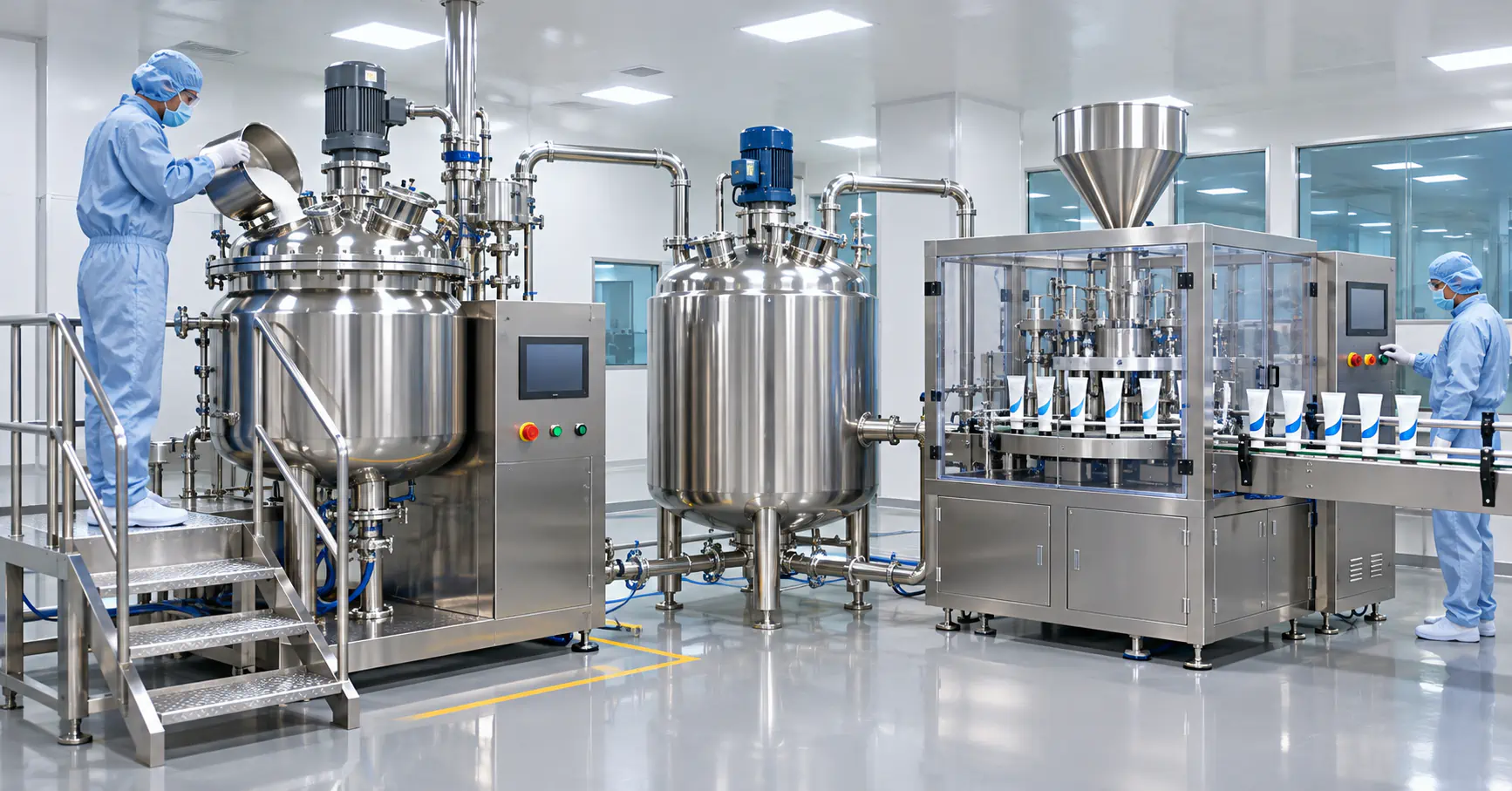
What is the toothpaste manufacturing process?
The toothpaste manufacturing process converts a liquid phase, a binder, an abrasive and other solids into a smooth, air-free paste that is filled into tubes. Toothpaste is a suspension of a particulate abrasive in an aqueous humectant phase (sorbitol or glycerin), thickened by a binder and supplied with a surfactant such as sodium lauryl sulfate (SLS), flavour and actives (Silverson application report).
This article follows one batch from charging to filling. For the full overview of dentifrice types and formulation, see Dentifrices; Types, Formulation, and Evaluation. The role of each ingredient is covered in the posts on humectants and binding agents, abrasives and polishing agents and detergents and foaming agents.
What is the principle behind making toothpaste?
The principle is to wet and disperse every solid completely in the liquid phase without trapping air. A binder added directly to water forms lumps that agitation alone cannot break, so the binder is dispersed in the humectant first and water is added afterwards.
Powders and surfactant carry air into the batch. Vacuum is therefore applied to remove the air, so that the paste is dense, smooth and free from voids in the tube. Low-density silica is also difficult to wet. Abrasive agglomerates must be broken down by high-shear mixing (Silverson application report).
SLS foams easily, so it is added last under slow agitation. Powders are drawn in below the liquid surface, because this avoids fish-eyes (dry lumps with a wet skin) and dust (Ross mixing report).
What are the stages of toothpaste manufacture?
The stages follow the general sequence given below. Exact timings, speeds and the order of minor ingredients depend on the formula and the equipment.
- Dispensing. Raw materials are dispensed against the BMR in the dispensing area. The Quality Assurance (QA) officer checks the line clearance, and vessels are status-labelled.
- Humectant and binder gel. Sorbitol or glycerin and water are charged into the mixer. The binder is dispersed in the humectant, and the gel is mixed until it is smooth.
- Actives, sweetener and preservative. These are dissolved or dispersed in the gel before the solids are added.
- Abrasive and filler incorporation. Powders are drawn in below the liquid surface under vacuum, sometimes as a slurry.
- Flavour, colour and detergent. Flavour and colour are added, and the SLS is added last and slowly.
- Deaeration and refining. The batch is held under vacuum. A homogenizer or in-line mixer may be used to refine the paste.
- Holding tank and IPC. The batch is discharged into a holding tank, and a sample is sent for in-process checks.
- Tube filling and sealing. The filler doses the paste into tubes, and the tubes are closed.
- Coding, cartoning and case packing. After taking line clearance, Batch details are printed, and the tubes are packed.
Which equipment is used to make toothpaste?
Several mixer designs are in use. A high-speed disperser can handle viscosities up to about 50,000 cP, and a high-shear rotor/stator mixer suits liquids from water-like thickness to about 10,000 cP. A multi-shaft mixer combines an anchor, a saw-tooth disperser and a rotor/stator in one vessel, and a double planetary mixer is used for the thick paste stage (Ross mixing report).
Vessels are generally stainless steel with a jacket for heating or cooling, a bottom scraper or anchor, a homogenizer and a vacuum pump. Downstream, a progressive cavity pump discharges the batch, and a tube filler doses and seals the tubes.
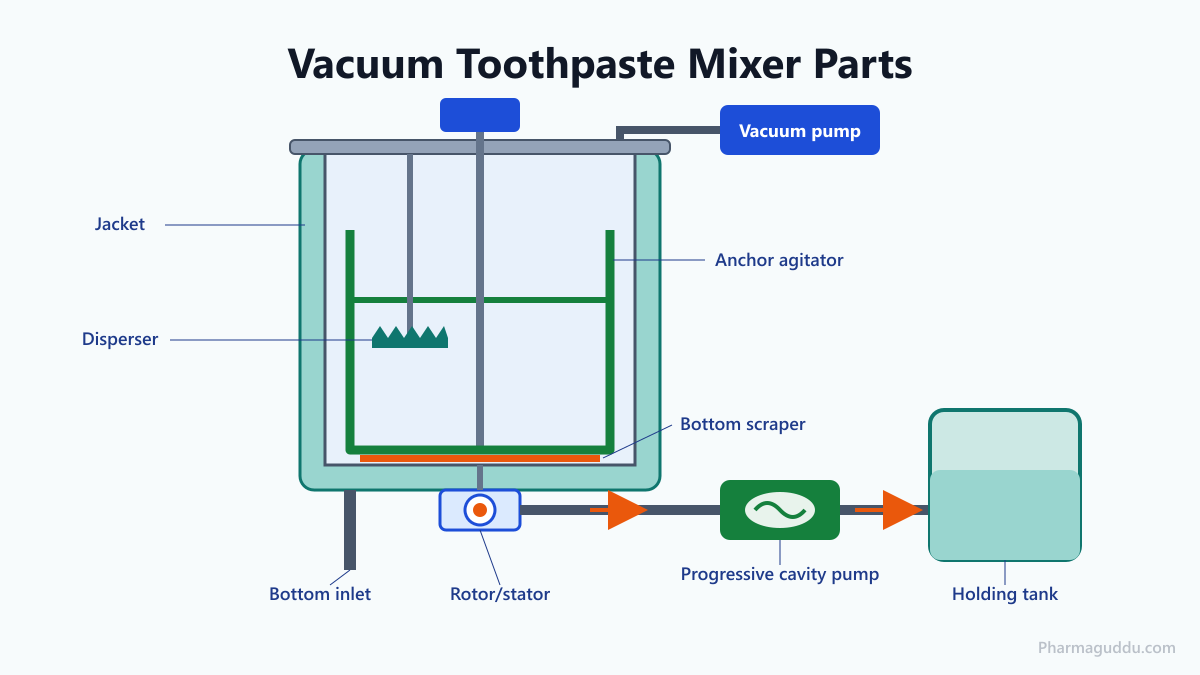
How is a toothpaste batch run?
Before starting a Batch, the production officer and IPQA officer checks the line clearance. The vessel, vacuum lines and pumps must be clean, and the status label (cleaned label) must be correct. The operator then charges the liquids and starts the agitators.
Agitators start at anchor 30 rpm and central blades 50 rpm. Water is added first, then sorbitol by pump or vacuum suction, and the liquids are mixed for about 45 minutes. Speeds are then raised to anchor 40 rpm and blades 80 rpm. Vacuum is applied next. Kaolin, titanium oxide and calcium carbonate are vacuum-fed through the bottom inlet, from the lowest to the highest volume, and the bottom mixer is stopped when the viscosity is reached.
The agitators then return to 30 and 50 rpm for about 1 hour, and the remaining liquids are added and mixed for 20 minutes. After the vacuum is released, perfume and other additives are added and mixed for about 10 minutes. Finally, a Quality Control (QC) sample is taken and the batch is discharged.
During the run, the operator records vacuum, speeds and times in the BMR. The production officer reviews the entries, and QA checks them on the floor. Any unplanned change of a parameter must be reported to the shift in-charge.
Because the paste is water based, microbial control depends on water quality, the preservative system and the hold time between mixing and filling. Hold-time limits are set in the BMR.
For filling, the line is cleared again. The filler is set up with the tube type, and fill weight and seal integrity are checked at the start of the run and at set intervals. Plastic and laminate tubes are sealed by hot-air or hot-jaw sealing, and metal tubes are crimped (IMA C1290 description). At the end of the batch, the bulk and tubes are reconciled. Losses in lines and heels are accounted for, and the yield is recorded.
Which in-process checks and cleaning controls apply?
IPC checks on the floor include pH, viscosity or consistency, density, fineness, fill weight and seal integrity. Fluoride assay, abrasivity and foaming are QC tests on the bulk. Limits are product specific, so they are set in the specification.
Cleaning is validated, with separate written procedures for batch-to-batch cleaning and for product change, and detergent residues must also be removed (FDA guide to inspections of cleaning validation). The mixer, vacuum lines, holding tank, pumps and filler are cleaned by clean-in-place (CIP) or manually. Flavour carry-over needs attention, and a placebo batch can be used as a simulated product in cleaning trials (PIC/S PI 006-3).
Once the Equipment is qualified, process, cleaning and methods are also validated. Guards and lock-out/tag-out must be applied on the mixer and the vacuum vessel before any entry or cleaning, and powder dust exposure is controlled during operation. On automated lines, recipe changes on the human-machine interface (HMI) must be controlled, and the audit trail must be active.
What are the critical process parameters?
Values below come from the sources named. They differ by manufacturer and model, so the qualified setting for the specific mixer applies.
| Parameter | Setting or range | Why it matters | How it is monitored |
|---|---|---|---|
| Vacuum level | Set for the product in the BMR, with units and gauge or absolute basis stated (INOXPA describes a constant 2-3 mbar) | Removes air and prevents voids | Vacuum gauge, recorded in the BMR |
| Agitator speed | Anchor 30-40 rpm, central blades 50-80 rpm (INOXPA MIX-5, by stage) | Disperses solids without excess air | HMI display, BMR |
| Homogenizer speed | Range set from the process qualification for the specific mixer | Breaks agglomerates | HMI display, BMR |
| Mixing time | About 45 min liquids, about 1 h solids, 20 min liquid additives, about 10 min perfume (INOXPA) | Complete wetting and dispersion | Timer, BMR |
| Temperature | No sourced value | Affects gel formation and viscosity | Jacket and product probe |
| Finished viscosity | 70,000-100,000 cP (Ross guide, formula dependent) | Extrusion and stability | Viscometer in IPC |
| Fill weight | No sourced value | Label claim | Checkweigher, IPC |
| Seal temperature | No sourced value | Tube leak prevention | Filler settings, seal checks |
What common problems occur and how are they fixed?
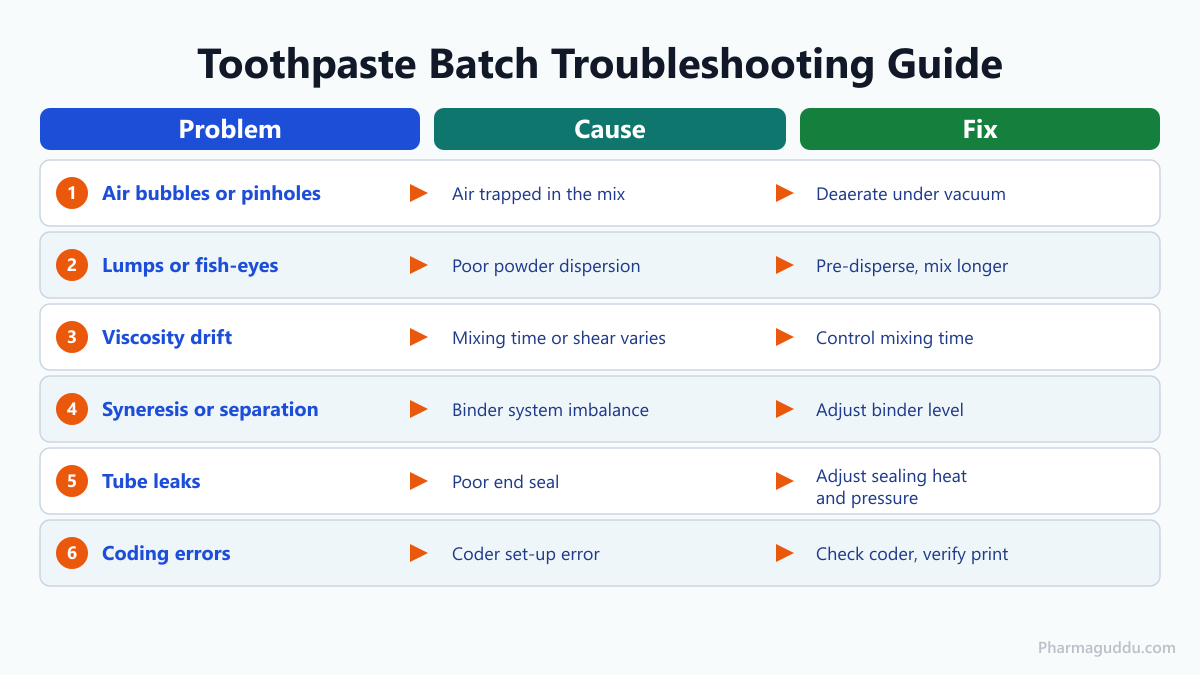
| Problem | Possible cause | Corrective action |
|---|---|---|
| Air bubbles or pinholes | Air from powders or detergent, low vacuum | Draw powders below the surface, maintain vacuum, add SLS slowly |
| Lumps or fish-eyes | Binder added to water, powders added on top | Disperse binder in humectant first, use sub-surface injection or high shear |
| Viscosity drift | Raw material grade change, incomplete hydration | Review change control, extend mixing within the qualified range |
| Syneresis or separation | Binder not fully hydrated, abrasive agglomerates | Refine with a homogenizer and recheck the formula |
| Tube leaks | Wrong seal setting, paste in the seal area | Adjust the seal, check the nozzle shut-off and tube material |
| Coding errors | Wrong batch data or printer fault | Stop the line, segregate the tubes, correct the data |
Out-of-range IPC results, loss of vacuum, unplanned parameter changes and seal failures are deviation triggers. They must be reported and investigated through the deviation procedure.
What regulatory points apply?
In the US, plain toothpaste is a cosmetic and falls under the Modernization of Cosmetics Regulation Act of 2022 (MoCRA). Manufacturers must register facilities with FDA. The registration must be renewed every two years. Its MoCRA page (current at 29 October 2026) still lists the Good Manufacturing Practice (GMP) requirements for cosmetics as under development, with a draft guidance published.
Fluoride toothpaste is an over-the-counter (OTC) anticaries drug under 21 CFR Part 355, and drug GMP in 21 CFR Part 211 applies to it. See anticaries, antibacterial and desensitizing agents in toothpaste.
Under a change-control procedure, a change of batch size, formula, process parameter or cleaning agent is a process change. A change of equipment capacity or principle is an equipment change. A change of raw material or packaging material is also among the changes likely to need revalidation (PIC/S PI 006-3). A new abrasive grade or a new tube material on an existing filler would therefore go through change control.
What are the recent trends?
England planned collection of toothpaste tubes from all councils by 31 March 2026, and Colgate and Haleon have moved to HDPE mono-material tubes (Circular Online). Plants must qualify the new tubes for sealing on existing fillers through change control. Continuous in-line blending, with CIP, is promoted by GEA and AZO.
Frequently Asked Questions
Powders and surfactant bring air into the batch, and vacuum removes it, so that the paste is dense and smooth and does not leave voids in the tube. Vacuum also limits dust and fish-eyes because it helps draw powders in below the liquid surface.
Vacuum multi-shaft mixers (anchor, disperser and rotor/stator), double planetary mixers and in-line high-shear mixers are used. The choice depends on the batch size, the formula and the viscosity at each stage.
Ross cites about 70,000-100,000 cP. The target is set for each formula and is measured by a defined viscometer method, so values from different methods cannot be compared directly.
HDPE mono-material tubes were designed for existing filling equipment. Sealing settings still need to be qualified for the new material through change control.
References
- Recommended Mixing Equipment for Toothpaste, Ross
- Production of Toothpaste, INOXPA
- Oral care, GEA
- C1290 Tube Filling, IMA
- Toothpaste solutions, Coesia
- Tube Filler TFS 80-6, IWK / ATS Automation
- Modernization of Cosmetics Regulation Act of 2022 (MoCRA), US FDA
- 21 CFR § 355.1 Scope, Cornell LII
- Toothpaste tubes recycling article, Circular Online
- PIC/S PI 006-3, Recommendations on Validation Master Plan, IQ/OQ, Non-Sterile Process Validation, Cleaning Validation, PIC/S, 25 September 2007
- Guide to Inspections Validation of Cleaning Processes, US FDA

Naresh Bhakar is the Founder and Author at Pharmaguddu.com, bringing his extensive expertise in the field of pharmaceuticals to readers worldwide. He has experience in Pharma manufacturing and has worked with top Pharmaceuticals. He has rich knowledge and provides valuable insights and data through his articles and content on Pharmaguddu.com. For further inquiries or collaborations, please don’t hesitate to reach out via email at [email protected].