
Quality Control Specialist | Industry Experience
✓ Reviewed by: Pankaj Sharma - Quality Control Specialist
Reviewed for Quality Control accuracy, laboratory practices, analytical methods, and technical relevance
📅 Last Updated: November 2, 2026
Media fill interview questions and answers should show that the candidate understands aseptic process simulation (APS). In this exercise, sterile nutrient medium replaces the product to verify the aseptic process controls. Interviewers usually ask about purpose, medium, incubation, run size, frequency, interventions, acceptance criteria and failure investigation. Under EU GMP Annex 1 (2022), the target is zero growth, and any contaminated unit fails the APS. A good answer names the source document and separates the regulatory requirement from site practice.
What Should Candidates Know Before a Media Fill Interview?
Candidates should know that APS (media fill), is a periodic check of the controls used in aseptic processing. For the full overview, see What is Media fill in Pharmaceutical.
The questions below move from beginner to advanced level and end with scenario questions. Each answer states whether a point is a regulatory expectation or a site decision.
Beginner Level Media Fill Interview Questions and Answers
Q.1 What is a media fill and why is it performed?
A media fill simulates the aseptic filling process with sterile nutrient medium in place of the product. The filled units are incubated and inspected for microbial growth. EU GMP Annex 1 describes the exercise as periodic verification of the effectiveness of the controls in place for aseptic processing. In the US, 21 CFR 211.113(b) requires written procedures to prevent microbiological contamination of sterile drug products, including validation of aseptic and sterilization processes.
Q.2 How does media fill differ from sterility testing?
A sterility test examines a small sample of the finished product for contamination. A media fill challenges the process, including the people, the equipment, the interventions and the environment. A sterility test cannot prove that a batch is sterile, and a media fill cannot replace it. Both belong to the contamination control strategy (CCS), which is the documented set of controls a site uses to manage contamination risk.
Q.3 Does a passed media fill prove that the product is sterile?
No. It states that the APS should not be considered the primary means of validating the aseptic process. The effectiveness of the process is determined through process design, the pharmaceutical quality system, process controls, training and monitoring data. Each simulation is unique, so its result cannot be extrapolated directly to actual contamination rates (PIC/S PI 007-6).
Q.4 Which medium is used, and why is the growth promotion test needed?
Soybean casein digest medium (SCDM), also called tryptic soy broth (TSB), is generally used. The FDA guidance expects the medium to promote the growth of Gram-positive bacteria, Gram-negative bacteria, yeast and mould. The EU text adds that the medium should grow reference organisms from the pharmacopoeia and representative local isolates.
The growth promotion test shows that the medium can support growth. Without it, a clear unit could mean either a clean process or a poor medium. Growth should be demonstrated within 5 days at the incubation temperature used (007-6). See SCDM, TSB and Growth Promotion Test in Media Fill for the detail.
Q.5 What incubation conditions are used?
The EU text asks for incubation conditions and duration that are scientifically justified and validated. Incubation at 20-25 °C for at least 7 days, followed by 30-35 °C, is generally accepted. The total time is at least 14 days (007-6). The US guidance keeps the temperature within 20-35 °C and the time at not less than 14 days. If two temperatures are used, each is applied for at least 7 days, starting with the lower one.
The two-temperature scheme is therefore accepted practice and not a requirement of the EU text. Before incubation, the filled units are agitated, swirled or inverted so that the medium contacts all interior surfaces. More detail is given in Media Fill Incubation Conditions and Inspection.
Related topic: media fill procedure and protocol
Related topic: media fill frequency and requalification
Related topic: media fill failure investigation
Intermediate Level Questions on Protocol, Frequency and Personnel
Q.6 How many units are filled in an APS?
Annex 1 states that typically a minimum of 5,000 to 10,000 units is filled, and the justification is recorded in the CCS. For small batches (under 5,000 units), the number of containers at least equals the production batch size. The FDA guidance gives the same starting range and allows an isolator process to use fewer units as a proportion of the operation. The exact number is a site decision based on risk.
Q.7 How many runs are needed for initial qualification, and how often is the APS repeated?
The guideline requires at least three consecutive satisfactory simulation tests covering all working shifts during initial validation (point 9.38). The same point states that the APS is normally repeated twice a year, approximately every six months. This applies to each aseptic process, each filling line and each shift. The word “normally” means that a different interval needs a documented justification. The US guidance also recommends three consecutive runs for initial qualification and semi-annual requalification for each line.
Q.8 How are operators qualified?
The guideline expects each operator to take part in at least one successful APS every year. Where the operation is manual, such as aseptic compounding or filling, each operator takes part in at least three consecutive successful APS initially. After that, each operator takes part in one APS about every six months. The US guidance expects everyone authorised to enter the aseptic room, including technicians and maintenance staff, to participate at least once a year.
The preferred wording is “operator qualified through successful APS participation”. The process is validated, while people are qualified.
Q.9 Which interventions and worst-case conditions are included?
The guideline requires inherent interventions (part of the routine process) and corrective interventions (made to fix a problem). They are performed in a manner and frequency similar to routine production, and their inclusion is based on the risk to sterility. Worst-case variables include container size, line speed, maximum holding times, shift changes and extended shifts. Environmental monitoring (EM) is performed throughout the entire APS.
A common incorrect assumption is that one passed APS covers every future intervention. A new intervention or process change needs assessment. See Media Fill Interventions and Worst-Case Design.
Q.10 What is checked during inspection of the incubated units?
The guideline requires inspectors who are trained and qualified. They must work under conditions that allow contamination to be identified. Where the product container is amber or opaque, a clear container of identical configuration is substituted. A positive control is prepared by inoculating samples of filled units with reference organisms and representative local isolates. All integral units are incubated, including units with cosmetic defects. Isolates are identified to species level when practical.
Advanced Level Questions on Acceptance Criteria and Guidelines
Q.11 What is the acceptance criterion: zero growth or the older investigation tiers?
Annex 1 states that the target is zero growth, and any contaminated unit results in a failed APS. The older tiers belong to other documents, as shown below.
| Document | Status | Position on contaminated units |
|---|---|---|
| EU GMP Annex 1 (2022) | EU GMP requirement, in operation since 25 August 2023 | Any contaminated unit fails the APS |
| PIC/S PI 007-6 (2011) | Recommendation, not mandatory | Older tiers: investigation at one unit, revalidation at two (section 6.2) |
| FDA guidance (2004) | Nonbinding recommendations | Under 5,000 units, none expected; one unit leads to revalidation after investigation. At 5,000 units or more, one unit leads to investigation and two lead to revalidation |
Reasoning:
The FDA guidance states that any contaminated unit is objectionable and must be investigated. It also states that a criterion allowing infrequent contamination does not permit a distributed lot to contain a nonsterile unit. Therefore, “investigate at one” is an investigation trigger and not acceptance of one positive unit.
A site may adopt zero growth as its internal limit for all markets. That is a site decision, while the guideline wording is the regulatory expectation in the EU.
Q.12 How is the APS designed for sterile powders and lyophilized products?
For sterile powders, the guideline requires an acceptable surrogate material in the same containers as the process. The surrogate must not inhibit the growth of contamination. Separate simulations of individual unit operations (drying, blending, milling, subdivision) should be avoided unless justified and shown to cover the whole process together.
For lyophilized products, the simulation represents the whole chain. The chain starts with filling and transport. It continues with loading, a representative chamber dwell, unloading and sealing under worst-case parameters. The solution is not frozen and air replaces nitrogen to break the vacuum. The longest loading time with the chamber open and the maximum interval between filtration and lyophilization are replicated. Details are available in Media Fill for Powders and Lyophilized Products.
Q.13 How does the APS differ for isolators and RABS?
The guideline states that, for campaign manufacturing such as barrier technologies, the simulation covers the risks at the beginning and end of the campaign. It also shows that campaign duration poses no risk. An end-of-campaign APS may give additional assurance but does not replace the routine APS. The US guidance notes that an isolator process may be simulated with fewer units. Interventions through gloves, ports or doors are still selected on risk.
Q.14 Which guidelines may be asked about?
The EU guideline (2022) and the US guidance (2004) are the usual references. Its advice is not mandatory for industry, as PIC/S PI 007-6 itself states. The document is dated 1 January 2011. The 2022 revision of WHO TRS 961 Annex 6 (2011) is WHO TRS 1044 Annex 2 (2022). It was prepared in collaboration with the EU and the Pharmaceutical Inspection Co-operation Scheme.
PDA Technical Report No. 22 is industry guidance and not a regulation.
Related topic: media fill acceptance criteria
Scenario Questions on Failed APS and QA Decisions
Q.15 One media fill unit is contaminated. What should be done?
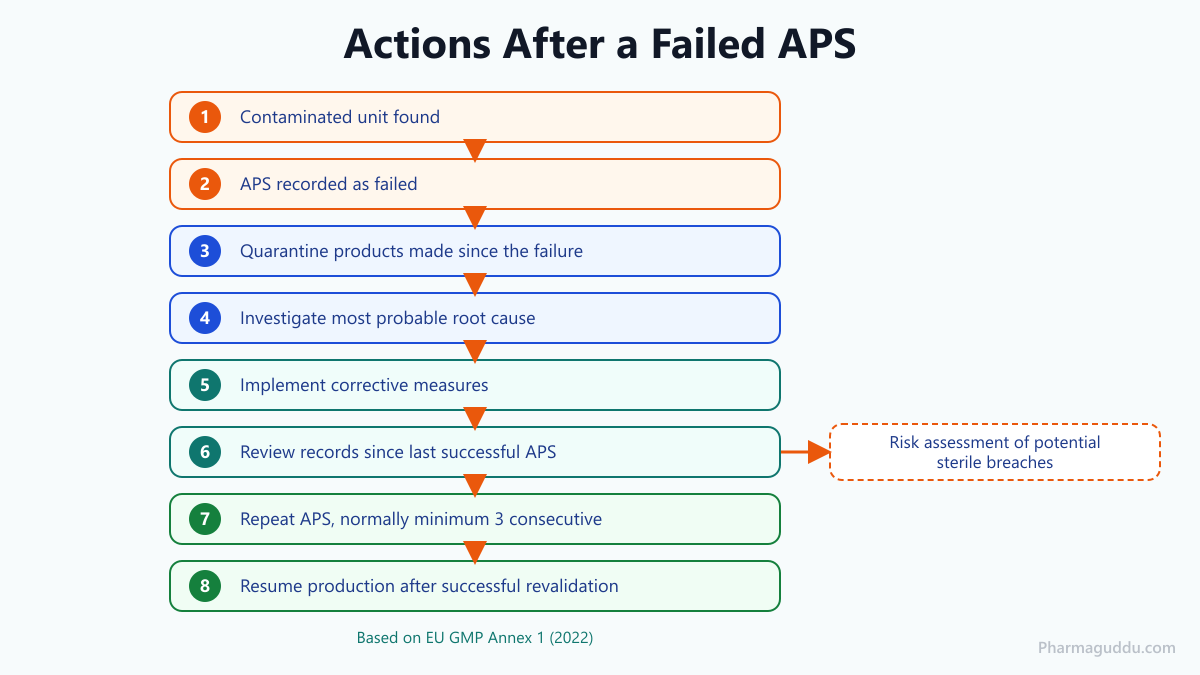
Annex 1 treats the run as a failed APS and lists the actions in Annex 1. The expected order of an answer is shown in the flow diagram.
- The contaminated unit is identified, and the APS is recorded as failed.
- Products manufactured on the line after the failure are quarantined.
- The investigation determines the most probable root cause, using a tool such as 5 Why or a fishbone diagram.
- Isolates are identified to species level when practical. The profile is compared with isolates from environmental monitoring, sterility tests and bioburden, and the container is examined for a breach.
- Appropriate corrective measures are implemented.
- All records since the last successful APS are reviewed, with a risk assessment of potential sterile breaches. Unreleased batches are included in the scope.
- Operator activities are limited until retraining and requalification, if the cause relates to an operator.
- A sufficient number of consecutive repeat APS, normally a minimum of three, shows that the process is back in control.
- Production resumes only after successful revalidation.
QA classifies the deviation and decides on the disposition of batches filled since the last good APS. QA closes the corrective and preventive action (CAPA) only after effectiveness is shown. Retraining is one possible corrective measure, but the root cause evidence must support it.
Q.16 A contaminated unit has a damaged closure. Does it count as a failure?
Damaged containers are not counted as failures, but the container and closure damage must be checked (PI 007-6). The FDA guidance states that any decision to exclude damaged incubated units from the tally must be fully justified in the media fill report. The documented check and justification decide the outcome. A correlation between hard-to-detect damage and contamination requires a thorough investigation.
Q.17 The growth promotion test fails. Is the run still valid?
The result of the run cannot be relied on. The US guidance states that the origin of any contamination found should still be investigated and the media fill promptly repeated. The cause of the growth promotion failure is also investigated.
Q.18 Can an APS run be aborted, and what must the records show?
The guideline allows an abort only where written procedures require commercial lots to be handled in the same way. An investigation must also be documented. The APS record includes reconciliation of units filled, incubated and not incubated. Every intervention is recorded with start time, end time and the person involved. Plate and inspection records follow ALCOA+ principles. They are attributable, legible and contemporaneous. They are also original and accurate. The data are complete, consistent, enduring and available.
References
- EU GMP Annex 1: Manufacture of Sterile Medicinal Products (2022), European Commission
- PIC/S PI 007-6 Recommendation on the Validation of Aseptic Processes, PIC/S
- Sterile Drug Products Produced by Aseptic Processing: Current Good Manufacturing Practice (2004), US FDA
- TRS 1044 Annex 2: WHO good manufacturing practices for sterile pharmaceutical products, WHO
- 21 CFR 211.113 Control of microbiological contamination, Cornell Legal Information Institute
- PDA Technical Report No. 22 (Revised 2025): Process Simulation for Aseptically Filled Products, PDA
- Validation standard operating procedure, section 30, internal library document
- Annex 1: 9.46 (scenario Questions on Failed APS and), 8.123 (recent Technology Trends)

Pankaj Sharma — Quality Control Specialist
Pankaj Sharma is a pharmaceutical QC professional who reviews our technical content for GMP accuracy, laboratory practices, and regulatory relevance.