
Quality Assurance & Regulatory Specialist
✓ Reviewed by: Satpal Singh - Quality Assurance & Regulatory Specialist
Reviewed for GMP compliance, quality systems, and regulatory accuracy
📅 Last Updated: October 16, 2026
An APR data checklist by source system lists, for every system that holds product data, what the review needs, who owns it and how you prove it is complete. Typical systems are LIMS, ERP, MES/EBR, QMS, stability, complaints, equipment records and contract-manufacturer files. Fix one data cut-off date, check each figure against the source record, and keep exports and spreadsheets under control. The split by system is good practice, not a legal requirement. The legal scope comes from 21 CFR 211.180(e) and EU GMP Chapter 1.
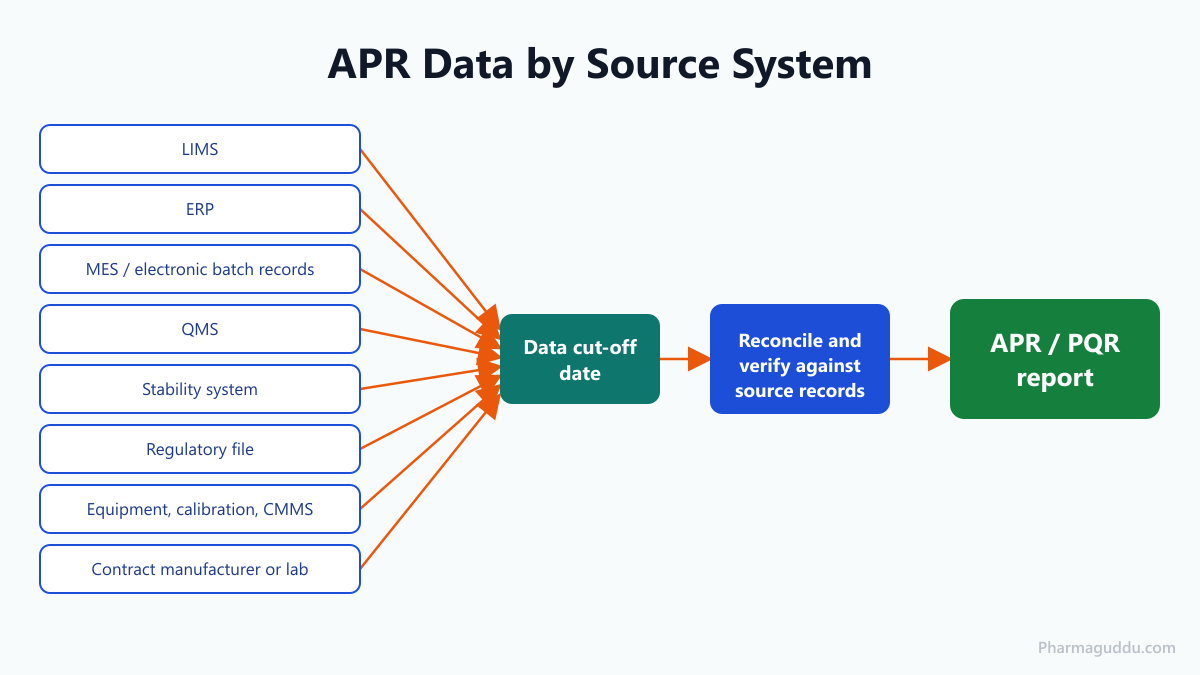
You can pull every number for an annual review and still fail the audit. Why? Because nobody can show where the numbers came from. This article gives you a working checklist, system by system. For the full overview, see Annual Product Review (APR / PQR).
What does an APR data checklist by source system cover?
It maps each required review element to the system that holds the record, the person who owns it, and the check that proves the data are complete. Two terms are used in this article. Annual Product Review (APR, US 21 CFR 211.180(e)) is the US term. Product Quality Review (PQR, EU GMP Chapter 1) is the EU term. Name the market in your checklist, because the scope differs.
Which data comes from which source system?
Start from the review elements, then trace each one to its system. The table below is a practical framework. Owners and system names vary by site, so adjust it to your own setup.
| Source system | Data elements | Usual owner | Completeness check |
|---|---|---|---|
| LIMS | Starting material, in-process and finished product results; OOS/OOT records | QC | Every released batch has a result for every test in the specification |
| ERP | Batches made, released, rejected; material and supplier data; yield | Supply chain, Production, QA | Batch totals match the batch record register |
| MES / electronic batch records | In-process data, process parameters, batch deviations | Production, QA | Every batch in ERP has a reviewed batch record |
| QMS | Deviations, CAPA, change control, audit actions | QA | Records opened before the cut-off date are closed or listed as open |
| Stability system | Stability monitoring results and adverse trends | QC | All scheduled pulls are tested or explained |
| Complaints, returns, recalls | Quality complaints, returns, recalls and investigations | QA | Complaint log matches the investigation files |
| Regulatory file | Variations submitted, granted or refused; post-marketing commitments | Regulatory Affairs | Each approved variation has a matching change control |
| Equipment, calibration, CMMS | Qualification status of equipment and utilities | Engineering | No instrument or utility used in the period is out of status |
| Contract manufacturer or lab | Technical agreements, batch and test data from their systems | QA | Data request sent and answered by the cut-off date |
EU GMP Chapter 1, section 1.10 (revision 3, in operation since 31 January 2013) asks for at least twelve review items. These include starting and packaging materials, critical in-process controls and finished product results, failed batches, significant deviations, changes to processes or methods, marketing authorisation variations, stability results, complaints and recalls, and the qualification status of equipment and utilities. It also lists a review of contractual arrangements under Chapter 7.
How do US and EU requirements differ?
The US rule is a regulation. EU GMP (EudraLex Volume 4) is a guideline that inspectors apply through national law. The checklist should say which one it follows.
US: 21 CFR 211.180(e) requires a written evaluation, at least yearly, of each drug product’s quality standards. It must cover a representative number of batches, approved or rejected, plus complaints, recalls, returned or salvaged product and investigations under 211.192.
EU: Section 1.10 covers all authorised products, including export-only products. Section 1.11 says the manufacturer and the marketing authorisation holder must evaluate the results and decide on CAPA or revalidation. It also allows grouping by product type where scientifically justified.
Other markets: India, UK, WHO, Canada and Australia are outside the sources used here. Check your local rules and add a market column to the checklist.
Chapter 1 is under revision. The consultation ran from 3 September to 3 December 2025. Treat it as a “draft revision, consultation” until the final text is published. Do not write draft wording into your procedure as a requirement.
What data integrity controls do source systems need?
Each source system must hold data that are attributable, legible, contemporaneous, original and accurate (ALCOA+). For the full principles, read ALCOA, ALCOA+ and ALCOA++ in pharma. For APR work, check these points:
- Audit trails: confirm they are on and reviewed for the data you pull.
- Access control: only named users can change records or exports.
- Interface and export validation: a validated computerised system needs a tested link or export, with a record that totals match.
- Spreadsheets: keep them under document control, with locked formulas, change control and a version history.
- Source check: confirm key figures against the original record, not only the export.
Use the right words. Equipment is qualified. A computerised system or process is validated. Don’t call an APR spreadsheet “validated” unless it went through a documented validation.
How do you set the data cut-off and reconcile totals?
Pick one data cut-off date and apply it to every system. Write it in the APR plan. A deviation closed on 3 March should not appear in one system’s data and not in another’s.
Then reconcile the totals before you trend anything:
- Count batches manufactured, released and rejected in ERP.
- Count the same batches in the batch record register and LIMS.
- List every difference with its cause, such as reprocessed batches or split lots.
- Record the source reference for each reconciled figure.
Handle missing data openly. If a result or record is absent, say so in the APR, give the reason and open an action. Don’t fill a gap with an estimate.
How do APR conclusions link to regulatory actions and CAPA?
Section 1.10 asks for a review of marketing authorisation variations and post-marketing commitments. Section 1.11 asks for evaluation and, where needed, CAPA or revalidation. So the checklist needs a regulatory row and an action row.
If a trend shows a specification is too tight or too loose, check the filed specification before you propose a change. A change to a filed specification may need a variation or supplement. Start it through change control and ask Regulatory Affairs for the filing impact.
Under the Pharmaceutical Quality System (ICH Q10), take the APR conclusions to management review. Chapter 1, section 1.6 expects periodic management review. Track every APR action to closure, then check that the CAPA worked, for example by looking at the next period’s data.
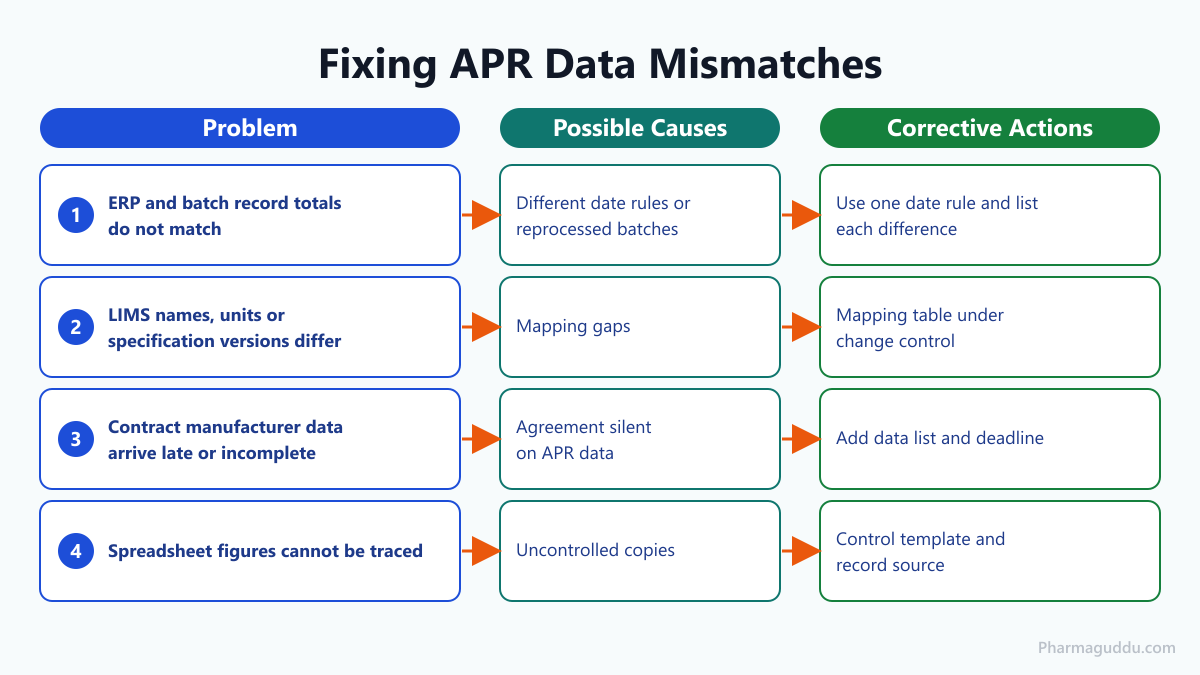
Common Problems and Troubleshooting
ERP and batch record totals do not match
Possible Causes: reprocessed or split batches, different cut-off dates, or batches counted by posting date in one system and release date in another.
Corrective Actions: use one date rule, list each difference, and trace it to the batch record.
LIMS names, units or specification versions differ from other systems
Possible Causes: product codes, analyte names or batch numbers mapped differently; old specification versions still active.
Corrective Actions: keep a mapping table under change control, and compare results with the specification version in force on the test date.
Contract manufacturer data arrive late or incomplete
Possible Causes: the technical agreement does not state APR data, timing or format.
Corrective Actions: add the data list and deadline to the technical agreement, and send the request well before the cut-off date.
Spreadsheet figures cannot be traced
Possible Causes: uncontrolled copies, manual edits, no source reference.
Corrective Actions: control the template, lock formulas and record the source of each figure.
Frequently Asked Questions
No. The regulations list what to review, not which systems to use. The system-by-system split is a practical way to find, own and check each data element. Your site procedure should define it.
The department that runs the system usually owns the data: QC for LIMS and stability, Production for batch records, Engineering for equipment status. QA coordinates the review and approves it. Your site SOP defines the exact roles.
No. An export is a copy. Verify key figures against the original record, such as the batch record or the LIMS entry, and keep the spreadsheet under document control with access and change control.
Summary
A good APR starts with a clear map: system, data, owner, completeness check. Fix one cut-off date, reconcile totals, and trace figures to source records. Control your exports and spreadsheets, link conclusions to variations and CAPA, and follow actions to closure. Then your review stands up on inspection day.
References
- EudraLex Volume 4, Chapter 1: Pharmaceutical Quality System (revision 3), European Commission
- EudraLex Volume 4, European Commission
- 21 CFR 211.180, Cornell LII
- eCFR 21 CFR 211.180, US National Archives / FDA
- Annual Product Quality Review: FDA vs EU GMP Requirements, IntuitionLabs
- TrackWise Product Quality Review (PQR), Sparta Systems
- ICH Q10 Pharmaceutical Quality System, ICH, 2008

Satpal Singh — Quality Assurance & Regulatory Specialist
Satpal Singh is an experienced pharmaceutical Quality Assurance and Regulatory professional with expertise in GMP compliance, quality systems, technical documentation, and regulatory requirements. He reviews our pharmaceutical content to ensure accuracy, industry relevance, and alignment with current quality and regulatory standards.
Expertise: QA Systems | GMP Compliance | Regulatory Documentation | Audits | Quality Management