
GMP & Pharmaceutical Manufacturing Expert
✓ Reviewed by: Pankaj Sharma - Quality Control Specialist
Reviewed for Quality Control accuracy, laboratory practices, analytical methods, and technical relevance
📅 Last Updated: November 7, 2026
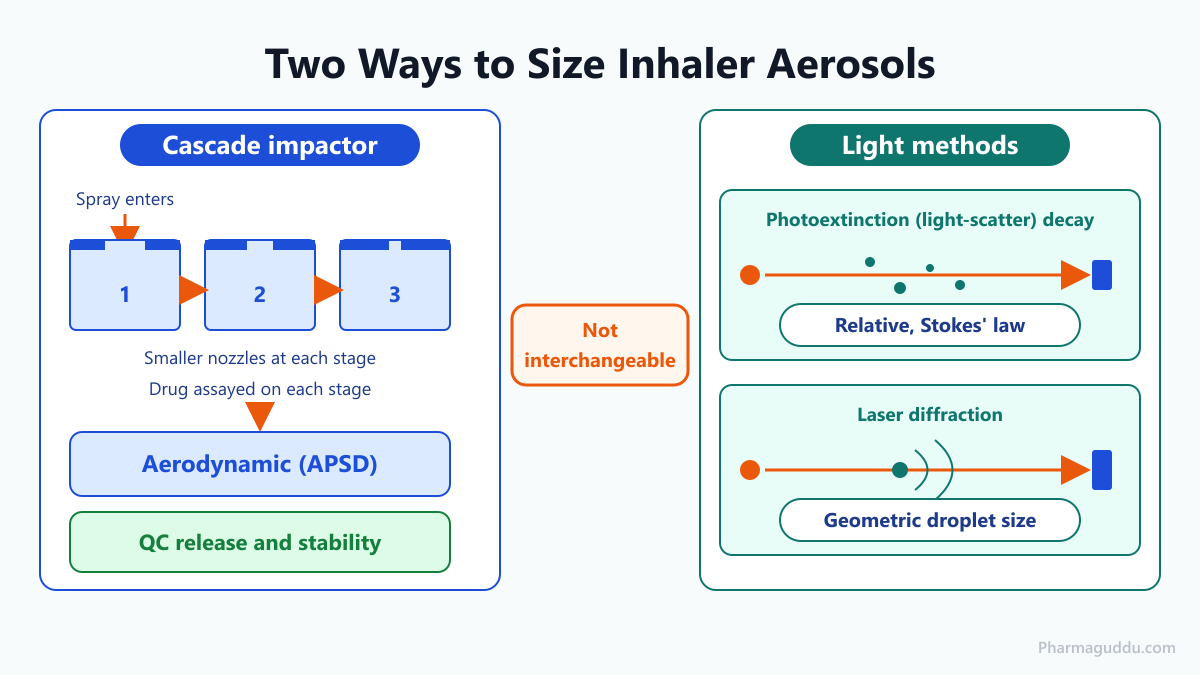
Aerosol particle size measurement for inhalation products relies on two groups of methods. A cascade impactor separates the spray by inertia into size bands, and the drug on each stage is assayed to give the aerodynamic particle size distribution (APSD). Light-based methods work differently: photoextinction (light-scatter) decay follows the fall of a light signal as droplets settle, and laser diffraction measures the geometric droplet size of the plume. Impaction is used for release and stability testing because it is drug specific, while the light methods give fast size information on the spray.
What is aerosol particle size measurement for inhalation aerosols?
Aerosol particle size measurement determines the size distribution of the particles or droplets that leave an inhaler, because size decides where the drug is deposited. Large particles stop in the mouth and throat, medium ones settle in the large airways, and fine particles of about 3 to 5 µm aerodynamic diameter are often cited as optimal for pulmonary delivery. The full overview of the dosage form is given in Aerosol in Pharma (Aerosols); Types, Container, Advantage, and Disadvantage. Size control during formulation is covered in suspension aerosols.
Related topic: aerosol propellants in pharmaceuticals
Related topic: aerosol valve and actuator components
Related topic: two-phase and three-phase aerosol systems
Related topic: cold filling and pressure filling aerosols
How does a cascade impactor separate particles by size?
A cascade impactor sorts an aerosol by inertia. Air carrying the spray is drawn through a series of stages, and the nozzles become smaller at each stage, so the air speed rises stage by stage. Particles that are too heavy to follow the bend in the air stream hit the stage plate. Finer particles then pass on to the next stage.
Each stage has a cut-off diameter, which is the size collected with about 50% efficiency on that stage. The size is the aerodynamic diameter, meaning the diameter of a unit-density sphere that settles at the same speed as the particle. The drug on each stage is then measured by a validated assay, normally high-performance liquid chromatography (HPLC). This gives a mass-based APSD.
Which parts make up the impactor set-up?
The set-up consists of the parts in the table, connected in the order in which the aerosol flows.
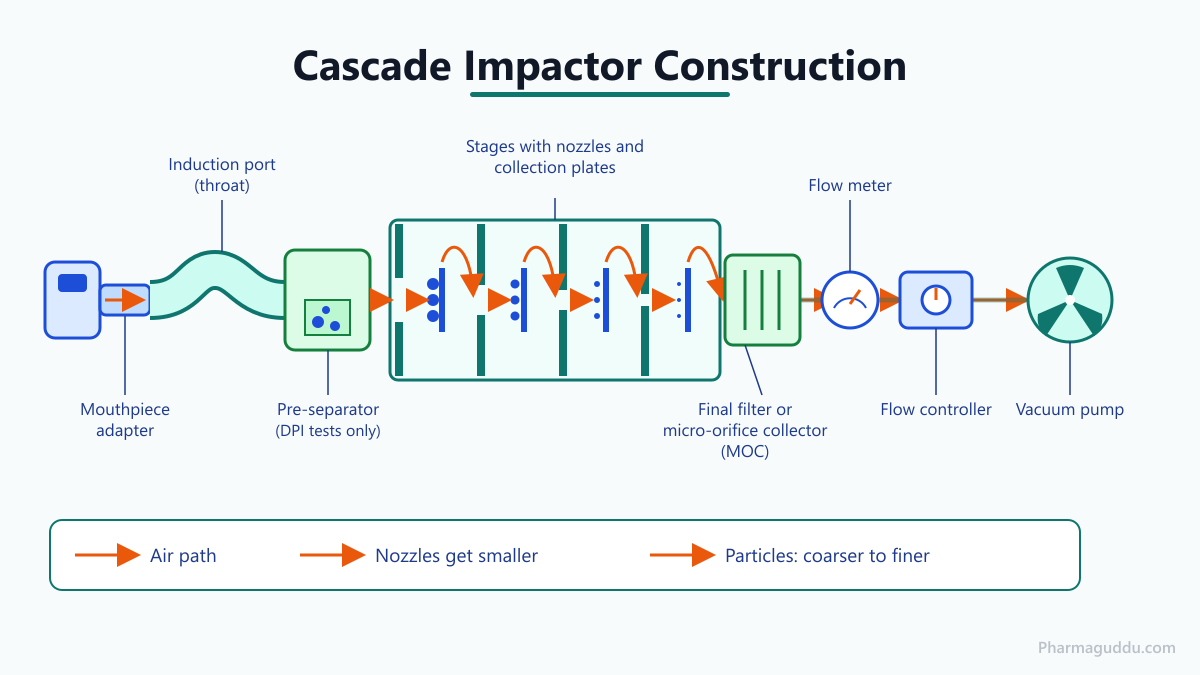
| Part | Function |
|---|---|
| Mouthpiece adapter | Seals the inhaler to the induction port |
| Induction port (throat) | Models the mouth and throat and collects coarse drug |
| Pre-separator | Collects the bulk of the powder before the stages in dry powder inhaler (DPI) tests |
| Stages with nozzles and collection plates | Separate the aerosol into size bands |
| Final filter or micro-orifice collector (MOC) | Captures the finest particles that pass the last stage |
| Vacuum pump, flow controller and flow meter | Draw the air through the impactor and control the flow |
A metered-dose inhaler (MDI) test normally runs without a pre-separator.
Which methods are used to measure aerosol particle size?
| Method | What is measured | Size reported | Typical use |
|---|---|---|---|
| Cascade impactor (Andersen, NGI) | Drug mass on each stage | Aerodynamic (APSD) | QC release and stability |
| Abbreviated impactor | Drug mass in a few grouped size bands, called impactor-sized mass (ISM) | Aerodynamic | Routine batch release |
| Photoextinction (light-scatter) decay | Fall of a light signal as droplets settle | Relative, based on Stokes’ law | Older method for spray size |
| Laser diffraction | Plume crossing a laser beam | Geometric droplet size | Plume and droplet size of a device and formulation |
The Next Generation Impactor (NGI) has seven stages plus the MOC. It can be run at any flow rate from 15 to 100 L/min (the older calibration covered 30 to 100 L/min), with cut-off sizes calibrated at set flow rates such as 30, 60 and 100 L/min, while the Andersen impactor has eight stages.
In the photoextinction decay method, the aerosol is sprayed into a closed settling chamber or rotating drum, and a light beam crosses it. As the droplets settle under Stokes’ law, the scattered or extinguished light falls. Large droplets settle fast and small ones slowly, so the rate of fall of the signal is used to estimate the size distribution. The signal is relative, not absolute, and it cannot identify the drug.
Laser diffraction measures the geometric droplet size of the plume as it crosses a laser beam and shows how the size changes during one actuation. Malvern Panalytical quotes a range of 0.1 to 2000 µm for its Spraytec. Geometric size is not the same as aerodynamic size, so laser diffraction does not replace impaction for release and stability testing.
How is the cascade impactor test carried out?
The test is a quality control (QC) release test and not an in-process control. The impactor and the flow controller must be qualified and calibrated, and the method must be validated.
- The impactor is assembled and the collection plates are coated, so that particles do not bounce or re-enter the air stream.
- A leak test is run on the assembled impactor.
- The flow is set and checked at the inlet before each run, because a wrong flow shifts every cut-off.
- The inhaler is connected through the mouthpiece adapter and fired for the number of actuations given in the validated method.
- The drug is recovered from the induction port, each stage and the filter, and assayed.
- The APSD and the recovery are calculated using the cut-off table for the flow actually used.
The QC analyst performs the test. Production supplies the samples and carries out any in-process spray checks. The record should include the actuation count, flow, temperature and humidity, coating lot, and any deviation or out-of-trend result.
How are impactor results read: MMAD, GSD and fine particle fraction?
The mass of drug on each stage is converted to a cumulative percentage below each cut-off, and from these values the mass median aerodynamic diameter (MMAD) is read as the size below which 50% of the drug mass lies. The geometric standard deviation (GSD) describes the spread. A higher GSD means a broader distribution. The fine particle fraction (FPF) is the mass fraction of drug with an aerodynamic diameter usually below 5 µm. This limit is a convention and not a measure of deep-lung deposition.
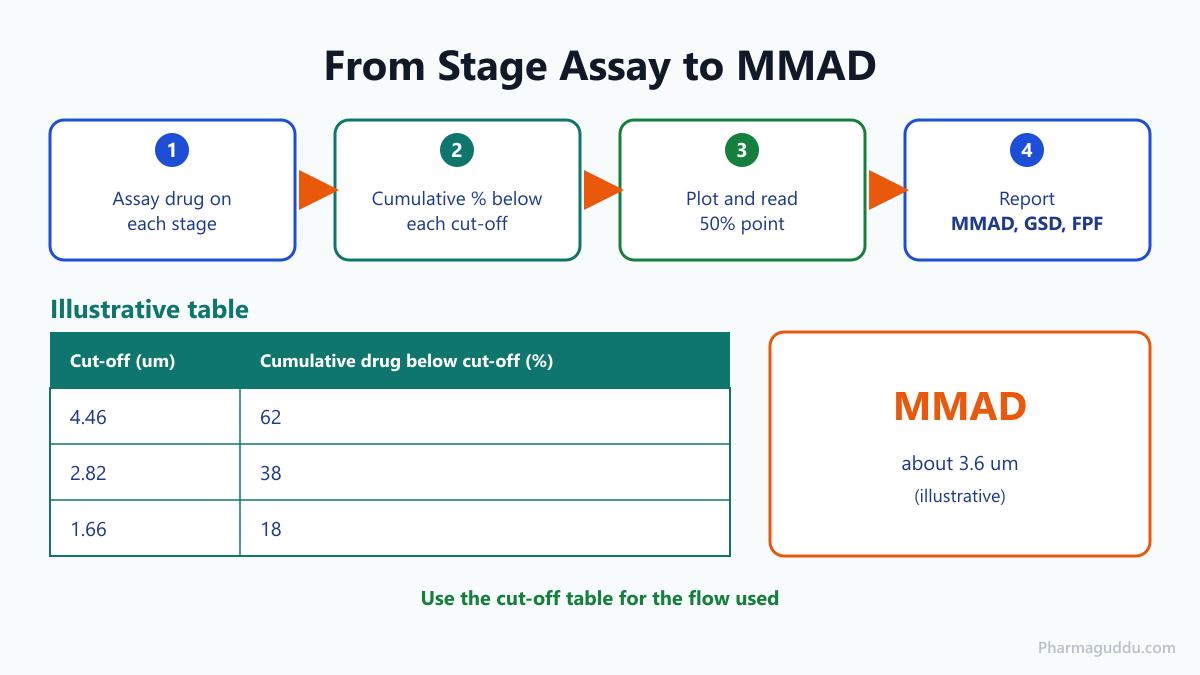
For illustration, a run at 60 L/min gives the cumulative values below (illustrative figures, not measured data).
| Stage cut-off (µm) | Cumulative drug below cut-off (%) |
|---|---|
| 4.46 | 62 |
| 2.82 | 38 |
| 1.66 | 18 |
The 50% point lies between 2.82 and 4.46 µm, and interpolation gives an MMAD of about 3.6 µm. If 4.46 µm is chosen as the fine particle limit, the FPF is 62% of the recovered drug. The cut-off table must match the flow used, so the 60 L/min NGI values must not be applied to a 30 L/min run. Total recovery is compared with the limit in the validated method.
What problems occur in impactor testing and how are they fixed?
| Problem | Possible cause | Corrective action |
|---|---|---|
| Product appears finer than it is | Particle bounce or re-entrainment from dry or poorly coated plates | Coat the plates and keep the same coating and humidity from run to run |
| Shifted stage cut-offs | Leak, or wrong flow at the inlet | Repeat the leak test and set the flow again before the run |
| Poor size separation | Blocked nozzles | Inspect and clean the nozzles |
| Drug lost before the stages | Wall loss in the induction port or between stages | Recover the drug from all parts and include it in the mass balance |
| Recovery outside the method limit | Incomplete recovery or assay error | Investigate under the deviation procedure |
For solution MDIs, wall loss and evaporation are usually the larger concern than bounce.
What do the regulations say about particle size testing?
The impactor apparatus and procedure are described in USP general chapter 601 and in Ph. Eur. 2.9.18 (aerodynamic assessment of fine particles). The FDA draft guidance on MDI and Dry Powder Inhaler (DPI) quality considerations (April 2018) is still a draft and is not for implementation. It treats APSD as a critical quality attribute of aerodynamic performance.
The impactor and flow-controller records fall under data integrity. The audit trail must be active, trial runs must not be left unrecorded, and printouts must be controlled.
How are impactor parts cleaned and maintained?
Impactor parts are cleaned between runs, and the nozzles are inspected periodically (for example by nozzle gauging). The flow controller is calibrated at intervals set by the department. Rinsing solvents, the vacuum pump and released propellant must be handled under the site safety procedure.
Recent Technology Trends
Copley Scientific launched Inhalytix+ software in August 2025. It links the flow controllers and other impactor equipment, keeps audit trails and calculates the APSD automatically. In November 2025 the European Pharmacopoeia Commission asked its Inhalanda Working Party to add an abbreviated impactor to Ph. Eur. 2.9.18, which would give routine batch release a shorter test.
Frequently Asked Questions
The cut-off depends on the air speed through the nozzles. A different flow rate (30, 60 or 100 L/min) changes that speed. Each flow therefore has its own set of cut-offs, and the correct table must be used for every run.
A coating on the collection surface stops particles from bouncing off the plate and moving to a lower stage. Without it, the product would appear finer than it really is. The same coating and humidity should be kept from run to run.
No, the readings are relative. The method therefore needs calibration, and the signal also cannot show which ingredient the particles contain, so for this reason the method cannot give the drug dose in each size band.
No. Impaction gives the drug-specific aerodynamic distribution used for release and stability, and laser diffraction gives the geometric size of the plume. The two sizes are not interchangeable, so the methods answer different questions.
References
- USP General Chapter 601, Inhalation and Nasal Drug Products: Performance Quality Tests, USP 38 edition (2015), USP 38 General Chapter 601 (mirror), drugfuture.com
- An Introduction to Cascade Impaction, OINDP News (2024)
- Measurement of the physical decay of aerosols by a light scatter method, Epidemiology and Infection (Cambridge)
- Spraytec laser diffraction system, ONdrugDelivery / Malvern Panalytical
- FDA draft guidance: MDI and DPI Products, Quality Considerations, US FDA (2018)
- Copley Scientific launches Inhalytix+, OINDP News (2025)
- EDQM news: Abbreviated Impactor in 2.9.18, EDQM (2025)
- Ph. Eur. 2.9.18, Preparations for inhalation: aerodynamic assessment of fine particles, European Pharmacopoeia, EDQM

Naresh Bhakar is the Founder and Author at Pharmaguddu.com, bringing his extensive expertise in the field of pharmaceuticals to readers worldwide. He has experience in Pharma manufacturing and has worked with top Pharmaceuticals. He has rich knowledge and provides valuable insights and data through his articles and content on Pharmaguddu.com. For further inquiries or collaborations, please don’t hesitate to reach out via email at [email protected].