
GMP & Pharmaceutical Manufacturing Expert
✓ Reviewed by: Naresh Bhakar
Reviewed for pharmaceutical accuracy
📅 Last Updated: November 10, 2026
Anticaries agents in toothpaste are fluoride salts that make enamel more resistant to acid and aid remineralisation. The US monograph permits sodium fluoride, sodium monofluorophosphate (MFP) and stannous fluoride. Antibacterial agents, such as triclosan or stannous fluoride, reduce plaque bacteria. Desensitizing agents, mainly potassium nitrate, reduce dentine hypersensitivity. In manufacture, each active is weighed, charged and verified as an active ingredient, and the finished paste is released on assay of total and available fluoride.
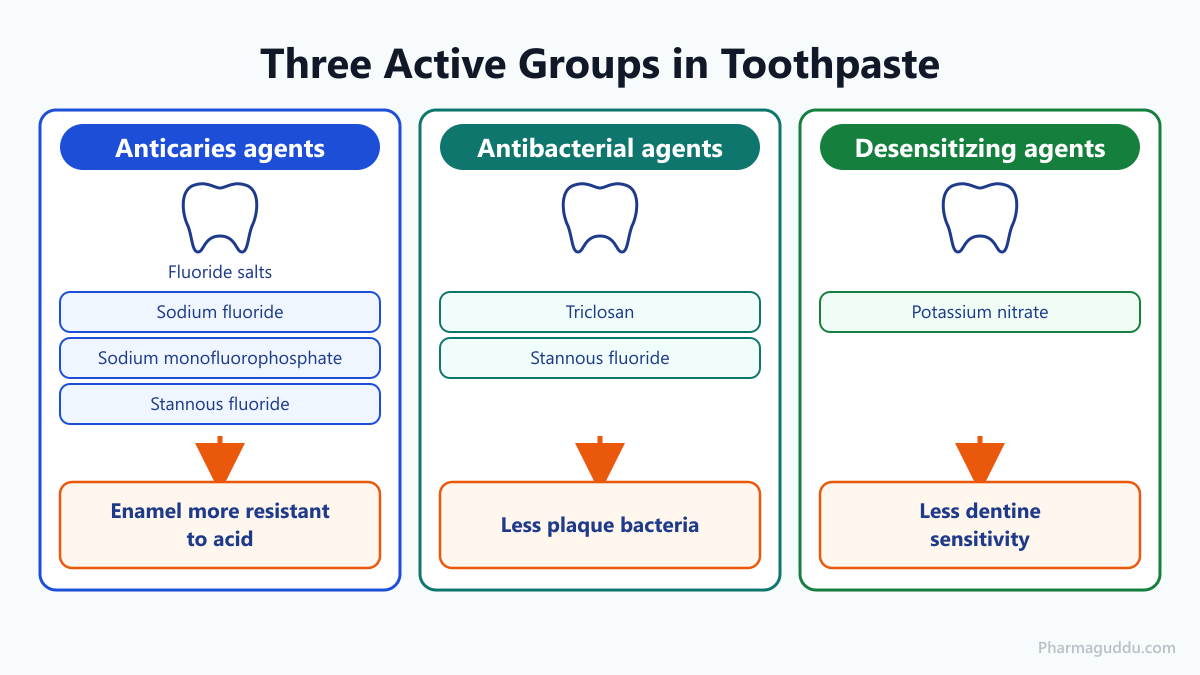
What are anticaries, antibacterial and desensitizing agents?
These three groups are the therapeutic actives of a dentifrice. They are added to the base of abrasive, humectant, binder and detergent. An anticaries agent helps prevent dental cavities, an antibacterial agent reduces the bacteria that form plaque, and a desensitizing agent relieves the pain that dentine exposure causes.
For the full overview of dentifrice types and evaluation, see Dentifrices; Types, Formulation, and Evaluation. The sections below cover the three active groups and their handling in production.
How do these agents work?
Fluoride promotes remineralisation and makes enamel more resistant to acid. Only the available fluoride (the fraction that is free to act) can do this work. The abrasive system therefore must not bind it, and calcium carbonate and dicalcium phosphate can lower available fluoride unless the system is designed for them, whereas silica and insoluble metaphosphate are fluoride-compatible. For more details read our abrasives article.
Antibacterial agents act on plaque bacteria, and triclosan is usually combined with a polycarboxylate copolymer (a methyl vinyl ether/maleic acid copolymer) that improves its delivery to, and retention on, tooth and soft oral surfaces. Stannous fluoride acts as both an anticaries and an antibacterial agent.
Potassium ions are postulated to diffuse along the dentinal tubules and depolarise or inactivate the intradental nerves, but this has not been confirmed in intact human teeth. The effect builds up over weeks of regular brushing.
Which actives are used and at what level?
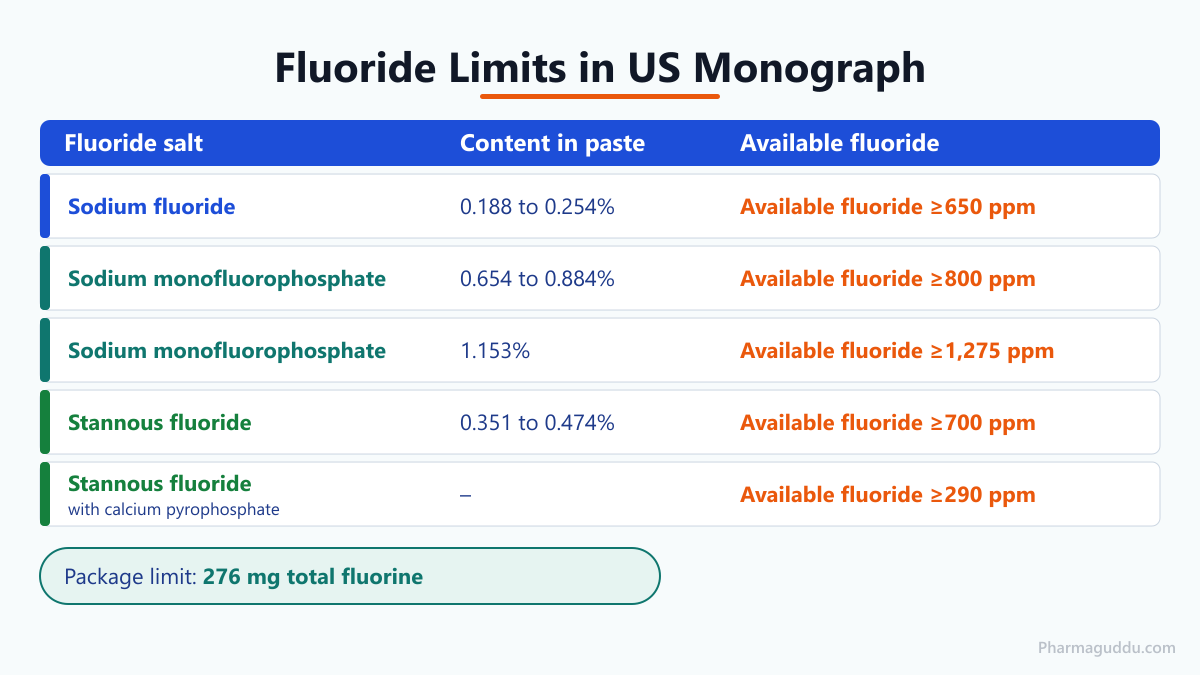
The US monograph, OTC Monograph M021 (formerly 21 CFR Part 355), sets the strengths for gel and paste dentifrices.
| Active | Strength in paste or gel | Available fluoride ion |
|---|---|---|
| Sodium fluoride | 0.188 to 0.254% | ≥650 ppm |
| Sodium monofluorophosphate | 0.654 to 0.884% | ≥800 ppm |
| Sodium monofluorophosphate (1,500 ppm option) | 1.153% | ≥1,275 ppm |
| Stannous fluoride (abrasive other than calcium pyrophosphate) | 0.351 to 0.474% | ≥700 ppm |
| Stannous fluoride (calcium pyrophosphate abrasive) | 0.351 to 0.474% | ≥290 ppm |
The first four standard options correspond to 850 to 1,150 ppm theoretical total fluorine, and the 1,500 ppm option to 1,500 ppm. The minimum available fluoride therefore depends on the salt, dosage form and abrasive. The ≥850 ppm figure applies only to sodium fluoride powders that contain sodium bicarbonate.
Potassium nitrate at 5% was proposed by FDA as the only Category-I (safe and effective) tooth desensitizer ingredient, a proposed monograph position and not a final one, and it can be combined with sodium fluoride in one paste.
How are the actives added during manufacture?
The usual sequence is shown below. The order is typical practice, not a regulatory rule, and each site fixes it in the validated process.
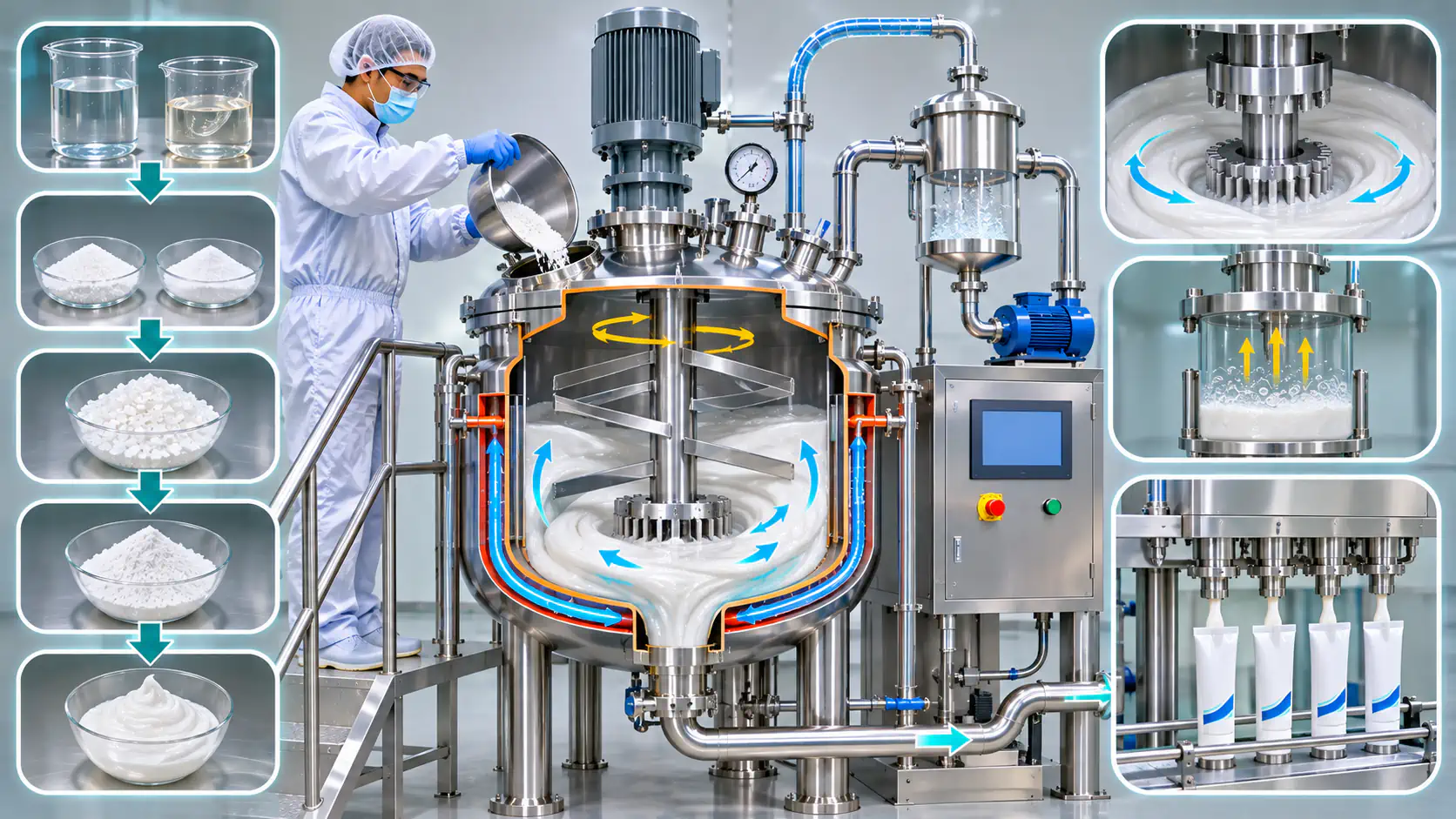
- The humectant and water phase is prepared in the vacuum mixer.
- Water-soluble actives such as sodium fluoride and potassium nitrate are dissolved in the aqueous phase before the abrasive is added.
- The binder and powders are charged, and the mass is dispersed under high shear.
- Detergent, flavour and colour are added, as described in the detergents article.
- The paste is deaerated under vacuum, and the vacuum level and hold time are recorded.
- The paste is filled into tubes.
Mixer speed, vacuum, temperature and batch time depend on the equipment and the formula, so these values are fixed in the validated process and not taken from a general figure.
Each active is an active-ingredient charge. Under 21 CFR 211.101, the batch must be formulated to provide not less than 100 percent of the labelled or established amount of active ingredient. One person adds each component and a second person verifies it, unless automated equipment is used. The batch manufacturing record (BMR) documents the addition point of each active.
What are the specifications and in-process controls?
In-process controls (IPC) commonly cover pH, viscosity, specific gravity, vacuum and fluoride assay. Release testing covers total fluoride and available fluoride. Total fluoride alone is not enough, because a calcium-based abrasive can lower available fluoride while total fluoride remains unchanged.
For the US drug product, OTC Monograph M021 requires animal caries reduction data and either enamel solubility reduction or fluoride enamel uptake, and United States Pharmacopeia (USP) fluoride dentifrice reference standards are used in these tests.
A deviation must be raised when available fluoride falls below the specification. Yield reconciliation at the end of filling confirms that the quantity of active used matches the quantity of paste produced.
What problems occur and how are they corrected?
Low available fluoride
Calcium-based abrasives can bind fluoride. The available fraction may also fall during storage, so the formulation team should select a fluoride-compatible abrasive and the stability data should include available fluoride.
Stannous fluoride instability
Stannous fluoride is unstable in water-based pastes. Stabilisation with nitrate and phosphates has been reported in a manufacturer-linked 2024 study (Compendium of Continuing Education in Dentistry). Pastes with stannous fluoride may stain teeth, so the label must carry the staining statement.
Texture and taste changes
Added salts can change viscosity or cause hardening. Viscosity is checked at the IPC stage, and changes are corrected through the validated formula, not by adjustment at the mixer, while taste effects are handled through flavour selection, as covered in Organoleptic Agents.
Carry-over between products
A fluoride paste can contaminate the next product. The line must be cleared and checked as part of line clearance, and cleaning of mixers and filling lines should be validated with worst-case swab and rinse sampling. The equipment must be qualified, and the process and cleaning validated. Fluoride, nitrate and stannous salts are corrosive or reactive, so stainless steel contact parts are normally used.
What are the regulatory points?
In the US, fluoride toothpaste is an OTC drug under monograph M021. In the EU it is a cosmetic, so the applicable Good Manufacturing Practice (GMP) differs by region.
Under M021, a dentifrice package must not contain more than 276 mg total fluorine, which limits the tube fill weight. The label must carry the warning to keep the product out of the reach of children under 6 years of age, with the instruction to seek medical help or contact a Poison Control Center if more than the brushing amount is swallowed. Stannous fluoride products must carry the surface-staining statement. The 1,500 ppm MFP paste carries its own directions for children under 6 years.
Equipment cleaning under 21 CFR 211.67 requires written procedures and records of cleaning and inspection.
Frequently Asked Questions
Sodium fluoride, sodium monofluorophosphate and stannous fluoride are the three permitted in the US monograph for dentifrices, and amine fluoride is also used in some markets. The choice depends on the abrasive, the stability of the paste and the claims.
Triclosan is no longer used in every market. Several brands have replaced it voluntarily, often with stannous fluoride. Zinc salts, cetylpyridinium chloride and essential oils are other antibacterial options used in dentifrices, and the permitted level depends on the regulation of the country of sale.
A 2026 systematic review in Clinical, Cosmetic and Investigational Dentistry found three hydroxyapatite trials and one arginine trial. The evidence is still limited compared with fluoride. For a plant, these pastes mean that actives must stay compatible with the other ingredients.
Yes. Trapped air changes the density and the stability of the paste and can lead to air bubbles in the tube, so the vacuum level and hold time should be recorded in the BMR for each batch.
The EU limit for toothpaste is 0.15% fluoride (1,500 ppm F) under the Cosmetics Regulation.
References
- OTC Monograph M021 Anticaries Drug Products for OTC Human Use (05.02.2023), US FDA
- 21 CFR 211.101 Charge-in of components, eCFR
- 21 CFR 211.67 Equipment cleaning and maintenance, Cornell LII
- Potassium nitrate is Category I tooth desensitizer ingredient, Pink Sheet (Informa)
- Antibacterial effects of a novel stannous fluoride toothpaste stabilized with nitrate and phosphates, Compendium of Continuing Education in Dentistry
- Fluoride-free toothpastes for caries prevention: a systematic review, Clinical, Cosmetic and Investigational Dentistry
- Commission Directive 2009/129/EC, EUR-Lex
- Guidelines for Cleaning Procedures, PDA (2000), Owner library

Naresh Bhakar is the Founder and Author at Pharmaguddu.com, bringing his extensive expertise in the field of pharmaceuticals to readers worldwide. He has experience in Pharma manufacturing and has worked with top Pharmaceuticals. He has rich knowledge and provides valuable insights and data through his articles and content on Pharmaguddu.com. For further inquiries or collaborations, please don’t hesitate to reach out via email at [email protected].