
GMP & Pharmaceutical Manufacturing Expert
✓ Reviewed by: Naresh Bhakar
Reviewed for pharmaceutical accuracy
📅 Last Updated: November 10, 2026
Humectants and binders in toothpaste are the two ingredient groups that turn a mass of abrasive powder into a smooth, stable paste. Humectants (glycerine, sorbitol, propylene glycol, polyethylene glycol (PEG) and xylitol) hold water in the paste and prevent hardening on exposure to air. Binders (hydrocolloid gums such as xanthan, carrageenan and sodium carboxymethylcellulose (CMC)) gel the liquid phase so that the solids do not settle. Together they decide the consistency, extrusion and storage stability of the paste. The gum must be hydrated without lumps, and the paste is deaerated under vacuum.
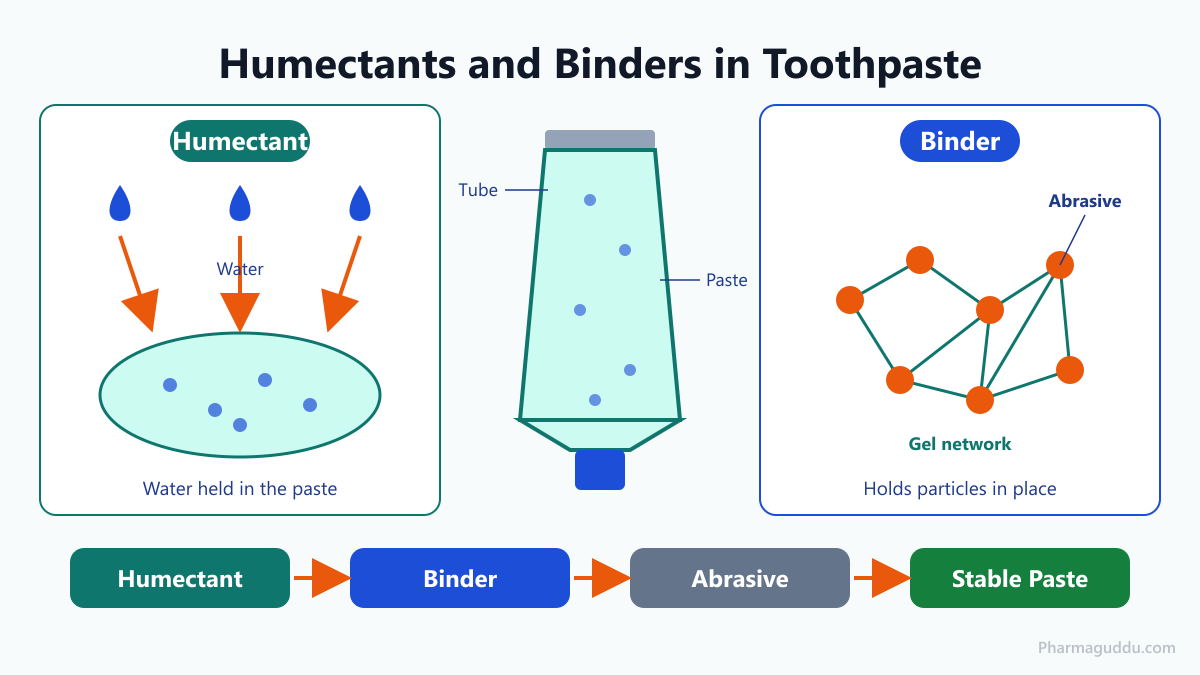
What are humectants and binders in toothpaste?
A toothpaste is mainly a suspension of particulate abrasive in a liquid phase made of water and humectant. The binder (also called a thickener or gelling agent) thickens this liquid, according to patent US5030444, so that the abrasive stays suspended and the paste does not separate.
A binder in toothpaste is a hydrocolloid, which gels the liquid phase. It differs from a tablet binder, which glues dry particles together. For the full overview of dentifrice types and formulation, see Dentifrices; Types, Formulation, and Evaluation. The abrasive itself is covered in Abrasives and Polishing Agents in Dentifrices.
How do humectants and binders work?
Humectants bind water and slow its loss, so the paste stays soft at the tube orifice and does not harden when it is exposed to air. Some of them, such as sorbitol and xylitol, also add sweetness.
Binders work in the opposite direction. Their high affinity for water makes them swell and form a gel network, and this network holds the abrasive and other solids in place. A tooth powder is a dry mix and needs no liquid phase, so humectants and binders are mainly a feature of pastes.
The paste is also shear-thinning, meaning that its viscosity falls under stress. It therefore stays firm in the tube and flows when it is squeezed.
Which materials are used?
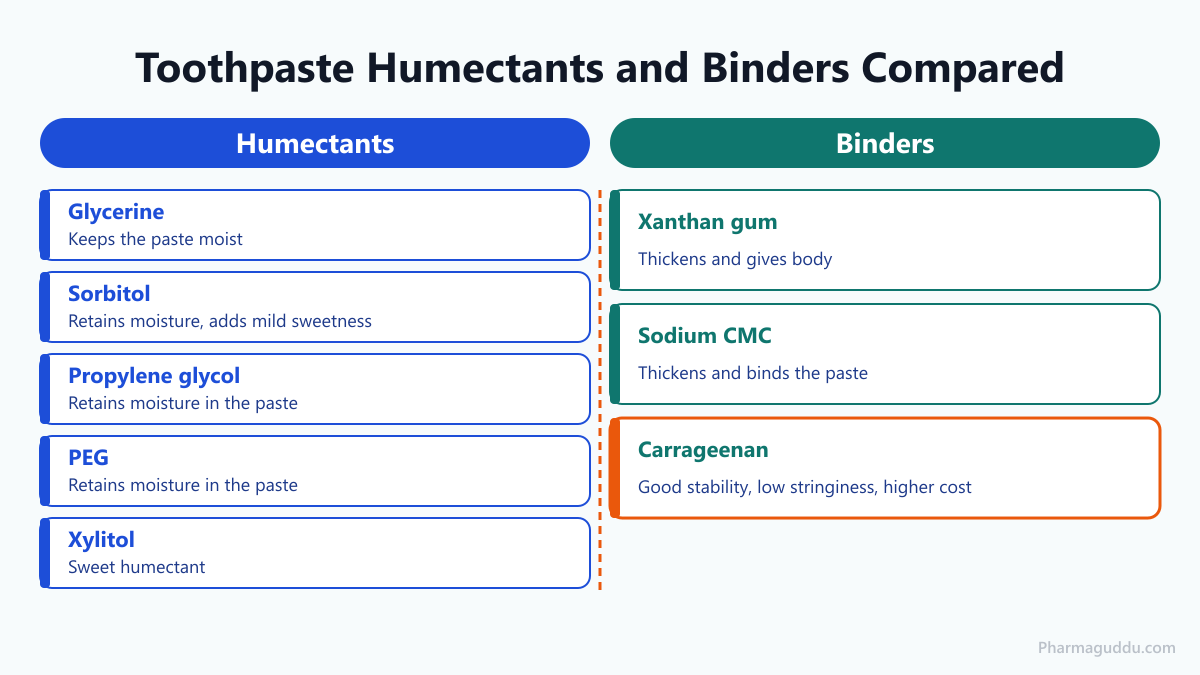
| Material | Group | Main function and effect on the paste |
|---|---|---|
| Glycerine | Humectant | Retains moisture, prevents hardening, forms the main liquid phase |
| Sorbitol (usually a 70% aqueous solution) | Humectant | Retains moisture and adds sweetness |
| Propylene glycol | Humectant | Alternative polyol that prevents drying |
| PEG | Humectant | Alternative polyol used in blends with glycerine and sorbitol |
| Xylitol | Humectant | Retains moisture and adds sweetness |
| Xanthan gum | Binder | Gels the liquid phase; little viscosity gain from hot filling |
| Sodium CMC | Binder | Lower cost than carrageenan; little viscosity gain from hot filling |
| Carrageenan | Binder | Good physical stability, low stringiness and good rheology; higher cost |
The humectant level of a conventional toothpaste is roughly 10 to 60% by weight. The binder level around 0.2 to 2% in total, with 0.5 to 2% preferred, carrageenan has been used less widely than CMC because of its higher cost. These are patent figures, and the actual levels vary by formula.
When part of the carrageenan is replaced by CMC or xanthan, the total binder level often has to be higher. Iota and modified kappa carrageenans gained more than 100% viscosity from hot filling in the patent tests, whereas xanthan and CMC at about 0.8% gained very little.
How are humectants and binders added during manufacture?
According to the our site floor, the usual order is powder wet-out and dispersion, gum hydration, homogenisation, vacuum deaeration, and final batching with surfactant, flavour and colour. For mixing, Multi-shaft or double planetary mixers are commonly used.
The humectants form the liquid phase first. The gum is then dispersed in it and hydrated, and the abrasive is added to the gel. Surfactant, flavour and colour follow at the end. The detergent step is described in Detergents and Foaming Agents in Toothpaste.
How is the gel phase prepared and the paste mixed?
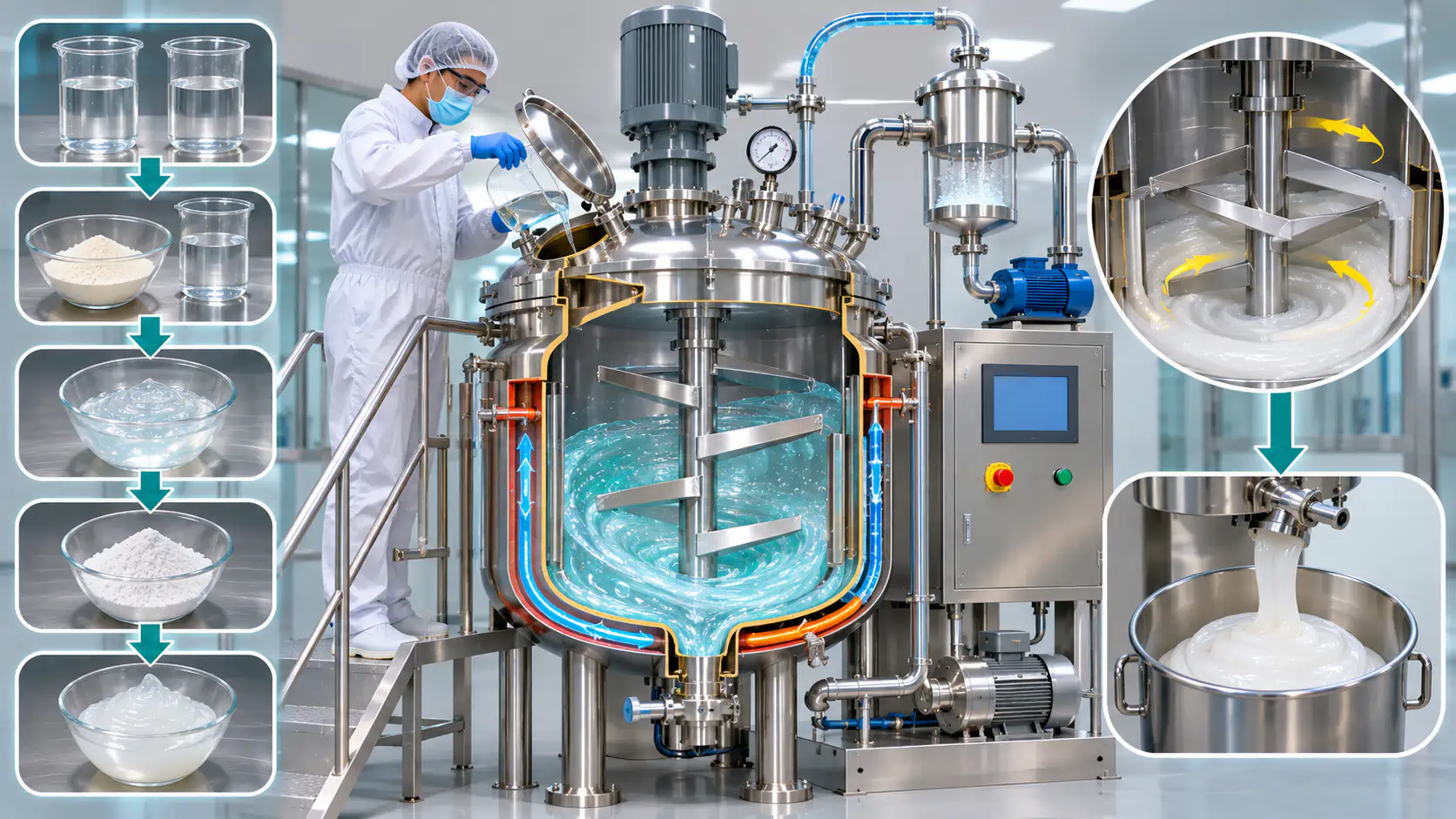
The sequence below follows the generic process. Example values from a patent or vendor vary by manufacturer and model, and the site Standard Operating Procedure (SOP) and the batch manufacturing record (BMR) govern the actual batch.
- The production Operator/ Technician charges the humectants (glycerine, sorbitol) into the qualified mixer. A qualified mixer is equipment that has completed installation, operational and performance qualification.
- The gum is pre-wetted in the humectant before water is added. our site describes the use of 0 to 33% sorbitol in the hydration medium, preferably under 20%.
- Water is added and the gum hydrates under mixing until a smooth gel without lumps is obtained.
- The abrasive is added, and the batch is mixed under vacuum. then the gel phase is mixed with the abrasive for about 10 to 30 minutes at 5 to 100 mmHg, and the surfactant is then added for 3 to 10 minutes.
- Flavour and colour are added, and the paste is deaerated and transferred to filling.
The BMR should record the charged quantities, the hydration time, the vacuum level and the mixing time actually used. Any departure from the batch record limits must be reported as a deviation to the Quality Assurance (QA) officer.
Operators must wear dust protection when they charge powdered gums and silica. The vacuum vessel lid interlock must not be bypassed.
Gum and paste residue dries into a hard film. The vessel should therefore be rinsed soon after the transfer, before the full cleaning is done, and the QA officer then verifies the cleaned equipment by visual inspection and by the rinse or swab checks that the site cleaning SOP requires.
Which in-process controls and limits apply?
In-process control (IPC) checks are done by the production officer or the in-process quality assurance (IPQA) officer on the floor, and the results are entered in the BMR. The usual checks are viscosity or consistency, pH and density (which shows the deaeration). A visual check of the paste for lumps and fish eyes is also done.
Limits come from the approved product specification. The vendor Charles Ross & Son reports a finished paste viscosity of 70,000 to 100,000 cP, and high-speed dispersers handle pastes up to about 50,000 cP during dispersion. These are vendor figures, and they depend on the product and the method. Because the paste is shear-thinning, the spindle and the speed must be stated together with every viscosity result.
What are the common problems and their fixes?
Lumps and fish eyes: the gum surface hydrates quickly and forms a gel skin around dry powder, so the paste becomes rough and dull instead of smooth and shiny. The options are pre-wetting the gum in the humectant, dispersing the polymer binder in water and the gum binder in humectant solution in separate tanks, or adding abrasive during hydration to raise the shear.
Hardening at the cap: the humectant level is too low, or the humectant is lost through a poor seal, so the paste dries.
Watery or separated paste: the binder level or hydration is insufficient, so the gel network does not hold the solids.
Air bubbles: deaeration is incomplete, and entrained air then remains in the tube.
Which regulatory points apply to toothpaste?
Dentifrices are covered by ISO 11609 (Dentistry, Dentifrices, Requirements, test methods and marking). According to the Estonian Centre for Standardisation and Accreditation, EVS-EN ISO 11609:2026 is valid from 17 August 2026 and replaces the 2017 edition.
In the United States, 21 CFR 355.10 lists fluoride dentifrice strengths of 850 to 1,150 ppm theoretical total fluorine for sodium fluoride, sodium monofluorophosphate and stannous fluoride.
Frequently Asked Questions
Yes, in principle. The granted European patent EP4106715 uses 0.1 to 5% swelling clay and 0.1 to 5% kaolin, with at most 5% humectant (preferably 2%), and the patent cites cost and rheology interference as the reasons for this approach. It is one applicant’s concept, and it is not a mainstream formula.
Vacuum removes the entrained air, so the paste becomes dense and smooth, and no bubbles are trapped in the tube. Air in the paste can also affect the flavour. The vacuum level and the mixing time depend on the equipment and the formula, and they must be set accordingly for each batch.
Mostly not. A tooth powder is a dry mix, whereas a paste needs a liquid humectant and binder phase to suspend the abrasive, so a powder has no need for the gel structure.
Sorbitol is normally used as a 70% aqueous solution in toothpaste. Patent US5030444 allows 20 to 75% final sorbitol in the paste, so the water content of the solution must be counted in the formula when the batch quantities are calculated.
References
- US5030444A Process for making toothpaste, Google Patents
- EP4106715A1 Humectant-free toothpaste composition, Google Patents / EPO
- US6447755B1 Process for making toothpaste using low levels of carrageenan, Google Patents
- Recommended mixing equipment for toothpaste, Charles Ross & Son
- EVS-EN ISO 11609:2026, Estonian Centre for Standardisation and Accreditation
- 21 CFR 355.10 Active ingredient, Cornell LII

Naresh Bhakar is the Founder and Author at Pharmaguddu.com, bringing his extensive expertise in the field of pharmaceuticals to readers worldwide. He has experience in Pharma manufacturing and has worked with top Pharmaceuticals. He has rich knowledge and provides valuable insights and data through his articles and content on Pharmaguddu.com. For further inquiries or collaborations, please don’t hesitate to reach out via email at [email protected].