
Quality Control Specialist | Industry Experience
✓ Reviewed by: Pankaj Sharma - Quality Control Specialist
Reviewed for Quality Control accuracy, laboratory practices, analytical methods, and technical relevance
📅 Last Updated: October 14, 2026
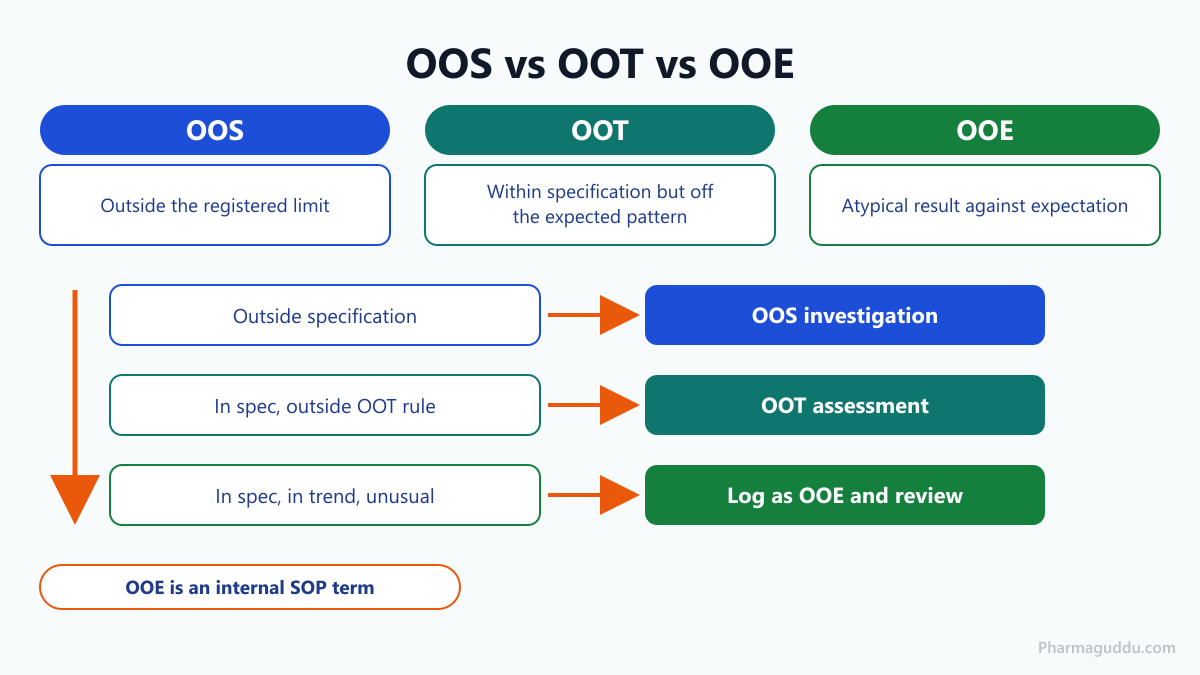
Out of Expectation (OOE) is a test result that passes specification but looks unusual against past data or scientific expectation. No regulator defines OOE, so each company sets its meaning in an SOP. OOS means outside the registered limit. OOT means within specification but off the expected pattern. OOE means an atypical result, such as an unknown HPLC peak that history cannot explain. Review it with a documented, risk-based check. Never retest quietly until the result looks normal.
What Is OOE in Pharma QC?
Think of a daily commute that always takes 30 minutes. One day it takes 55, and you can’t see why. You still reach work on time, but you’d want to know what happened. That’s the idea behind Out of Expectation (OOE) in a QC lab.
An OOE result passes its limits, yet it doesn’t look like the batches before it. It may be the first sign of a method, instrument or process problem. For the full overview, see OOT vs OOS in Pharma: Differences and Investigation. This article goes deep on OOE only.
What Is the Definition of Out of Expectation OOE Pharma?
In this article, OOE means a result that is inside specification but unusual against scientific, historical or statistical expectation. Specification means the tests plus their limits. Acceptance criteria are the numerical limits or conditions a result must meet.
OOE is an industry and internal SOP term. FDA and EU GMP do not define it. Some trade sources use OOE as an umbrella that also covers OOS and OOT. This article uses the narrower, in-specification meaning, because it keeps the three terms apart.
How Does an OOE Review Work?
An OOE review starts with a simple question: is this result wrong, or is it telling us something real? The lab first rules out its own mistakes. Then QC compares the result with history. Finally, QA decides whether it is a closed observation, a deviation, an OOT or an OOS.
A suggested decision order looks like this. It is a company choice, not a regulatory rule.
- Outside specification: start an OOS investigation.
- Inside specification but outside your OOT rule: do an OOT assessment.
- Inside specification, inside the OOT rule, but scientifically unusual: log it as OOE and review it.
OOT limits are also company-defined. No regulation gives a numeric OOT limit. Your SOP must say where OOT ends and OOE begins.
What Are the Main Parts of an OOE Procedure?
Trigger and logging:
Purpose: gets every unusual result recorded, not ignored.
Function: the SOP names who logs it (analyst or reviewer), how fast, and who decides on escalation.
Common Issues: analysts see the oddity but feel nobody wants to hear about a passing result.
Historical data table:
Purpose: shows what “normal” looks like.
Function: lists results from a defined window of earlier batches, plus validation and stability data. State the window length in the SOP.
Common Issues: the table is built after the question is asked, so the review is slow.
Phase I laboratory check:
Purpose: rules out lab error before anyone blames the product.
Function: covers analyst error, calculations, reference standard (primary, secondary or working) and sample preparation, instrument, system suitability, integration events and audit trail review.
Common Issues: skipping the audit trail because the result passed.
Risk assessment and report:
Purpose: decides the product impact and the follow-up.
Function: uses FMEA, fishbone or 5 Whys, then records findings, root cause (or “not identified”), impact and actions.
Common Issues: a vague conclusion such as “no impact” with no reasoning.
What Is the Step-by-Step OOE Review Process?
This is a suggested approach based on trade practice, not a regulator-prescribed procedure. Adapt it to your SOP.
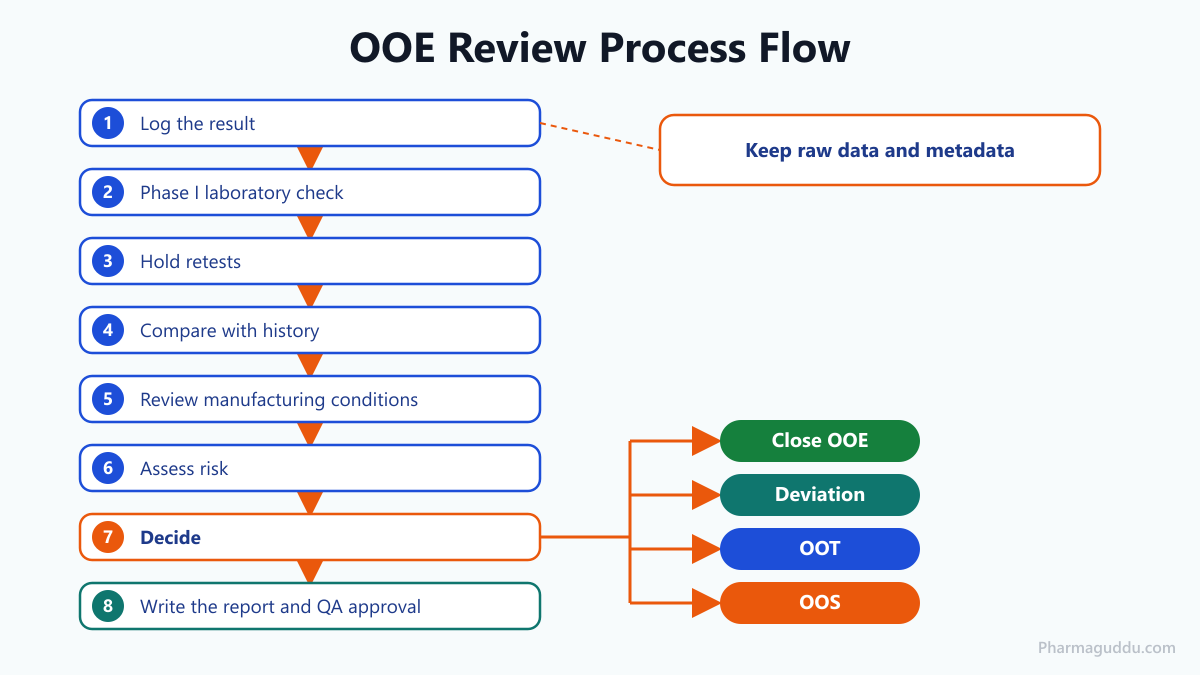
- Log the result. Record it under the SOP. Keep all raw data and metadata.
- Run the Phase I laboratory check listed above. Confirm that system suitability passed.
- Hold all retests and re-injections. Write a hypothesis first, then act only under a documented plan.
- Compare the result with the historical table, validation data and stability data.
- Review manufacturing conditions, materials, equipment and utilities.
- Assess risk with FMEA, fishbone or 5 Whys. Check trends for process drift.
- Decide: close the OOE, or raise a deviation, OOT or OOS.
- Write the report. QA reviews and approves it.
The report usually holds the result, the history, the analysis, the root cause, the impact, the actions and a reasoned conclusion. These fields are common practice, not a regulatory template.
What Does an OOE Look Like? A Worked Example
The two examples below are hypothetical. They show the thinking, not real data.
Assay example: the specification is 95.0–105.0%. Earlier batches ran 99.2–100.5%. A new batch gives 95.4%. It passes, but it sits far from the usual pattern.
Unknown peak example: a related-substances HPLC run shows one small peak at a retention time never seen in earlier batches. All results are within specification.
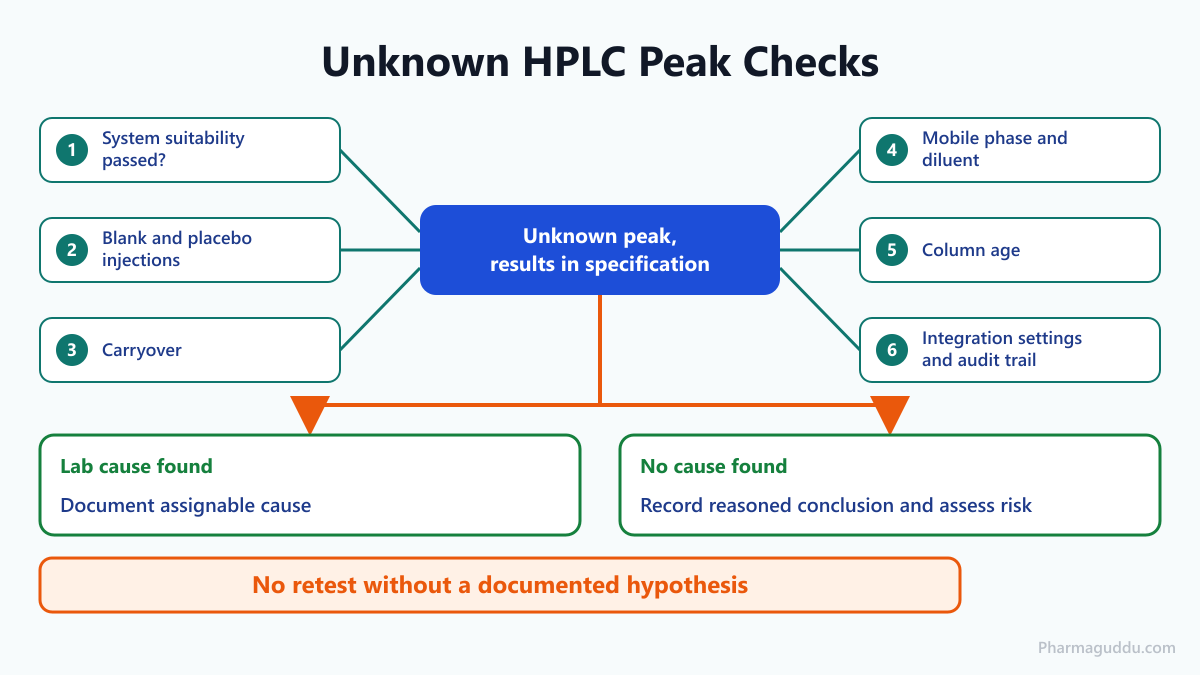
For the unknown peak, review it in this order:
- Check that system suitability passed for that run.
- In my experience, a “new” peak turned out to be carryover or diluent contamination more often than a real impurity, which is why the blank comes first. A peak in the blank is not a sample impurity.
- Check carryover, mobile phase, diluent and column age.
- Check whether integration settings changed. Review the audit trail.
- Compare the chromatogram with earlier batches and known degradants.
- If nothing explains the peak, record that conclusion and assess product risk.
Whether such a small peak is even visible or reportable depends on the method, the integration settings and your SOP. Don’t assume it must be reported.
Where Do You See OOE in a QC Lab?
OOE can appear in any test where history exists. Trade sources list these common cases:
- A new unknown impurity peak in HPLC.
- An unusual dissolution result that still passes.
- Water conductivity creeping toward historically high values.
- Environmental or HVAC readings that pass qualification limits but behave unlike history.
What Are the Benefits and Limits of OOE Reviews?
Benefits:
- Gives early warning of drift in a process, method, instrument or utility.
- Helps prevent later deviations, OOS results and complaints.
- Builds a habit of looking at data, not only at pass or fail.
Limitations:
- No regulatory definition, so inspectors judge your SOP by its logic.
- Too broad a definition floods the lab with reviews.
- Too narrow a definition hides real signals.
What Should an OOE SOP Define?
| Item | What to define | Note |
|---|---|---|
| Definition | In-spec but atypical result | Company choice |
| History window | Number of earlier batches used | State it in the SOP |
| OOT boundary | Where OOT ends and OOE begins | No regulatory numeric limit |
| Who logs it | Analyst or reviewer, and time frame | Confirm for your site |
| Escalation | Who decides on deviation, OOT or OOS | Usually QA |
| Closure | Who approves the report | Usually QA |
How Do OOE, OOT and OOS Compare?
| Point | OOS | OOT | OOE |
|---|---|---|---|
| Meaning | Outside the registered limit | Within specification but off the expected pattern | Atypical result against expectation |
| Compared with | Specification | Historical series over time | History and scientific expectation |
| Regulatory term | Yes (FDA OOS guidance) | Mentioned in EU GMP Chapter 6; limits are company-defined | No; internal SOP term |
| Effect on batch | Cannot be released until the investigation closes and the batch is dispositioned | Assessed before disposition | Does not block disposition unless the review finds a quality impact |
What Do the Regulations Say About OOE?
Nothing directly. FDA’s OOS guidance (Level 2 revision, May 2022) covers OOS results only. The EU GMP Chapter 6 revision (in operation 2014) expects results to be recorded so trends can be evaluated, and OOT or OOS data to be investigated.
In the US, 21 CFR 211.192 says any unexplained discrepancy “shall be thoroughly investigated”. An unexplained peak can reasonably be treated as one. For impurities, ICH Q3A(R2) and Q3B(R2) set thresholds for drug substances and products, so a peak near or above those thresholds is a controlled-impurity question, not just an OOE.
What Are Common OOE Problems and How Do You Fix Them?
Retesting until the result looks normal
Possible Causes: pressure to release the batch; no written rule on retesting.
Corrective Actions: write a hypothesis first. Allow a retest only under a documented plan with an assignable cause. An invalid result needs an assignable cause. A passing retest never erases the original result.
Data integrity gaps
Possible Causes: unofficial trial injections, deleted files, integration changed without a reason.
Corrective Actions: keep raw data and metadata. Review the audit trail and every integration change. Follow ALCOA+ principles; see ALCOA, ALCOA+ and ALCOA++ in Pharma.
No clear escalation
Possible Causes: the SOP stops at “review the result”.
Corrective Actions: state when the review becomes a deviation, OOT or OOS. Link it to change control and CAPA where the cause is a change or a systemic weakness.
CAPA for every OOE
Possible Causes: fear of audit questions.
Corrective Actions: raise CAPA only for a systemic weakness, such as repeated equipment failure, supplier variability, a training gap or a weak method. Otherwise record a reasoned “no root cause identified” conclusion.
What Are the Expert Tips for OOE?
- Define it in writing. One clear SOP sentence prevents arguments between QC and QA later.
- Check system suitability first. Don’t call an extra peak a real impurity until the run is proven valid.
- Keep the history table ready. A review without trend data is only a guess.
- Hold the retest. If you feel the urge to re-inject, write your hypothesis first.
- Read the audit trail. It often explains a strange peak in minutes.
- Use the same words everywhere. Keep OOS, OOT and OOE apart in logs and reports.
- Look at the pattern. Three small OOEs in one quarter tell a story one cannot.
- Know your audit file. The Audit Checklist for Quality Control Department shows what auditors ask about unusual results.
Frequently Asked Questions
No. Out-of-Trend (OOT) compares results with a historical series using company-defined limits. OOE can be a single unusual value that breaks no trend rule. Because OOT limits are also set by each company, your SOP must state clearly where OOT ends and OOE begins.
Not by itself. If the result is within specification and the review finds no quality impact, QA can disposition the batch and record the reason. If the investigation finds a real fault or a limit breach, the case becomes a deviation, OOT or OOS, and release waits for that outcome.
Only under a documented plan. First check system suitability and raw data, and write a hypothesis. Repeating injections to make the result go away is testing into compliance. An invalid result needs an assignable cause, and a passing retest does not erase the original result.
Only when the review shows a systemic weakness, such as repeated equipment failure, supplier variability, a training gap or a weak method. Many OOE reviews end with a reasoned “no root cause identified” conclusion and no CAPA. QA should record that reasoning in the report.
Teams commonly use FMEA, fishbone (Ishikawa) diagrams, 5 Whys and trend charts of earlier batches. Pick the tool that fits the question. A trend chart suits drift. A fishbone suits a mix of lab and process causes. Record the chosen tool and the reasoning in the report.
Summary
OOE sits between “fine” and “failed”. It’s a passing result that doesn’t look right, and no regulator defines it, so your SOP must. Check the lab first, compare with history, hold retests, protect the data and escalate when the facts say so. For the wider picture, read the Out of trend (OOT) results in Pharmaceutical Quality Control post.
References
- Out-of-Expectation (OOE) Results: Definition, Examples, and Investigation, GMP Insiders
- Investigating OOS Test Results for Pharmaceutical Production – Level 2 Revision, US FDA
- 21 CFR 211.192 – Production record review, Cornell Legal Information Institute
- EudraLex Volume 4, Chapter 6 Quality Control, European Commission
- EU Commission issues new EU GMP Guide Chapter 6, ECA / gmp-compliance.org
- ICH Q3A(R2) Impurities in New Drug Substances, ICH
- Shimadzu LabSolutions Detect release, Shimadzu

Pankaj Sharma — Quality Control Specialist
Pankaj Sharma is a pharmaceutical QC professional who reviews our technical content for GMP accuracy, laboratory practices, and regulatory relevance.