
Founder | Pharmaceutical Professional
✓ Reviewed by: Satpal Singh - QA & Regulatory Specialist
Reviewed for GMP compliance, quality systems, and regulatory accuracy
📅 Last Updated: June 1, 2026
Before starting to process validation, let us first understand validation and its types. Then we will cover the types of pharmaceutical process validation, along with flow charts and real floor experience.
Validation is the established document evidence, or proof that provides a high degree of assurance. A particular method can systematically produce a product that meets its predetermined specifications and quality attributes. Process validation is also a component of the validation, which is explained below.
The Importance of Validation in Pharmaceutical
Validation plays an essential role in pharmaceuticals as follows:
- In routine pharmaceutical manufacturing, product quality cannot be assured by finished product testing alone, because of limitations of sample representativeness, and the inability to test each unit produced. So, Validation helps us to ensure processes consistently deliver products meeting pre-determined quality standards.
- For Cost reduction: Due to the streamlined validation process, there’s a reduction in the number of sampling and testing procedures. This leads to fewer product rejections and retesting, resulting in cost savings.
Compliance: Validation is essential according to cGMP compliance.
Responsible Departments for Validation
- Site validation committee: To develop a site master plan with preparation, execution, and studies of the master plan.
- Manufacturing departments: For the preparation of a batch.
- Quality assurance: To approve the protocol, documentation procedure, report, and compliance.
- Quality control: For testing according to protocol and generating reports.
The Responsible Authority for validation execution
- Head of Quality Assurance
- Head of Quality Control
- Head of Production
- Head of Validation
Types of Pharmaceutical Validations
Different types of validations in pharmaceuticals are:
- Process validation
- Equipment validation
- Facilities validation
- HVAC system validation
- Cleaning validation
- Analytical method validation
- Computer system validation
What is Process Validation?
Process validation is the analysis of data collected throughout the design and manufacturing of products to ensure the process is consistently produced as per the given standard.
Process Validation is a demand of current (GMPs) for finished pharma products as per CFR (21CFR 211), and GMP rules for medical devices as per CFR (21 CFR 820), and so it applies to the manufacturers of each drug product and medical device.
The aim of validating the process is to make sure we get high-quality products that remain consistent. Regulatory authorities like EMA and FDA have published guidelines that link to process validation.
According to the Food and Drug Administration, product quality assurance comes from careful and general attention to various factors. This includes picking good-quality materials, having a well-designed process and method, and keeping an eye on the process through tests during and at the end.
FDA Guidelines describe the Process Validation into three stages:
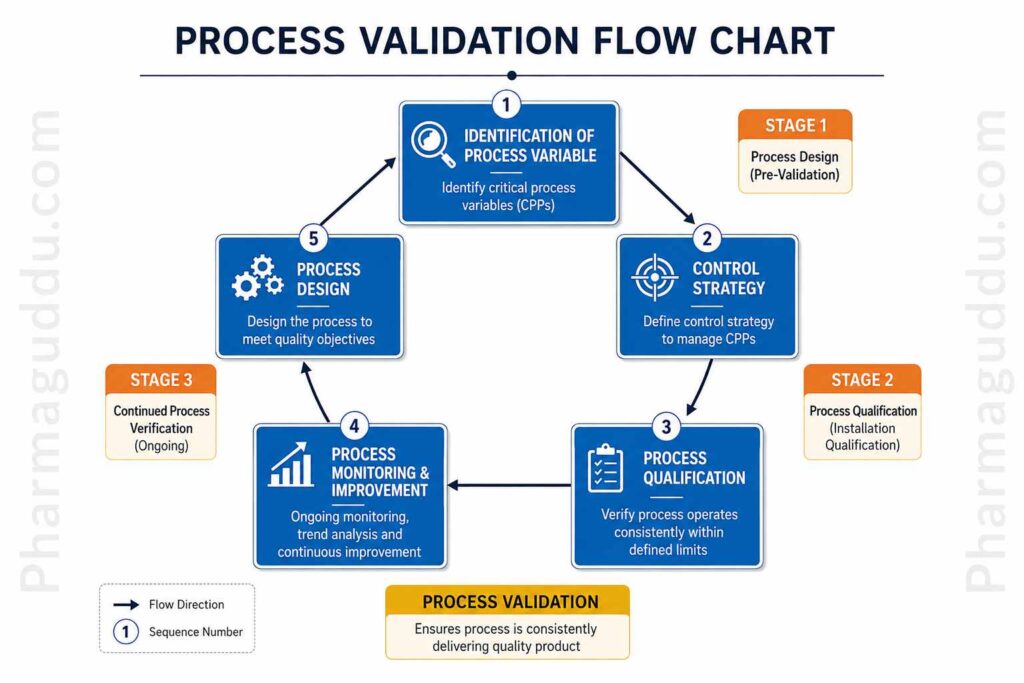
Process Design: Process design is the collection of data from the development stage to analyze the commercial manufacturing process. The collected information is used to analyze the established benchmark for quality and production control.
Process Qualification: Process Qualification is designed to find a result of the process that can determine the capability to reproduce commercial manufacturing output. During this process, all critical quality parameters are taken into account to ensure product quality.
Continued Process Verification: It is an ongoing monitoring process that ensures all production stages are under control.
Types of Process Validation?
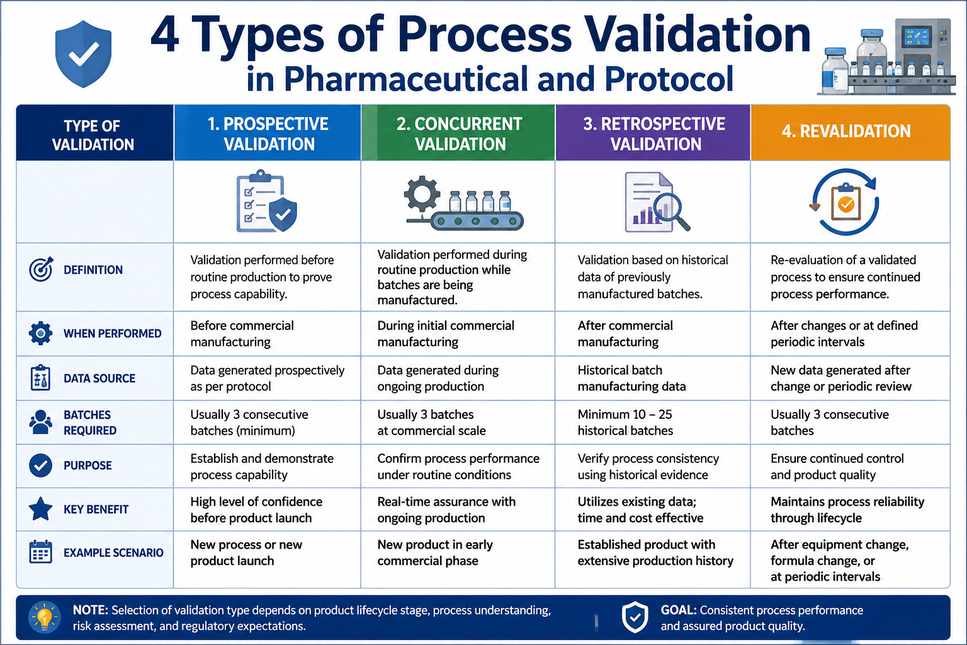
Types of Process Validation depend on when validation is performed relative to production; validation can be classified into four types:
- Prospective validation
- concurrent validation
- Retrospective validation
- Revalidation
1. Prospective validation: (Premarket Validation)
Prospective validation is carried out during the development stage (Also called premarket validation). The results of prospective validation help in identifying the risk factors in the production process. This process is broken down into various steps to analyze crucial points during product manufacturing, like mixing time, relative humidity (RH), and temperature.
Process validation is carried out for the manufacturing process when;
- Introduction of New Products in the manufacturing facility.
- If there is a significant change in the manufacturing process and the impact of the changes, e.g., leak test failed due to sealing problems in blister.
- The validation will include at least the first three consecutive production scale batches after the process stabilizes.
Criteria for Prospective Validation?
- Three prospective validation batches should have the same parameters.
- Process parameters shall be identical for these three batches.
- The first batch shall be dispatched after the completion of the third batch of manufacturing, testing, and review of results.
If there are any needed changes in the manufacturing process after the first batch, then follow these criteria:
- Take three batches with revised parameters and do not consider the first batch for this validation.
- Consider the 2nd, 3rd, and 4th batches as prospective validation batches, which have identical parameters.
- A change shall be made through the proper change control system.
- The first validation batch shall be released for sale and distribution after manufacturing, testing, and review of all three batches.
- The results of all three batches shall be within acceptable limits.
2. Concurrent Validation:
Concurrent validation is carried out during the regular production stage. It is based on a complete studying the process through prospective validation.
The first three production scale batches must be monitored as carefully as possible.
Concurrent validation is carried out when:
- A new product has been prospectively validated in a manufacturing facility.
- There is no change in the manufacturing process, and the impact of change in the manufacturing process is not significant.
- If there is a change in the supplier of raw materials in the existing production formula.
Examples of in-process testing are:
- pH Value
- Tablet Hardness
- Weight Variation
- Dissolution Time
- Content Uniformity
- Viscosity or Density
- Color uniformity
- Particle Size Distribution
- Average Unit Potency
FDA Position On Concurrent Validation:
FDA rejected Concurrent validation because pharmaceutical organizations do not provide sufficient data to show where the variability in the mixing process comes from and how it is controlled., Therefore use of concurrent validation is inappropriate, and FDA goes on to state that concurrent validation should only be used rarely.
Source: GMP compliance org
3. Retrospective validation:
Retrospective Validation is based on historical and testing data of previously manufactured batches. It includes the analysis of trends compiled and checks whether the process is within the allowed range of process parameters. This can be done using computer-based data or manual methods.
Retrospective Validation is carried out when:
- Collect data from previously completed batches.
- Organize all data sequence-wise, i.e., batch manufacturing and expiry date.
- Use 10 to 25 batches or more for this purpose, preferably processed within 12 months and reviewed collectively.
- A Batch rejected during routine quality control is not included in this review.
4. Revalidation:
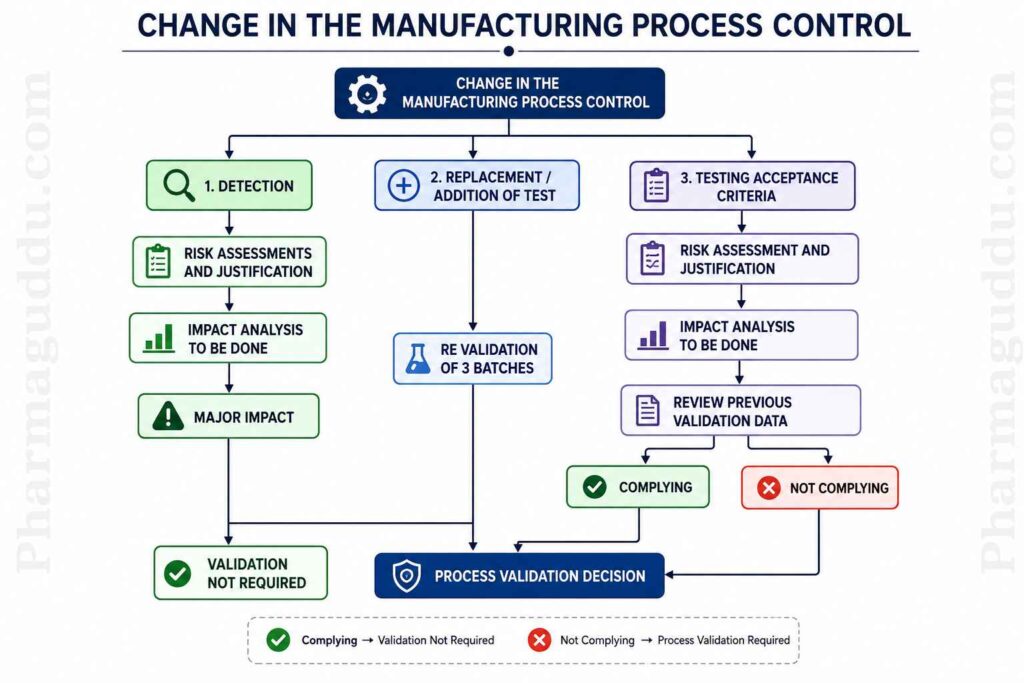
Revalidation is required to make sure that any changes made in the process environment, whether done intentionally or unintentionally, do not adversely affect the process characteristics and product quality.
Revalidation is needed when:
- After any change having a bearing on product quality.
- Periodical Revalidation.
- Change in Batch size.
- Change in facility and plant.
VALIDATION V/S QUALIFICATION
Validation is Related to the Process.
Qualification related to system/Equipment.
Eg, For validation of the sterilization process, the autoclave must be qualified.
Validation Master Plan (VMP):
The validation master plan must be summarized before describing the whole thing in projects. These are the following points to be included in a protocol that is followed by all pharmaceutical industries.
- Introduction
- Methodology
- Qualifications (IQ, OQ, PQ)
- Personnel
- Schedules
- Preventive maintenance
- Change control
- Procedure
- Documentation
- Appendix
VMP should state who is responsible for the validation:
- Preparation of VMP
- The protocol and SOPs
- Validation work
- Report, documentation, and its control
- Approval and authorization of validation protocol
- Report on all stages of the validation process
- Tracking system
- The need for training in support of validation
Validation master plan, the following are the points to be considered during the preparation of the validation protocol:
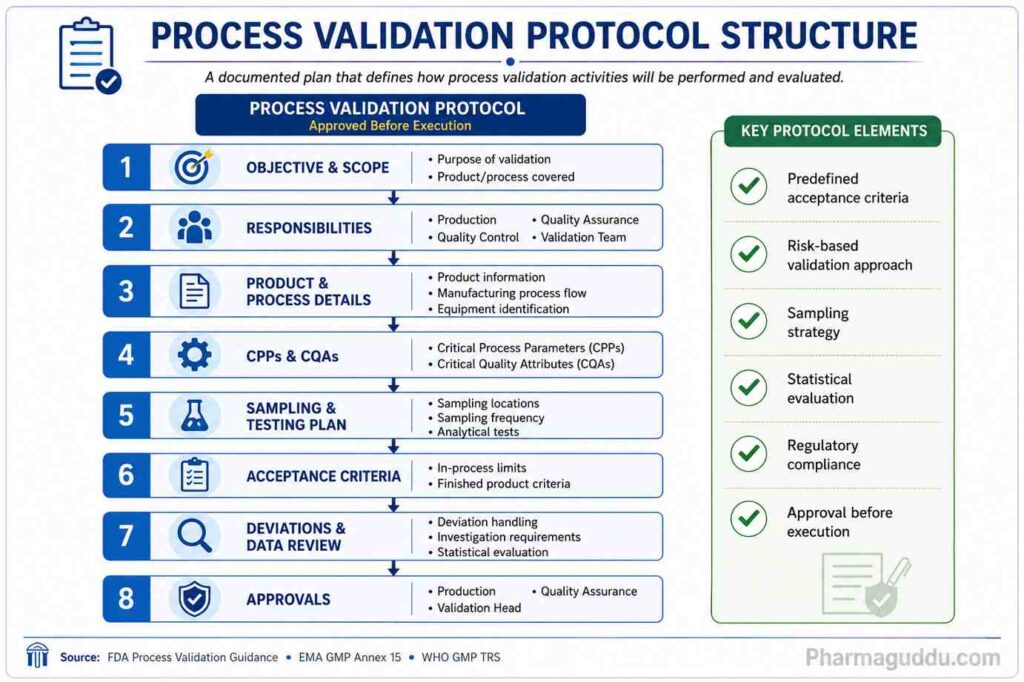
Process Validation Protocol:
The following are the contents required for the validation protocol:
- Objective and Scope
- Responsibilities
- Product and process details
- CPPs and CQAs
- Sampling, tests, and specifications
- Acceptance criteria
- Deviation and data review
- Approvals
Process Validation Protocol Structure
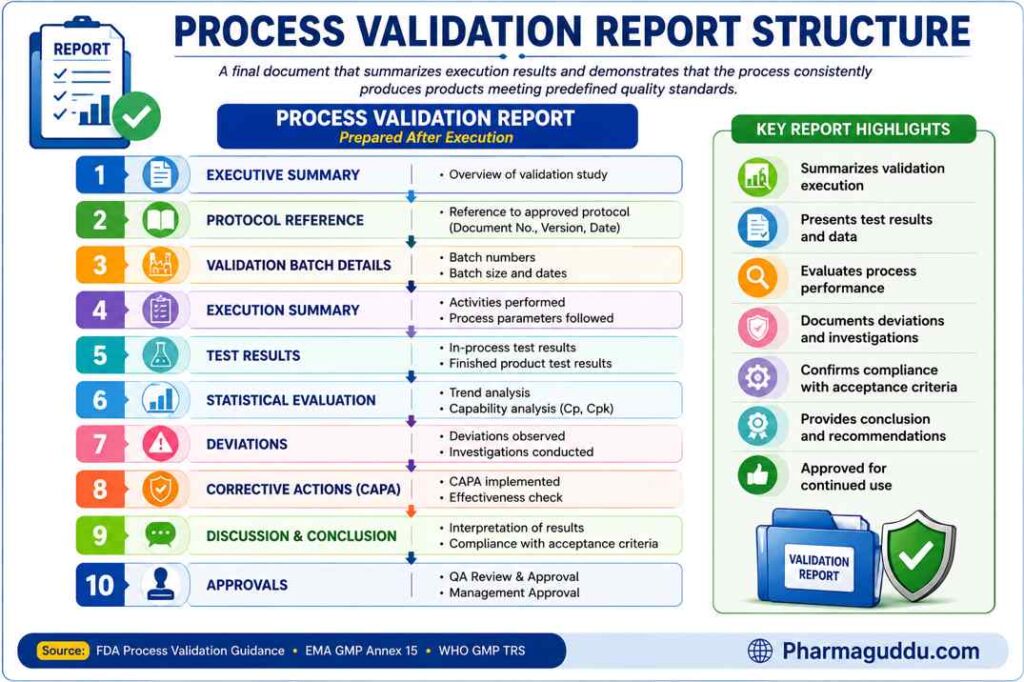
Process Validation Report Structure
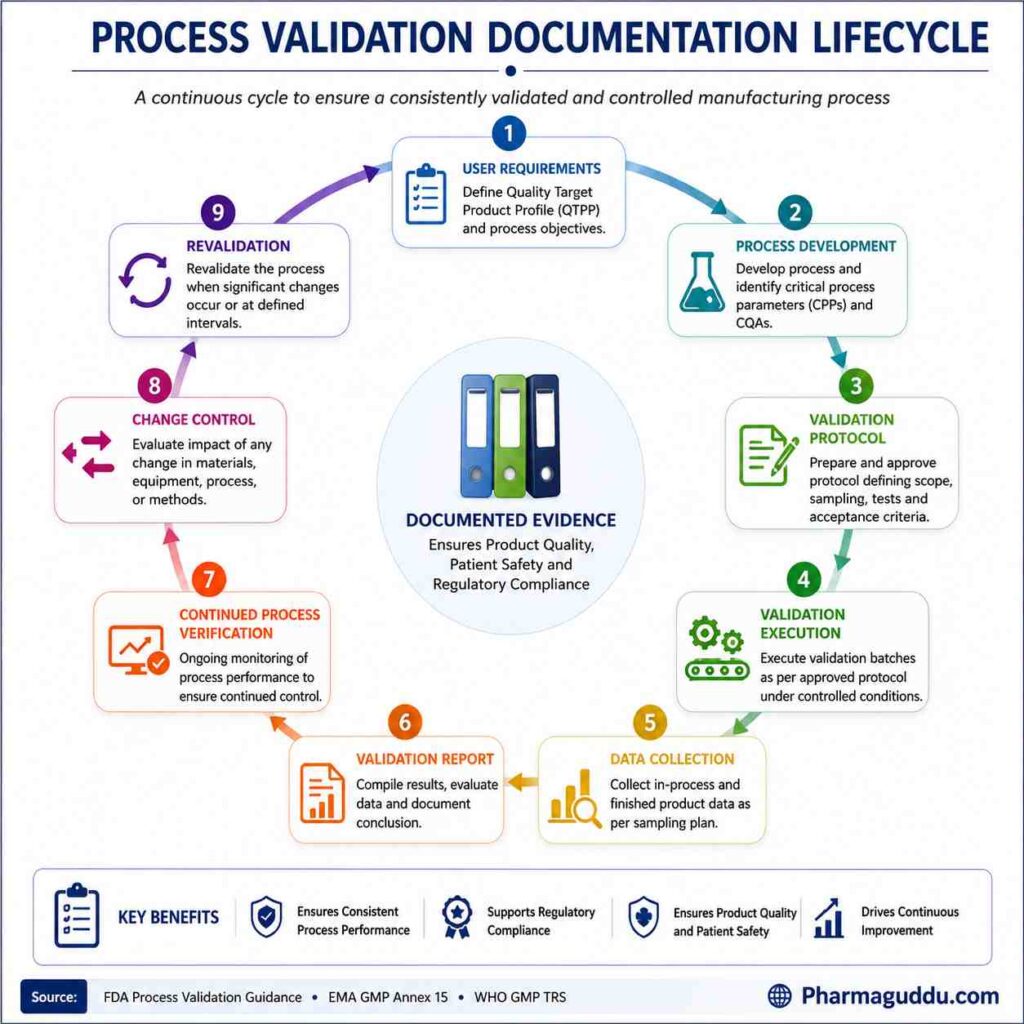
Process Validation Documentation Lifecycle
This article covers the following questions asked by interviewers:
- Types of validation in pharmaceuticals?
- What is process validation and its types in pharmaceuticals?
- Why is process validation required?
- Validation of master protocol contents in pharmaceuticals
- How do we validate the process?
References:
Current FDA guidelines on Process validation
Related Topics:
- Responsibilities of the Validation Team to Meet the cGMP Compliance
- Cleaning Validation Protocol for Pharmaceutical Equipment
- Fundamentals of Validation SOP
- Facility Upgrade Master Validation Plan
- Protocol on Hold Time Study of Machine Parts
- Difference between Validation, Calibration, and Qualification in Pharma
- Water System Validation and Phases
FAQs on Process validation:
Answer: 1.Prospective validation
2. concurrent validation
3. Retrospective validation
4. Revalidation
All four must follow an approved protocol and comply with FDA 21 CFR Part 211 and EU GMP Annex 15.
Answer: Prospective validation is performed before a product is commercially released.
Answer: It provides documented evidence that the process will consistently produce a product meeting its specifications. It is required for all new products, new manufacturing processes, or new equipment introductions.
Answer: As per FDA’s 2011 guidance, A minimum of three consecutive batches is the widely accepted standard. All batches must meet pre-defined acceptance criteria before commercial production begins.
Answer: Yes, FDA and EMA allow it when prospective validation is not feasible — for example, a product with limited self life. It requires a pre-approved protocol, enhanced in-process monitoring, and proper QA observation thoughout the production.
Answer: Product from concurrent validation batches may be released before full validation is complete, but only with documented QA justification. It should not be used routinely as a substitute for prospective validation.
Answer: Retrospective validation requires a review of 10 to 25 historical commercial batches. Data must include finished product test results, in-process results, batch processing records, deviation histories, OOS investigations, and equipment performance records.
Answer: Under current FDA and EMA expectations, retrospective validation is largely discouraged for new products and should only be used for well-established legacy processes.
Answer: Revalidation is done if we have any change that may affect product quality or process performance. Common triggers include:
1. Changes to raw material supplier, grade, or specification
2. Equipment replacement or major repairs
3. Changes to batch size, formulation, or manufacturing process steps
4. Facility changes or site transfers
5. Repeated batch failures or OOS trends identified in annual product reviews
Answer: FDA’s 2011 process validation guidance does not mandate a fixed number of batches. As we know, currently, three-consecutive-batch standard remains widely accepted. They may be more than 3 if any product has complex stages.
Answer: Common FDA 483 observations for process validation include:
1. Lack of revalidation following equipment or process changes
2. Insufficient justification for the number of validation batches
3. Failure to establish or monitor CPPs during commercial production
4. Missing or inadequate continued process verification data
5. Acceptance criteria not defined before batch execution
6. Inadequate investigation of OOS results during validation batches
7. Cleaning validation not linked to process validation activities
Answer: EU GMP Annex 15, revised in 2015, requires a Validation Master Plan covering all validation activities. It defines prospective, concurrent, and ongoing process verification. Key requirements include:
1. Minimum three batches for prospective validation with documented justification
2. Process Performance Qualification (PPQ) before commercial release
3. Ongoing process verification using statistical monitoring
4. Change control linkage to revalidation
5. Cleaning validation using HBEL-based limits
Answer: QA is responsible for reviewing and approving all validation protocols and reports. During execution, QA person monitors compliance with the approved protocol, he is responsible for investigating any deviations, and confirms that acceptance criteria are met before final report made. No commercial batch may be released from a validated process until QA has formally approved the validation report. QA also links validation status to change control and annual product reviews.
Answer: Any deviation during a validation batch must be documented immediately as per deviation SOP. QA department access the deviation types (minor, major and critical) and its impact on product quality. If the product comes under critical deviation, validation should be on hold for root cause analysis.
Answer: A site transfer requires revalidation at the receiving site. A technology transfer protocol must compare equipment, utilities, process parameters, and environmental conditions between sites. A risk assessment determines the scope of revalidation needed. Regulatory filings, such as a Prior Approval Supplement (FDA) or Type II variation (EMA), may be required depending on product registration status.
Answer: 1. Cpk and Ppk — assess process capability; a Cpk ≥1.33 is generally expected
2. Control charts (X-bar, R) — monitor process stability over validation batches
3. ANOVA — assess variance between batches or process runs
4. Regression analysis — evaluate relationships between CPPs and CQAs
5. Tolerance intervals — confirm results fall within acceptable limits
Answer: PPQ is the corresponds to Stage 2 of FDA’s three-stage validation lifecycle. PPQ combines equipment qualification (IQ, OQ, PQ) with validation batch execution under enhanced sampling and monitoring. It is the equivalent of prospective validation. it is must to required before any commercial batch is released. Following PPQ, Stage 3 continued process verification monitors ongoing performance.
Answer: The APQR evaluates batch data, OOS trends, deviations, and validation status for each product annually.FDA 21 CFR 211.180(e) and EU GMP Chapter 1 both require APQRs as part of the pharmaceutical quality system.

Naresh Bhakar is the Founder and Author at Pharmaguddu.com, bringing his extensive expertise in the field of pharmaceuticals to readers worldwide. He has experience in Pharma manufacturing and has worked with top Pharmaceuticals. He has rich knowledge and provides valuable insights and data through his articles and content on Pharmaguddu.com. For further inquiries or collaborations, please don’t hesitate to reach out via email at [email protected].
Is there any frequency for periodical revalidation in guide lines?
No, there are no such Guidelines for this.but you have to add it (time Frame) in periodic revalidation in protocol with proper justification.