
GMP & Pharmaceutical Manufacturing Expert
✓ Reviewed by: Pankaj Sharma - Quality Control Specialist
Reviewed for QC, QA accuracy, laboratory practices, analytical methods, and technical Documents
📅 Last Updated: November 13, 2026
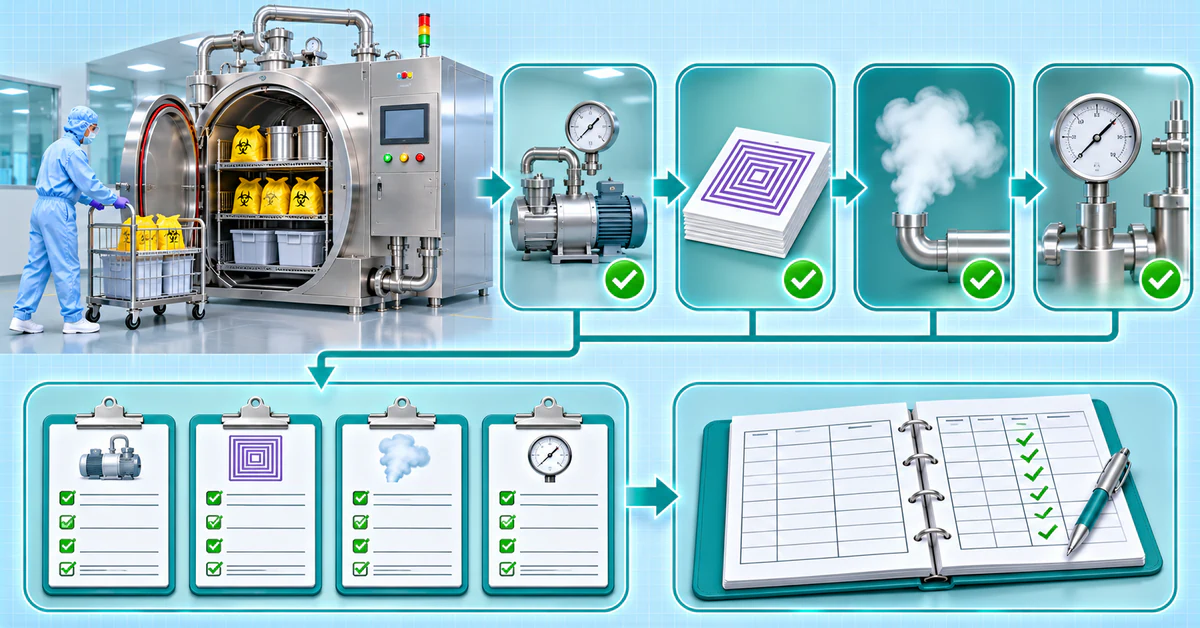
The annexure for decontamination autoclave is the set of forms attached to the Standard Operating Procedure (SOP). It has a standard parameters sheet for each cycle (vacuum leak test, Bowie & Dick, standard and HPHV). It also has a cycle log book, which records the date, cycle, load pattern, hold times and signatures.
1.0 Objective of the Annexure for Decontamination Autoclave
This SOP is a procedure that defines the annexure for decontamination autoclave, which means the parameter sheets and the log book used with the decontamination autoclave SOP.
This SOP has two annexures: Annexure-I sets the standard parameters for each cycle, and Annexure-II is the log book. The procedure for running the cycle is given in the SOP on operation and cleaning of the decontamination autoclave.
2.0 Scope
This SOP applies to the decontamination autoclave in the production area and to its parameter sheets and log book.
3.0 Responsibility
Each department has a defined part in running, checking, validating and maintaining the decontamination autoclave, as shown in the table below.
| Role | Responsibility |
|---|---|
| Production operator | Runs the cycle and fills the log book |
| Supervisor | Checks the log book entries |
| QA | Approves changes to the annexure, reviews the records and handles deviations |
| Microbiology | Validates the cycles and reads the biological indicators |
| Engineering | Carries out preventive maintenance and calibration, and releases the unit back to Production |
4.0 Accountability
The Head of Production is accountable for the implementation of this SOP and for the training of the operators. The Head of QA is accountable for its compliance.
READ ALSO
Difference Between Validation, Calibration, and Qualification in Pharma
There is often confusion surrounding the terms validation, calibration, and qualification within the pharmaceutical industry.
5.0 Procedure
The procedure lists the annexures, the checks before operation, the cycle parameters, the load patterns, validation, records, failure handling, maintenance and segregation, and it must be followed together with the operating SOP of the decontamination autoclave.
5.1 Annexures attached to the SOP
5.1.1 Annexure-I shall hold the standard parameters of each cycle in the example plant’s SOP, and Annexure-II shall be the log book.
5.1.2 The images of both annexures are given in section 9.0.
5.2 Pre-operation checks
5.2.1 The operator must check the minimum utility pressures before operation: plant steam 1.5 kg/cm2, pure steam 1.5 kg/cm2, compressed air 6.0 kg/cm2 and soft water 1.2 kg/cm2 (the example plant’s values).
5.2.2 The operator shall switch on the strip chart recorder before the cycle starts.
5.2.3 The set parameters of the selected cycle must be compared with Annexure-I before the cycle is started. The cycles are described in the SOP on operation and cleaning of the decontamination autoclave.
5.3 Standard parameters for each cycle
The tables below show the settings of one example plant (vaccine formulation plant, procedure PRXX Rev 02), and another plant sets its own values through validation. They are not industry limits.
Vacuum leak test
| Parameter | Set value |
|---|---|
| Pre-vacuum | -0.700 bar |
| Delay before hold | 3 min |
| Vacuum hold time | 10 min |
| Acceptable leakage | 0.013 bar |
| Process end pressure | -0.060 bar |
Bowie & Dick test
The Bowie Dick test for autoclave validation checks steam penetration. This cycle runs with these settings.
| Parameter | Set value |
|---|---|
| Pre-vacuum | -0.600 bar |
| Pre-pressure | 0.600 bar |
| Pre-pulses | 3 |
| Heat-up 1, 2, 3 | 110.0, 115.0, 119.0 C |
| Heat-up holds 1, 2, 3 | 5, 4, 3 min |
| Heat-up band | 0.5 C |
| Small valve set point | 120.0 C |
Standard cycle (no pre-vacuum, no pulses)
| Parameter | Set value |
|---|---|
| Heat-up 1, 2, 3 | 110.0, 115.0, 119.0 C |
| Heat-up holds 1, 2, 3 | 7, 5, 3 min |
| Sterilisation hold | 121.4 C for 30 min |
| Temperature control band | 0.2 C |
| Overshoot temperature | 124.0 C |
| Stop temperature / reset temperature | 120.0 C / 119.0 C |
| Exhaust on / off | 5 s / 55 s |
| Process end pressure / temperature | 0.050 bar / 105.0 C |
| Chamber pressure high alarm | 1.500 bar |
The sheet also carries a variant with heat-up holds of 7, 12 and 15 min. A second standard variant has a 600 s hold, exhaust of 7 s on and 55 s off, and an end pressure of 0.015 bar at 100.0 C.
High pressure high vacuum (HPHV) cycle
| Parameter | Set value |
|---|---|
| Pre-vacuum / pre-pressure | -0.500 bar / 0.500 bar |
| Pre-pulses | 3 |
| Heat-up 1, 2, 3 | 100.0, 110.0, 119.0 C |
| Sterilisation hold | 121.4 C for 30 min |
| Post-vacuum | -0.500 bar, held for 20 min |
| Post-pulses | 1 |
| Process end pressure / temperature | -0.068 bar / 100 C |
| Chamber pressure high alarm | 1.500 bar |
5.4 Load patterns
5.4.1 A load pattern is a defined way of arranging a given material in the chamber, and each pattern is validated so that steam reaches every item. EU GMP Annex 15 is the basis for qualification and validation, as described in the post on autoclave qualification tests.
5.4.2 Glassware must be loaded as bottles filled with water for injection (WFI) and then 1 N sodium hydroxide (NaOH) solution, together with silicone tubing and siphon assemblies, and the bottle caps must be fitted loose.
5.4.3 Rejected vials and syringes must be loaded in biohazard bags as per load pattern 02 of the example plant, and the bag openings must be left open.
5.4.4 Garments contaminated by active material must be loaded in biohazard bags, and expired active raw material must be loaded only after the treatment prescribed by QA. The load types are also covered in the SOP on decontamination of used material contacted with API.
5.4.5 Filling accessories are soaked in 1 N NaOH for 40 to 45 min and washed before they are decontaminated at a product change. The final rinse goes to Quality Control (QC) and is released before reuse.
5.4.6 The operator shall write the load pattern in the log book for every cycle.
5.5 Validation and indicators
5.5.1 Microbiology shall place a Geobacillus stearothermophilus spore biological indicator (BI) in the centre of the load and incubate it for about 24 h at 55 to 65 C, depending on the maker’s instructions. Chemical indicators are used alongside it.
5.5.2 The MIT EHS autoclave programme gives 121 C for 30 min or longer as a common minimum for biological waste, depending on the size of the load. The plant’s validated hold governs, and the frequency of the BI test is set by risk (MIT runs it quarterly). Probe placement is discussed in the post on autoclave validation with temperature probes.
5.6 Log book and records
5.6.1 The log book (Annexure-II) shall have these columns: date, cycle, load pattern, material loaded, sterilisation hold start time, sterilisation hold end time, done by, checked by and remarks.
5.6.2 The operator signs in the “done by” column and the supervisor signs in the “checked by” column, and QA reviews the log book.
5.6.3 The printed temperature and pressure record of each cycle must be attached to the log book. Entries must follow Attributable, Legible, Contemporaneous, Original and Accurate (ALCOA)+ (attributable, legible, contemporaneous, original, accurate, and complete, consistent, enduring and available).
5.6.4 Electronic controller records need an audit trail, user access control and electronic signatures. EU GMP Annex 11 applies to the controller’s audit trail and access control, and 21 CFR Part 11 covers the e-signatures. Alarm acknowledgements must be recorded.
5.7 Failure handling
5.7.1 When an alarm such as chamber pressure high (1.500 bar in the example plant) occurs, the cycle stops and the load must be treated as not decontaminated.
5.7.2 The operator shall inform QA, and a deviation must be raised. The cause (steam supply, leak or loading) is then investigated, and the cycle is repeated after the correction. The same steps apply when a BI is positive or the cycle does not reach 121˚C. This is plant practice and not a regulatory limit.
5.8 Maintenance and calibration
5.8.1 Engineering shall carry out preventive maintenance and sensor calibration as per the SOP on operation and calibration of autoclave.
5.8.2 QA must approve any change through change control.
5.9 Segregation and GMP context
5.9.1 A decontamination autoclave is not a product-sterilising unit, so its loads must be kept separate from sterile loads.
6.0 Precautions
The precautions protect the operator from hot surfaces, hot contents and broken glass during loading, door opening and unloading.
6.0.1 The operator must wear goggles and gloves, and must keep a distance while opening the door because the surfaces and contents are hot.
6.0.2 Glass accessories must be handled with care.
7.0 Abbreviations
The abbreviations used in this SOP are listed below with their full forms.
| Abbreviation | Full form |
|---|---|
| ALCOA+ | Attributable, legible, contemporaneous, original, accurate, plus complete, consistent, enduring and available |
| BI | Biological indicator |
| GMP | Good manufacturing practice |
| HPHV | High pressure high vacuum |
| NaOH | Sodium hydroxide |
| QA | Quality assurance |
| QC | Quality control |
| SOP | Standard operating procedure |
| WFI | Water for injection |
8.0 Annexures
The annexures are the standard parameter sheets of the example plant (Annexure-I) and the log book format (Annexure-II), and both are filled in for every cycle.
Annexure-I: Standard parameters (Form PRX/0XX/A)
The images below show the standard parameter sheets of the example plant, which are filled in with the set parameters of each cycle.
| Equipment: Decontamination Autoclave Process: Vacuum leak test |
Set parameters
| 1 | Pre Vacuum | -0.700 |
| 2 | Delay before hold | 3 Min |
| 3 | Vacuum hold time | 10 min |
| 4 | Acceptable leakage | 0.013 bar |
| 5 | Process end pressure | -0.060 Bar |
| Equipment: Decontamination Autoclave Process: Bowie Dick Test |
| Set Parameter | ||
| 1 | Pre-vacuum | -0.600 Bar |
| 2 | Pre pressure | 0.600 Bar. |
| 3 | Number of pre pulses | 3 Nos |
| 4 | Heat up-1 | 110.0 ˚C |
| 5 | Heat up-2 | 115.0˚C |
| 6 | Heat up-3 | 119.0˚C |
| 7 | Heat up hold-1 | 5 Min |
| 8 | Heat up hold-2 | 4 Min |
| 9 | Heat up hold-3 | 3 Min |
| 10 | Heat up band | 0.5˚C |
| 11 | Small valve SP | 120.0˚C |
| 12 | Ster. Hold temperature | 121.4˚C |
| 13 | Ster hold time | 600 sec |
| 14 | Temperature control band | 0.2˚C |
| 15 | Overshoot temperature | 124.0˚C |
| 16 | Ster. Stop temperature | 120.0˚C |
| 17 | Ster. Reset temperature | 119.0˚C |
| 18 | Exhaust “ON” time | 7 Sec |
| 19 | Exhaust “OFF” time | 55 Sec |
| 20 | Process end pressure | 0.015 Bar |
| 21 | Process end temp. | 100.0˚C |
| 22 | Chamber pressure high | 1.500 Bar |
| Equipment: Decontamination Autoclave Process: HPHV Test |
| Set parameters | ||
| 1 | Pre-vacuum | -0.500 Bar |
| 2 | Pre pressure | 0.500 Bar. |
| 3 | Number of pre pulses | 3 Nos |
| 4 | Heat up-1 | 100.0 ˚C |
| 5 | Heat up-2 | 110.0˚C |
| 6 | Heat up-3 | 119.0˚C |
| 7 | Heat up hold-1 | 5 Min |
| 8 | Heat up hold-2 | 4 Min |
| 9 | Heat up hold-3 | 3 Min |
| 10 | Heat up band | 0.5 ˚C |
| 11 | Small valve SP | 120.0˚C |
| 12 | Ster. Hold temperature | 121.4˚C |
| 13 | Ster hold time | 30 Min |
| 14 | Temperature control band | 0.2˚C |
| 15 | Overshoot temperature | 124.0˚C |
| 16 | Ster. Stop temperature | 120.0˚C |
| 17 | Ster. Reset temperature | 119.5˚C |
| 18 | Post Vacuum start pressure | 0.500 Bar |
| 19 | Post Vacuum | -0.500 Bar |
| 20 | Post vacuum hold time | 20 Min |
| 21 | Post pressure | -0.100 Bar |
| 22 | Number of post pulses | 1 Nos |
| 23 | Exhaust “ON” time | 7 Sec |
| 24 | Exhaust “OFF” time | 55 Sec |
| 25 | Process end pressure | -0.068 Bar |
| 26 | Process end temp. | 100˚C |
| 27 | Chamber pressure high | 1.500 Bar |
| Equipment: Decontamination Autoclave Process: Standard Process |
| Set Parameter | ||
| 1 | Pre-vacuum | 0.000Bar |
| 2 | Pre pressure | 0.000 Bar. |
| 3 | Number of pre pulses | 0 Nos |
| 4 | Heat up-1 | 110.0 ˚C |
| 5 | Heat up-2 | 115.0˚C |
| 6 | Heat up-3 | 119.0˚C |
| 7 | Heat up hold-1 | 7 Min |
| 8 | Heat up hold-2 | 12 Min |
| 9 | Heat up hold-3 | 15 Min |
| 10 | Small valve SP | 120.0˚C |
| 11 | Heat up band | 0.5˚C |
| 12 | Ster. Hold temperature | 121.4˚C |
| 13 | Ster hold time | 30 Min |
| 14 | Temperature control band | 0.2˚C |
| 15 | Overshoot temperature | 124.0˚C |
| 16 | Ster. Stop temperature | 120.0˚C |
| 17 | Ster. Reset temperature | 119.0˚C |
| 18 | Exhaust “ON” time | 5 Sec |
| 19 | Exhaust “OFF” time | 55 Sec |
| 20 | Process end pressure | 0.050 Bar |
| 21 | Process end temp. | 105.0˚C |
| 22 | Chamber pressure high | 1.500 Bar |
| Equipment: Decontamination Autoclave Process: Standard Process |
| Set Parameter | ||
| 1 | Pre-vacuum | 0.000 Bar |
| 2 | Pre pressure | 0.000 Bar. |
| 3 | Number of pre pulses | 0 Nos |
| 4 | Heat up-1 | 110.0 ˚C |
| 5 | Heat up-2 | 115.0˚C |
| 6 | Heat up-3 | 119.0˚C |
| 7 | Heat up hold-1 | 7 Min |
| 8 | Heat up hold-2 | 5 Min |
| 9 | Heat up hold-3 | 3 Min |
| 10 | Small valve SP | 120.0˚C |
| 11 | Heat up band | 0.5˚C |
| 12 | Ster. Hold temperature | 121.4˚C |
| 13 | Ster hold time | 30 Min |
| 14 | Temperature control band | 0.2˚C |
| 15 | Overshoot temperature | 124.0˚C |
| 16 | Ster. Stop temperature | 120.0˚C |
| 17 | Ster. Reset temperature | 119.0˚C |
| 18 | Exhaust “ON” time | 5 Sec |
| 19 | Exhaust “OFF” time | 55 Sec |
| 20 | Process end pressure | 0.050 Bar |
| 21 | Process end temp. | 105.0˚C |
| 22 | Chamber pressure high | 1.500 Bar |
Annexure-II: Log book for decontamination autoclave (Form PRX/0XX/B)
LOG BOOK FOR DECONTAMINATION AUTOCLAVE
The image below shows the log book format of the example plant, and the blank format follows it.

| Date | Cycle No. | Load Pattern No. | Material Loaded | Hold Start Time | Hold End Time | Done By | Checked By | Remarks |
|---|---|---|---|---|---|---|---|---|
9.0 Revision History
The revision history records every change made to this SOP, with the reason for each revision.
| Revision No. | Effective Date | Reason for Revision | Prepared By |
|---|---|---|---|
| 00 | DD/MM/YYYY | New SOP | Production |
10.0 References
The following sources were used for the validation basis, the GMP context and the record requirements of this SOP.
- EudraLex Volume 4 (EU GMP Annex 1, 11 and 15), European Commission
- Autoclave Validation and Calibration Program, MIT EHS
- Laboratory biosafety manual, 4th edition: Decontamination and waste management, WHO, 2020

Naresh Bhakar is the Founder and Author at Pharmaguddu.com, bringing his extensive expertise in the field of pharmaceuticals to readers worldwide. He has experience in Pharma manufacturing and has worked with top Pharmaceuticals. He has rich knowledge and provides valuable insights and data through his articles and content on Pharmaguddu.com. For further inquiries or collaborations, please don’t hesitate to reach out via email at [email protected].