
GMP & Pharmaceutical Manufacturing Expert
✓ Reviewed by: Naresh Bhakar
Reviewed for pharmaceutical accuracy
📅 Last Updated: November 28, 2026
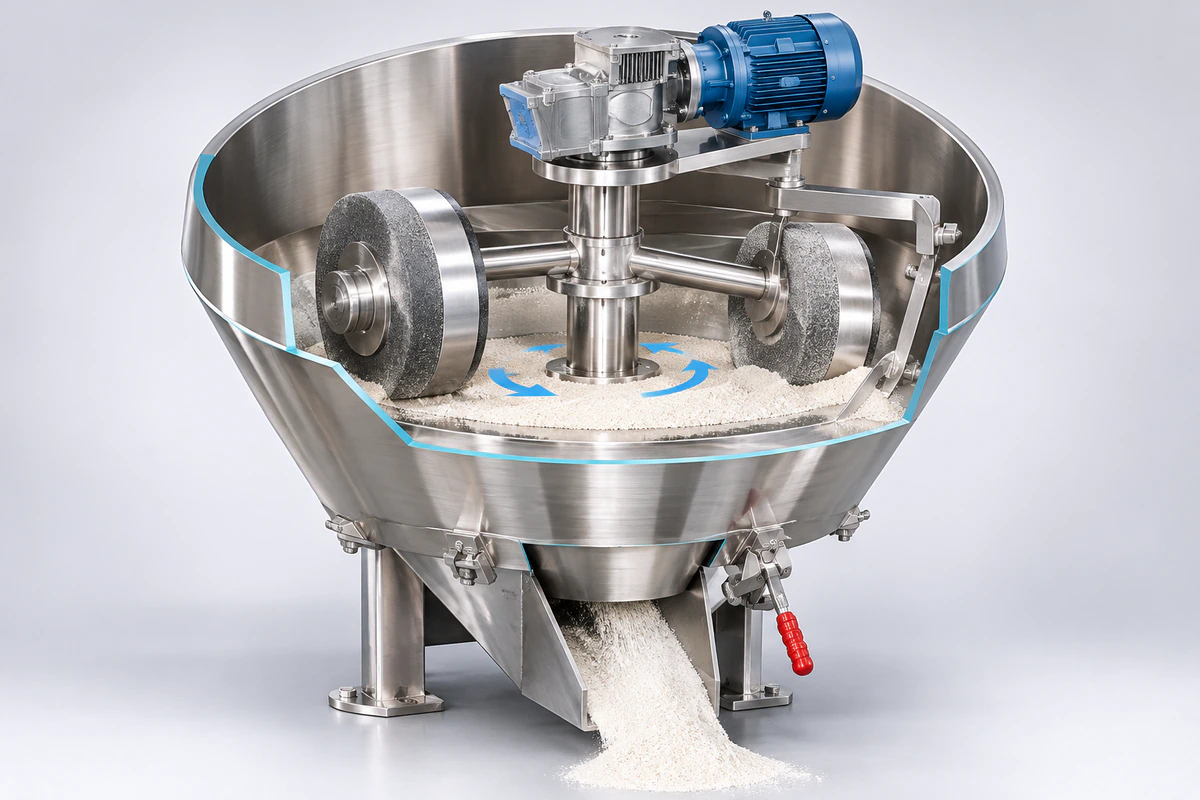
An edge runner mill is a batch size-reduction machine in which heavy steel or granite wheels roll over a shallow bed and reduce dry material by crushing combined with shearing. It is used for tough, fibrous and herbal drugs, and it is not suitable for sticky or oily material.
What Is an Edge Runner Mill?
An edge runner mill is a batch size-reduction machine in which heavy wheels roll over a shallow bed and crush and shear dry material. It is the mechanical form of the mortar and pestle. The manual mortar and pestle was the traditional tool for size reduction for centuries, and it is still used on a small scale.
Principle of Size Reduction
Size reduction in the edge runner mill takes place by crushing (compression) combined with shearing. The wheels rotate on their own axis while they travel around the shallow bed. The outer part of the wheel travels farther than the inner part, so it shears the material. The inner part crushes it.
Construction of Edge Runner Mill
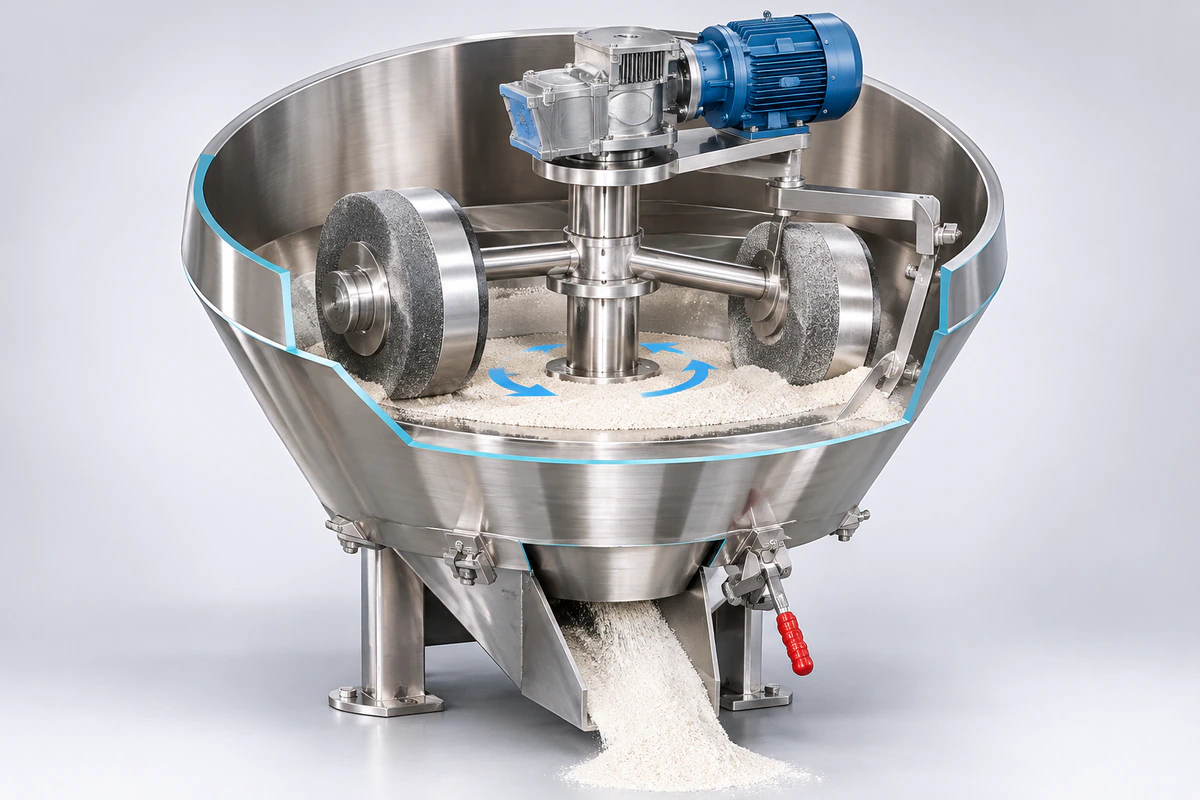
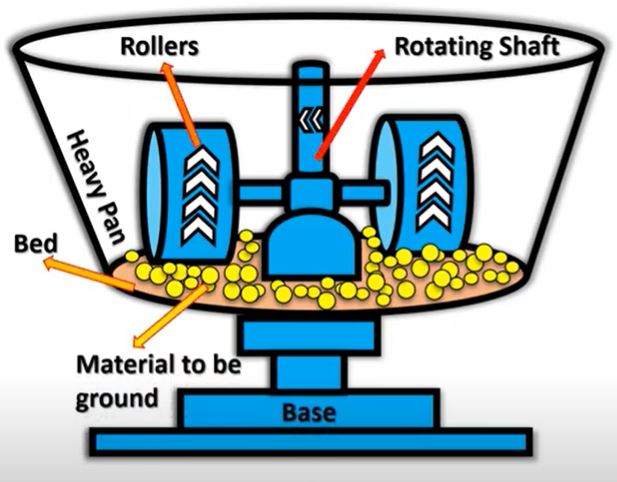
The mill has two heavy wheels (rollers) of steel or granite, carried on a horizontal shaft, which run on a shallow steel or granite bed (pan). There Commercial equipment are also made of cast iron or stainless steel.
Main Components
- Pan or bed, which holds the material.
- Wheels, which crush and shear the material.
- Vertical shaft, which turns the wheel assembly round the centre of the pan.
- Horizontal shaft, which carries the wheels.
- Scraper, which keeps the material in the path of the wheels.
- Gearbox and motor, which drive the vertical shaft.
- Discharge, through which the ground powder is removed.
- Guard, which covers the moving parts.
Specifications of Commercial Units
The values below are taken from one equipment and vary from one manufacturer to another. The speed of the wheels and the gap between the wheels and the bed depend on the model.
| Parameter | Range in commercial listings |
|---|---|
| Pan diameter | 250–1585 mm (900–1250 mm common) |
| Motor power | 1.5–20 HP (5–10 HP common) |
| Capacity | 30–100 kg/h for small units, 200–250 kg/h for medium units |
| Batch size | Up to 300 kg |
| Wheel size (example) | 1200 mm pan with wheels of 620 mm diameter and 230 mm face width |
| Materials | Mild steel, stainless steel, granite, cast iron |
Working of Edge Runner Mill
The edge runner mill works as a batch mill, so each load remains on the bed for the grinding time that is set before start trial for that product and is then collected. The steps are as follows:
- Once line clearance is taken and the mill is checked for status label on all equipments, now operator loads the material on the bed.
- The operator closes the guard and starts the drive, and the wheels begin to crush and shear the material while they travel round the bed.
- While the mill runs, the scraper pushes the material back into the path of the wheels.
- During processing of batch make sure each data is recorded online in BMR.
- After the completion of batch, the powder is finally, collected and passed through a sieve to obtain the desired particle size.
Although the mill needs no operator attention for feeding or adjustment during grinding, the guard must stay closed and the production officer should supervise the run.
Critical Parameters
| Parameter | Setting or range | Why it matters | How it is monitored |
|---|---|---|---|
| Load per batch | Up to 300 kg (commercial listings) | An overloaded bed gives uneven grinding | Weight recorded in the BMR |
| Grinding time | No general value; set by trial per product | Controls the fineness of the powder | Timer and BMR entry |
| Wheel speed | Model specific | Affects crushing and shearing | Manufacturer’s data sheet |
| Gap between wheel and bed | Model specific | Affects the fineness of the powder | Engineering checks |
| Sieve size | Set by the product specification | Defines the final particle size | Sieve record in the BMR |
Uses of Edge Runner Mill
The mill grinds hard, tough or fibrous dry drugs such as roots, barks and herbal material to powder. It is also used for Ayurvedic preparations, and in foundry, chemical, ceramics and food work. inside edge runner mill, Sticky or oily material is not suitable, because it cannot be ground and collected as a dry powder.
READ ALSO
Fluid Bed Processor (FBP), Principle, and Working
The fluid bed processor (FBP), principle, and working: hot filtered air fluidizes granules so granulation.
Merits of Edge Runner Mill
- Its design is simple.
- It needs no operator attention for feeding or adjustment while it is running.
- It gives fine powder.
- It can grind tough and fibrous drugs.
Demerits of Edge Runner Mill
- The risk of contamination is high, because the bed is open and the wheels and bed wear, releasing stone or metal particles and dust into the powder.
- It is not suitable for sticky or oily materials.
- It needs more floor space than a hammer mill or a ball mill.
- Cleaning is slow, because the mortar is fixed to the gearbox shaft.
- Grinding is done in batches and takes more time, and energy consumption is high.
- The noise level is high.
Cost
Indian vendor listings on IndiaMART show prices from about INR 85,000 to 3,75,000, depending on the size of the mill. These are vendor figures and change with the supplier.
Edge Runner Mill Compared with Other Mills
The edge runner mill is also called a Chilean mill, and the mechanical mortar and pestle is known as khalva yantra in Ayurveda. The end runner mill has an eccentric pestle that moves in a mortar, and it works by impact combined with shear in batches only.
| Feature | Edge runner mill | End runner mill | Hammer mill | Ball mill |
|---|---|---|---|---|
| Mechanism | Crushing with shearing | Impact with shearing | Impact | Impact and attrition |
| Operation | Batch | Batch | Continuous feed | Batch or continuous |
| Contamination | High, from open bed and wear of wheels and bed | High, from wear of the pestle and mortar | Lower, because the chamber is enclosed | Lower, because the drum is closed |
| Suitable for | Tough, fibrous and herbal drugs | Ayurvedic and herbal material | Wide range of dry materials | Fine grinding of hard materials |
A triple roller mill shears pastes between rollers, and wet milling is done in a colloid mill.
Maintenance and Troubleshooting
Preventive Maintenance
Engineering carries out preventive maintenance of the following items, and the intervals follow the manufacturer’s manual:
- Gearbox oil.
- Bearings.
- Scraper.
- Gap between the wheels and the bed.
- Guards.
Before any maintenance, the power must be isolated with lockout/tagout. After maintenance and cleaning, QA releases the mill back to production.
Troubleshooting
| Problem | Probable cause | Action |
|---|---|---|
| Coarse or uneven powder | Worn wheels or bed, wrong gap, short grinding time or overloaded bed | Inform engineering, correct the gap or load, and extend the grinding time as validated |
| Overheating | Overload or bearing fault | Stop the mill and inform engineering |
| Vibration | Loose fittings or worn bearings | Stop the mill and inspect the fittings and bearings |
| Noise | Worn parts or lack of lubrication in the gearbox | Stop the mill and inspect the gearbox |
| Gearbox leak | Damaged seal or loose cover | Stop the mill, and lubricant must be kept away from the product |
Modern Alternatives
Conical mills, hammer mills, multi mills and pin mills are also usefull alternative for edge runner mill. They are therefore easier to clean and produce less noise and dust. Conical mills may be best choice for dry size reduction in pharmaceutical plants. A fluid energy mill is used where very fine particles are needed. The edge runner mill is still chosen for herbal and Ayurvedic powders and for fibrous drugs.
Frequently Asked Questions
It is a batch mill. The material load remains on the bed for the grinding time as per time sets in BMR, and the powder is then collected and sieved before the next load is charged.
The outer edge of the wheel travels a longer path and moves faster than the inner edge. It therefore drags over the bed and shears the material, while the inner edge presses and crushes it.
The wheels are made of heavy steel, cast iron or granite stone. Contacts parts made with Stainless steel (316L) is useful for pharmaceutical use, and the choice depends on the product and the contamination risk.
References
- Edge Runner Mill listings, IndiaMART
- 21 CFR 211.65, Cornell LII (eCFR text)
- Design and Development of End Runner Mill for Ayurvedic Medicines, IRJET via Issuu
- Conical mill, Wikipedia
- Multimill, GMP multi mill design specification

Naresh Bhakar is the Founder and Author at Pharmaguddu.com, bringing his extensive expertise in the field of pharmaceuticals to readers worldwide. He has experience in Pharma manufacturing and has worked with top Pharmaceuticals. He has rich knowledge and provides valuable insights and data through his articles and content on Pharmaguddu.com. For further inquiries or collaborations, please don’t hesitate to reach out via email at [email protected].