
Quality Control, Quality Assurance Specialist | Industry Experience
✓ Reviewed by: Pankaj Sharma - Quality Control Specialist
Reviewed for QC, QA accuracy, laboratory practices, analytical methods, and technical Documents
📅 Last Updated: November 5, 2026
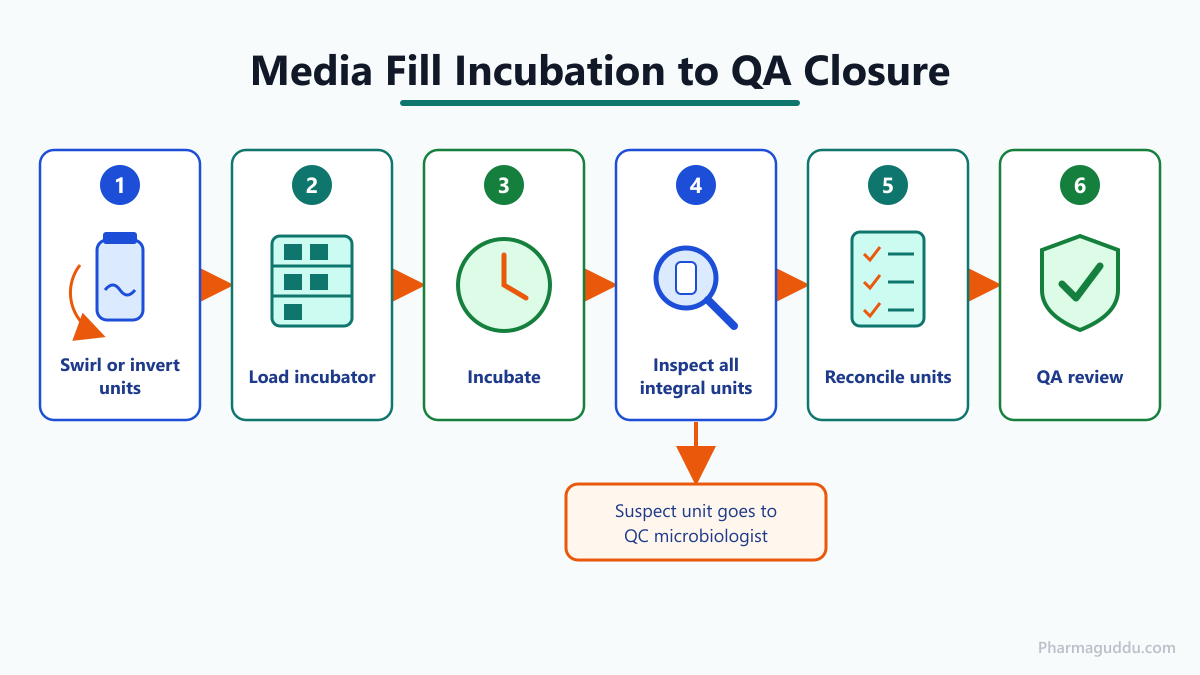
Media fill incubation conditions and examination will determine if contamination can be detected in an aseptic process simulation (APS). There is no fixed incubation temperature and time given in EU GMP Annex 1 (2022), however it must be scientifically justified and validated. A commonly accepted incubation period is 7+ days at 20-25oC followed by incubation at 30-35oC. (PIC/S PI 007-6). The FDA guidance (2004) suggests a minimum incubation period of 14 days between 20-35oC. Once incubated all integral units are examined by trained and qualified personnel. Any contaminated units will result in a failed APS. The approved protocol will dictate how the APS is carried out.
What Are Media Fill Incubation Conditions and Inspection?
These are the final two stages of simulating an aseptic process (APS). This involves using sterile growth media instead of product during the filling process. The term aseptic process simulation (APS) is used in Annex 1, however they can also be referred to as media fill (PI 007-6 definitions). The units are then stored at defined temperatures for a defined period of time. Each unit is checked for any visible microbial growth.
For the full overview, see What is Media fill in Pharmaceutical. This article covers only what happens after the filling stops.
There are four documents to consider here. The EU GMP Annex 1 was published on the 25th August 2022 and applies from the 25th August 2023. However, section 8.123 regarding loading of lyophilizers only applies from the 25th August 2024. The WHO Technical Report Series 1044, Annex 2 (2022) has been updated in conjunction with the EU. The PIC/S PI 007-6 (1st January 2011) states it is “advisory and not binding for industry”. The FDA guidance from 2004 gives recommendations that are not binding. The Annex 1 is what the EU inspector will be using as their benchmark. However, the other two can be used as a reference and implemented if justified.
How Do You Prepare and Identify Units Before Incubation?
The pre-incubation stage will affect the quality of the results. Ensure you follow your protocol and complete the following:
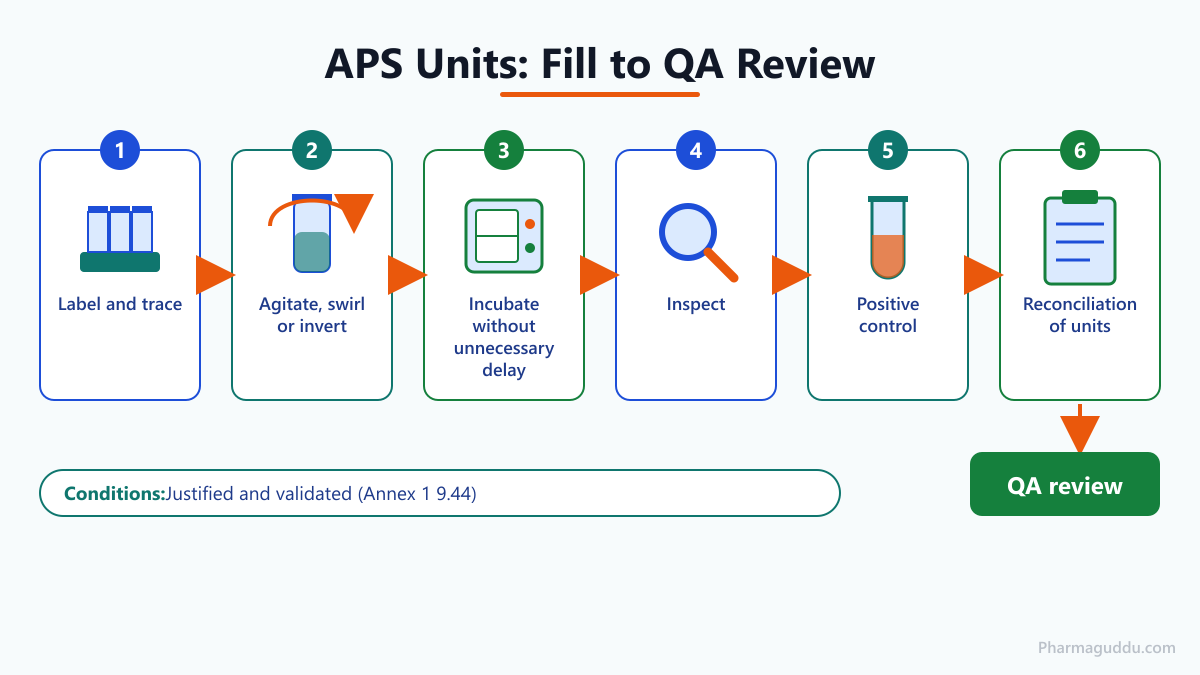
- Labeling and tracking. Trays or containers should be labelled to enable each individual unit to be traced back to the batch, line and filling time. Vials should be numbered or arranged in date order to enable tracing back (PI 007-6 5.1.8).
- Shake or invert to ensure contact of the medium with all internal surfaces including the closure (Annex 1 9.41).
- All integral units should be incubated including those with cosmetic damage or passed non-destructive in process checks (Annex 1 9.41). Units that are not integral should be rejected according to the FDA guidance 2004. Any unit that is wrongly rejected should be returned for incubation as soon as possible.
- Non-incubated discards can only be used if it is in line with normal practice and named in the production SOPs. The reason for discarding, line and number of units should be named. These units are usually incubated separately and may not be included in the acceptance criteria (Annex 1 9.41).
- Use clear containers. If the product container is an amber or opaque container then a clear container of the same design should be used. If this is not possible then a detection method should be developed and validated (Annex 1 9.43).
- Incubate as soon as possible (Annex 1 9.44).
The volume of the sample is important. Ensure all surfaces that may contaminate the product are adequately wetted and there is sufficient headspace to allow growth and show turbidity. (Annex 1 9.36 (iv)). Containers should not be filled to the top to allow obligate aerobes to have oxygen available. They should not be covered with inert gas. (PI 007-6 5.3.2). Inert gas should be replaced with air. (Annex 1 9.33 (iii)) unless an anaerobic simulation is required.
What Incubation Temperature and Duration Do the Guidelines Describe?
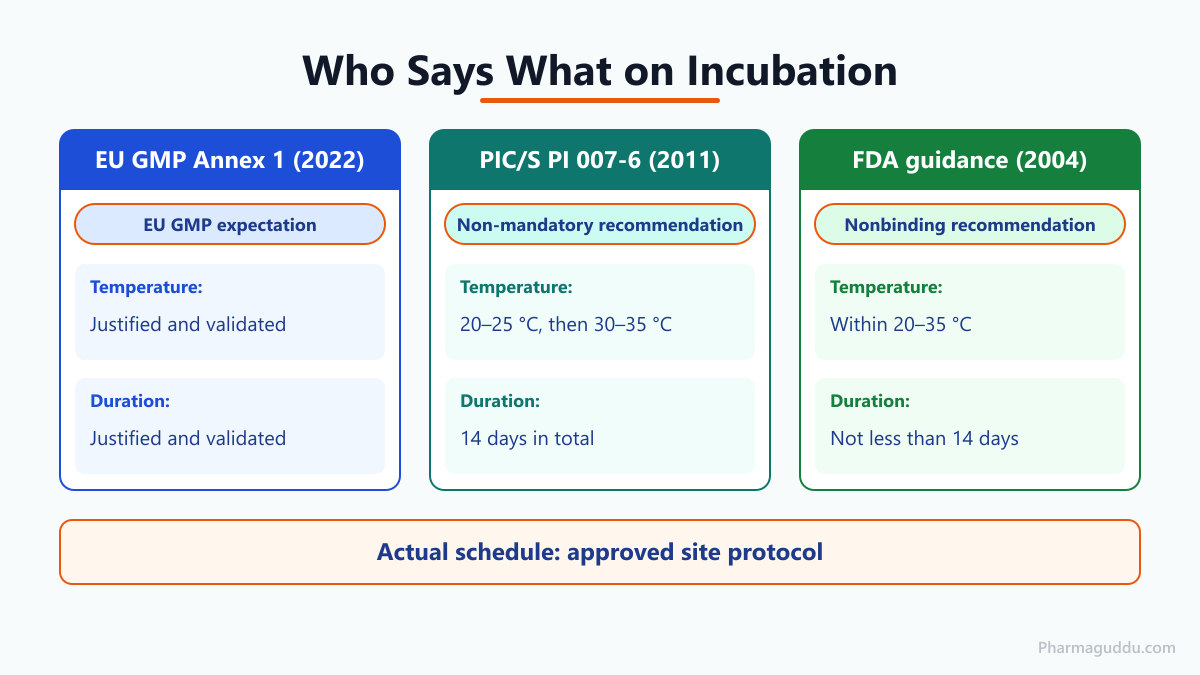
Annex 1 9.44 gives no fixed figures. It requires conditions and duration that are scientifically justified and validated to give an appropriate sensitivity of detection. The numbers people quote come from other documents, and their status differs.
| Source | Status | Temperature | Duration |
|---|---|---|---|
| EU GMP Annex 1 (2022), 9.44 | EU GMP expectation | Justified and validated by the site | Justified and validated by the site |
| PIC/S PI 007-6 (2011), 5.3.1 | Non-mandatory recommendation | 20–25 °C, then 30–35 °C | At least 7 days at the first stage; 14 days in total |
| FDA guidance (2004), media fill section | Nonbinding recommendation | Never outside 20–35 °C; within ±2.5 °C of the target | Not less than 14 days; at least 7 days at each temperature if two are used, lower first |
How Do You Inspect Incubated Media Fill Units?
Annex 1 9.45 (i) says trained and qualified personnel inspect the units, under conditions that help them identify contamination. The site fills in the rest.
- Reader training. PI 007-6 8.8 asks for specially trained evaluators with routine eyesight tests, and training that mixes contaminated units among sterile ones.
- Reference unit. Compare each unit with a known sterile container. Some growth shows only as a faint haze that is hard to see alone (PI 007-6 5.4.1). Faint haze causes more arguments between readers than anything else, and a reference unit settles most of them.
- Lighting and background. Neither document gives a lux value or background colour. Write the values your qualification supports into the protocol. Your routine visual inspection SOPs, such as this SOP for manual visual inspection of filled vials, are a useful layout reference. The APS read still follows its own protocol.
- QC oversight. If QC staff do not inspect, FDA’s 2004 guidance wants QC oversight throughout, and suspect units go straight to the QC microbiologist.
- Hazy or opaque plastic. Reading under room lighting is not enough. PI 007-6 4.2.2.2 says to remove and examine the whole contents, and Annex 1 9.43 allows a validated detection method instead.
Indicators of growth promotion include turbidity, particulate matter, flocs or scum. Any other methods of detecting contamination, including instrumentation, must be scientifically justified to ensure reliable detection (Annex 1 9.36 vii).
There are two types of control. The growth promotion of the medium is performed prior to use (Annex 1 10.9). The positive control of the incubated units is carried out after incubation by inoculating samples with reference organisms and local isolates (Annex 1 9.45 ii). PI 007-6 states that growth promotion tests are carried out when incubation has been completed to confirm growth has occurred within 5 days at the test temperature (PI 007-6 5.2.5).
What Do You Do With Positive, Damaged or Unclear Units?
Set a suspect unit aside at once and treat it as a potential failure until the investigation decides otherwise.
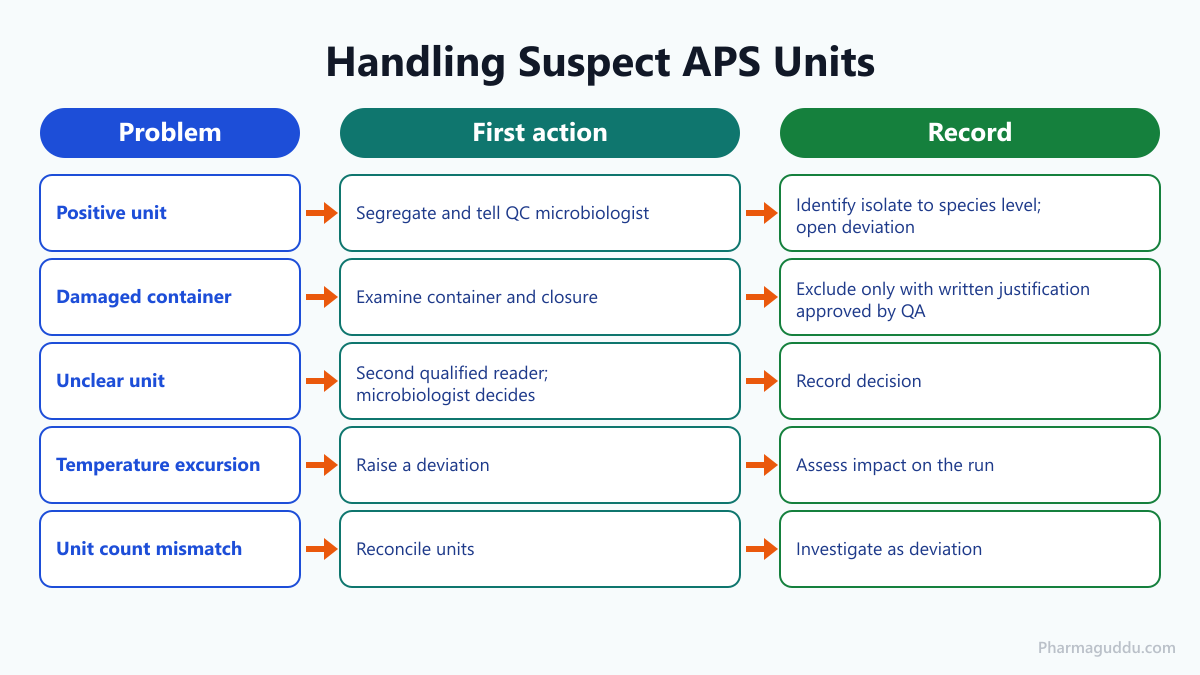
- Segregate the unit, record its identity and position, and tell the QC microbiologist immediately.
- Examine the container and closure for damage that could have let organisms in (PI 007-6 6.1).
- Identify the isolate to species level when practical (Annex 1 9.43). PI 007-6 5.3.3 accepts genus as a minimum.
- Open a deviation and start the investigation.
Any contaminated unit fails the APS, then follow the below actions:
- Investigate the most probable root cause and apply corrective measures.
- Run successful, consecutive repeat APS, normally at least three, to show the process is back in control.
- Review records since the last successful APS and assess the risk of sterile breaches in those batches.
- Quarantine products made on the line since the failure until it is resolved, and include other unreleased batches in the investigation.
- Limit the operator’s activities until retraining and requalification, where the root cause points to operator activity.
- Resume production only after successful revalidation.
What Must You Record, and What Does QA Review?
Annex 1 9.47 says every APS run must be fully documented. The record should hold:
- A reconciliation of units: filled, incubated and not incubated, with a justification for each non-incubated unit.
- Every intervention, with its start and end time and the persons involved.
- All microbial monitoring data and other testing data, kept in the APS batch record. Environmental data from a qualified area, as in this AHU performance qualification protocol, belongs here.
- Incubator identity, start and end dates, and temperature records as the protocol defines.
- Each inspection: date, inspector, reference unit used, result, and the outcome for every suspect unit.
- Growth promotion results for the medium, positive control results and isolate identifications.
FDA defines yield as units incubated divided by units filled and expects criteria for yield and accountability. A count that does not reconcile is a deviation. Most reconciliation gaps I have seen began with units pulled after an intervention and never written down.
QA reviews the whole package against the protocol, closes the deviations and approves the report. Records should follow ALCOA+ data integrity principles, so a reviewer can see who inspected what, and when. A failed APS also feeds the PQS, because it can change the disposition of batches made since the last good run.
Recent Technology Trends
The biggest change is regulatory. Annex 1 was published on 25 August 2022 and applied from 25 August 2023. Its paragraphs 9.41 to 9.48 state one zero-growth target and require justified, validated incubation. The older run-size tiers in PI 007-6 and FDA’s 2004 guidance sit below that standard. WHO’s 2022 Annex 2 carries matching APS wording for 9.46 to 9.48.
What Common Errors Weaken APS Results?
- Treating the PI 007-6 schedule as an Annex 1 requirement, or changing it without validation data.
- Discarding integral units, or removing more units at an intervention than routine production would.
- Skipping the swirl or inversion, so the closure surface never meets the medium.
- Overfilling the container or overlaying it with inert gas, which starves aerobes.
- Reading without a sterile reference unit, or reading opaque containers under room light.
- Using readers who were never tested with contaminated units.
- Leaving temperature excursions or late incubator loading unrecorded.
- Excluding damaged units without justification, or closing a run with unreconciled counts.
These gaps appear often in inspections, as the top audit findings in pharmaceutical manufacturing show for documentation in general. A self-inspection programme can catch them before an auditor does.
Our Expert Tips
- Name the source. Write in the protocol which document each incubation value comes from and where the validation data sits.
- Map under real load. Qualify the incubator with the load pattern the APS will use, and file the mapping report with the run.
- Keep a sterile reference. Place a known sterile unit beside the tray at every read.
- Write pulled units down at once. Log every unit removed during an intervention at the moment it happens.
- Test your readers. Mix spiked units into reader training, as PI 007-6 8.8 describes, and repeat it at set intervals.
- Define doubtful in advance. State who decides on an unclear unit and how the decision is recorded.
Frequently Asked Questions
Annex 1 fixes no number of days. It requires a scientifically justified and validated duration. PIC/S PI 007-6 describes 14 days in total for its generally accepted schedule, and FDA’s 2004 guidance says not less than 14 days. Your approved protocol states the actual duration, and the validation file supports it.
20–25 °C for at least 7 days, then 30–35 °C. FDA recommends staying within 20–35 °C and within ±2.5 °C of the target, starting with the lower temperature if two are used. The site protocol decides the exact schedule.
Annex 1 9.41 requires units to be agitated, swirled or inverted before incubation so the medium wets every interior surface, including the closure. It does not state the position during incubation. The protocol defines it, as long as closure contact was achieved beforehand and the position is applied and recorded consistently.
Annex 1 9.45 requires inspection on completion of incubation by trained, qualified personnel. PI 007-6 5.3.1 allows a reading between the two temperature stages. Intermediate reads are otherwise a site decision. Whatever your plan, write it into the protocol and record every read.
Under Annex 1 9.46, any contaminated unit means a failed APS. Required actions include a root cause investigation, corrective measures, and normally at least three consecutive successful repeat APS. You also review batches since the last successful APS and quarantine product made on the line since. Isolates are identified to species level when practical.
Only with written justification. PI 007-6 says damaged containers are not counted as failures. FDA’s 2004 guidance keeps units damaged after incubation starts in the data unless exclusion is fully justified and the deviation explained. Annex 1 treats any contaminated unit as a failure. Document the damage and obtain QA approval.
Annex 1 9.36 (vii) accepts a detection method only if it is scientifically justified to detect contamination reliably. Annex 1 does not name laser headspace or automated readers. A site would need its own validation, and usually a discussion with its inspectorate, before replacing trained visual inspection.
Summary
Annex 1 asks for justified, validated incubation, trained inspection and zero growth. PI 007-6 and FDA supply reference schedules, including 14 days at 20–35 °C. Wet the closure, incubate every integral unit, read against a sterile reference, investigate any positive, and reconcile every unit before QA review.
References
- EU GMP Annex 1: Manufacture of Sterile Medicinal Products (2022), European Commission
- PI 007-6 Recommendation on the Validation of Aseptic Processes (2011), PIC/S
- Guidance for Industry: Sterile Drug Products Produced by Aseptic Processing, Current Good Manufacturing Practice (2004), US FDA
- WHO good manufacturing practices for sterile pharmaceutical products, Annex 2, TRS 1044 (2022), World Health Organization
- Automated Media Fill Inspection (2025), Wilco

Pankaj Sharma — Quality Control Specialist
Pankaj Sharma is a pharmaceutical QC professional who reviews our technical content for GMP accuracy, laboratory practices, and regulatory relevance.