
Quality Assurance & Regulatory Specialist
✓ Reviewed by: Pankaj Sharma - Quality Control Specialist
Reviewed for Quality Control accuracy, laboratory practices, analytical methods, and technical relevance
📅 Last Updated: October 29, 2026
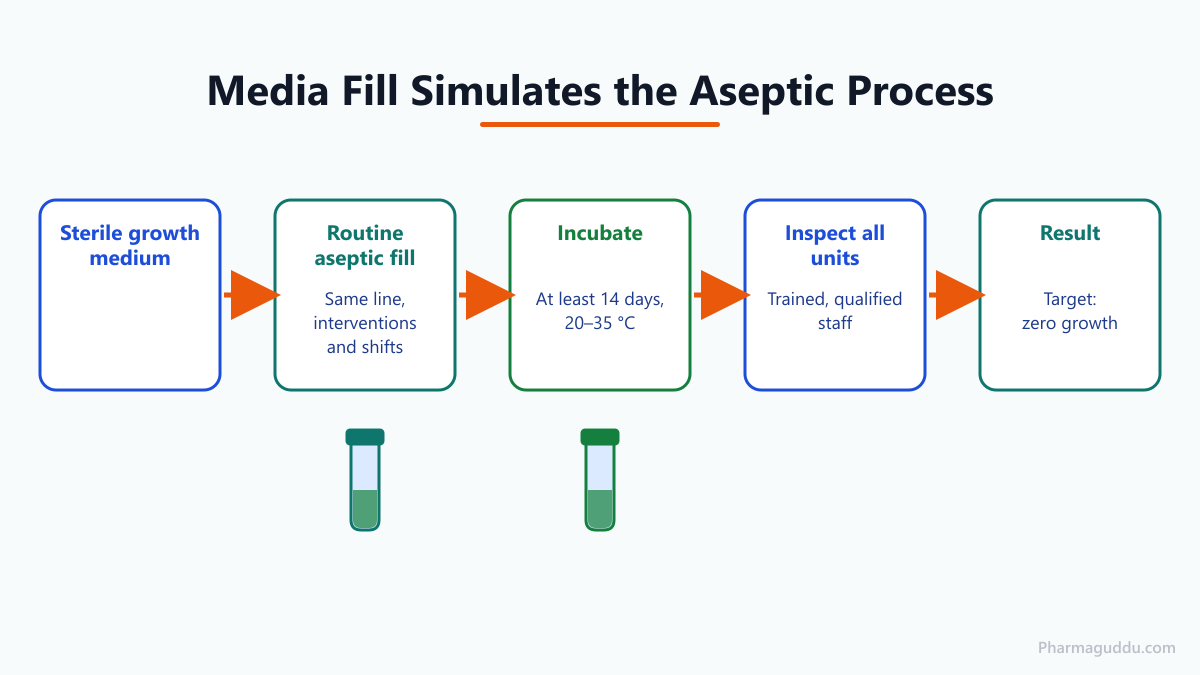
The media fill procedure and protocol describe how a site tests its aseptic process by filling sterile growth medium instead of product. An approved protocol fixes the design: units, interventions, shifts, incubation and acceptance. The team then runs the simulation under routine conditions, incubates every integral unit for at least 14 days, inspects the units and investigates any growth. QA approves the report. EU GMP Annex 1 sets a target of zero growth, and FDA lists tiered investigation triggers by run size. Your site SOP and approved protocol always govern the work.
What Is the Media Fill Procedure and Protocol?
A media fill, also called aseptic process simulation (APS), replaces the product with a sterile microbiological growth medium and runs the full aseptic process. If a microorganism gets into a unit, it multiplies during incubation and the medium turns cloudy. The protocol is the approved document that fixes the design of one run. The procedure is the sequence of actions the team follows to carry it out.
For the full overview, see What is Media fill in Pharmaceutical. This article goes deeper into planning, documenting, running, evaluating and closing out a run.
Two documents drive most protocols. EU GMP Annex 1 covers APS in paragraphs 9.32 to 9.49. The FDA guidance “Sterile Drug Products Produced by Aseptic Processing – cGMP” (2004) replaced the 1987 industry guideline. Use the term APS for periodic verification and qualification of the aseptic process. Annex 1 paragraph 9.32 says APS is not the primary means of validating that process. Design, quality system adherence, process controls, training and monitoring data carry that job. If you want the wider validation picture, read 4 Types of Process Validation in Pharmaceutical and Protocol.
How Does a Media Fill Simulate the Aseptic Process?
It works like a dress rehearsal where the product is swapped for a broth that grows almost anything. FDA names soybean casein digest medium as the usual choice. The same line, gowning, cleaning and interventions are used, so any lapse that would contaminate product contaminates the broth instead.
Annex 1 paragraph 9.33 says the simulation should cover every aseptic operation after sterilisation and decontamination of the materials, up to the point where the container is sealed. For non-filterable formulations, extra aseptic steps are included. Where the routine process uses an inert gas, air replaces it, unless an anaerobic simulation is intended. A lyophilised product needs the whole chain: filling, transport, loading, a representative chamber dwell, unloading and sealing. The vials are not frozen, and air breaks the vacuum instead of nitrogen.
FDA also notes that process simulations have scientific and technical limits. A clean media fill supports confidence in the process. It does not prove that every routine unit is sterile.
What Goes Into a Media Fill Protocol?
Typical protocols follow the layout below. Treat it as common industry practice, not a mandatory template. Your site SOP decides the final format.
| Protocol section | What it covers | Basis |
|---|---|---|
| Objective, scope, responsibilities | Process, line, container and shift covered; who does what | Typical practice |
| References and risk assessment | SOPs, contamination control strategy (CCS), intervention list | Annex 1 9.34, 9.36 |
| Line and container description | Container sizes, line speed, maximum hold times | Annex 1 9.36 i–iii |
| Media and growth promotion | Medium, reference strains, local isolates, challenge level | FDA guidance; Annex 1 9.36 vi |
| Run design | Number of units, duration, shifts, interventions, personnel | Annex 1 9.34, 9.40; FDA |
| Environmental monitoring plan | Monitoring as in routine production, for the whole run | Annex 1 9.36 xi |
| Incubation and inspection | Conditions, inspector qualification, positive control | Annex 1 9.44–9.45; FDA |
| Acceptance and failure handling | Zero-growth target, deviation route | Annex 1 9.46 |
| Attachments and approval | Batch record, intervention log, reconciliation sheet, signatures | Annex 1 9.47 |
Roles usually split as follows, again depending on the site SOP:
| Role | Responsibility |
|---|---|
| Production | Runs the simulation, records interventions, reconciles units |
| QC/ microbiology | Prepares and tests the medium, incubates, inspects, identifies isolates |
| Validation team | Drafts the protocol and report, tracks the requalification schedule |
| Engineering staff | Confirms the line is ready and records equipment stoppages |
| QA | Approves the protocol and report, manages deviations and CAPA, decides batch disposition |
FDA says the QC unit should observe the run. If QC staff do not inspect the incubated units, QC must oversee the inspection throughout.
What Are the Steps of a Media Fill Procedure?
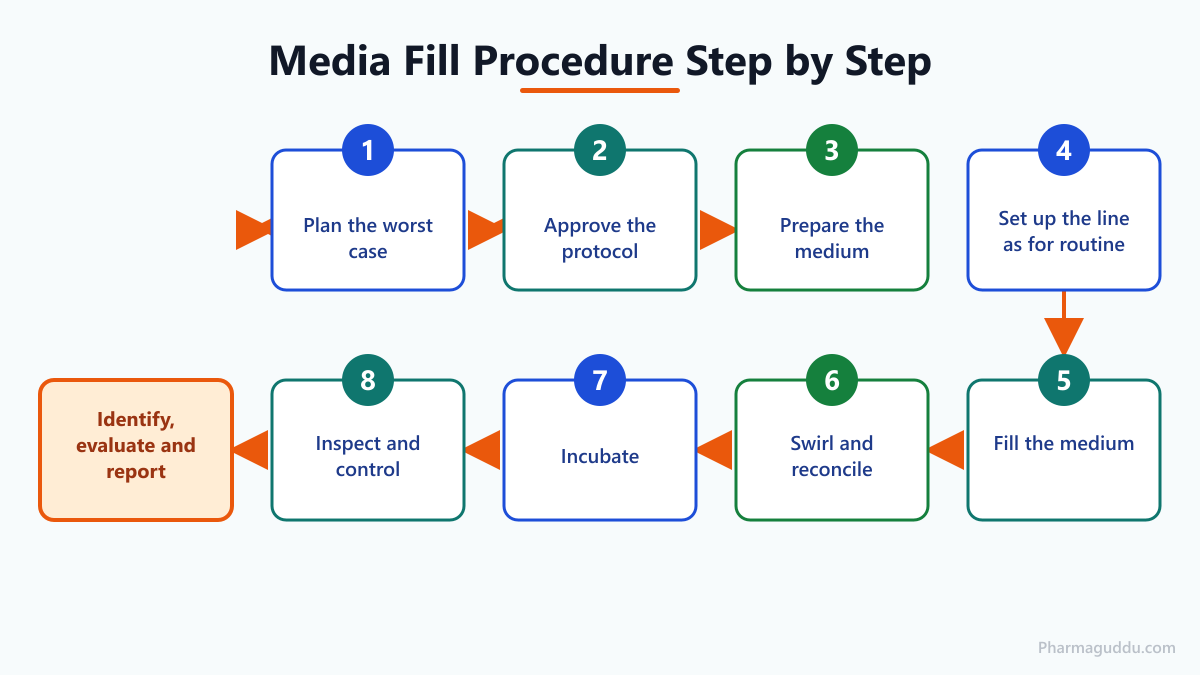
The steps below show example practice. The approved protocol of your site overrides this list.
- Plan the worst case. Pick the container size, line speed, maximum hold times and shifts that stress the process most. FDA allows one line speed per run. A risk assessment protocol helps justify each choice.
- Approve the protocol. Production, QC microbiology, validation and QA sign before any medium is filled.
- Prepare the medium. Sterilise it and run growth promotion testing. Annex 1 requires media for APS to pass growth promotion before use.
- Set up the line as for routine. Use the normal sterilisation and set-up steps. Do not add extra cleaning or adjust the HVAC beforehand. FDA warns that a cleaner-than-routine run makes the process look better than it is.
- Gown and assign personnel. Use the normal staffing, including the people who will perform interventions.
- Fill the medium. Run the process as in the routine filling procedure, with the approved interventions at routine frequency. The fill volume must wet all internal surfaces and leave enough headspace to see turbidity.
- Record everything. Log each intervention with its start time, end time and the person involved. Run environmental monitoring for the full duration.
- Swirl and reconcile. Agitate or invert the filled units so the medium touches all inner surfaces. Reconcile units filled, incubated and not incubated.
- Incubate. Move units to the incubator without unnecessary delay, in clear containers.
- Inspect and control. Trained, qualified staff inspect all units at the end of incubation. Positive control units are inoculated with reference organisms and local isolates.
- Identify, evaluate and report. Identify any isolate to species level, review the monitoring data, write the report and send it to QA.
What Parameters Control a Media Fill Run?
| Parameter | Example value | Source |
|---|---|---|
| Run size | 5,000 to 10,000 units; for batches under 5,000, at least the batch size | Annex 1 9.40; FDA |
| Initial qualification | At least three consecutive satisfactory runs covering all shifts | Annex 1 9.38 |
| Periodic revalidation | Normally twice a year (approximately every six months) per process, line and shift | Annex 1 9.38 |
| Operator participation | At least one successful APS per year; manual operations: three consecutive runs at start, then about every six months | Annex 1 9.38, 9.39 |
| Incubation time | Not less than 14 days; with two temperatures, at least 7 days each, lower first | FDA guidance |
| Incubation temperature | Within 20–35 °C and held within ±2.5 °C of the target | FDA guidance |
| Growth promotion challenge | Fewer than 100 CFU | FDA guidance |
Annex 1 fixes no single incubation temperature. Paragraph 9.44 asks for conditions that are scientifically justified and validated for detection sensitivity. The justification for the number of units belongs in the CCS.
How Do FDA and Annex 1 Acceptance Criteria Differ?
Annex 1 is stricter on paper. FDA gives tiered triggers, and it adds that a firm whose criteria allow infrequent contamination is still fully liable for shipping any nonsterile unit.
| Run size | FDA 2004 recommendation | Annex 1 (2022) |
|---|---|---|
| Fewer than 5,000 units | No contaminated units; one is cause for revalidation after investigation | Target is zero growth; any contaminated unit fails the APS |
| 5,000 to 10,000 units | One unit: investigation, including a repeat run; two units: cause for revalidation | Same |
| More than 10,000 units | One unit: investigation; two units: cause for revalidation | Same |
Whatever the run size, FDA treats any contamination as a possible sterility assurance problem. Recurring incidents on one line signal an adverse trend, even when each run met the criteria. Annex 1 paragraph 9.35 and FDA agree on another point: an APS must never be used to justify practices that carry unnecessary contamination risk.
Recent Guidelines and Observation
- Annex 1 in force (2023). Since 25 August 2023, inspectors read the APS against the CCS. Unit numbers, interventions and worst-case choices need a written justification (Annex 1 9.36, 9.40).
- Sato warning letter (18 May 2026). FDA’s letter followed an inspection from 13 to 21 November 2025 and cited at least six media fill failures between November 2022 and February 2025. FDA judged the aseptic line design unable to maintain a state of control.
- European inspection case (October 2026). ECA Academy reported a critical deficiency at a Chinese biosimilar manufacturer: APS deviations with weak impact assessment, plus gaps in how interventions were defined for operator requalification. The GMP certificate was withdrawn.
What Goes Wrong in a Media Fill and What Do You Do?
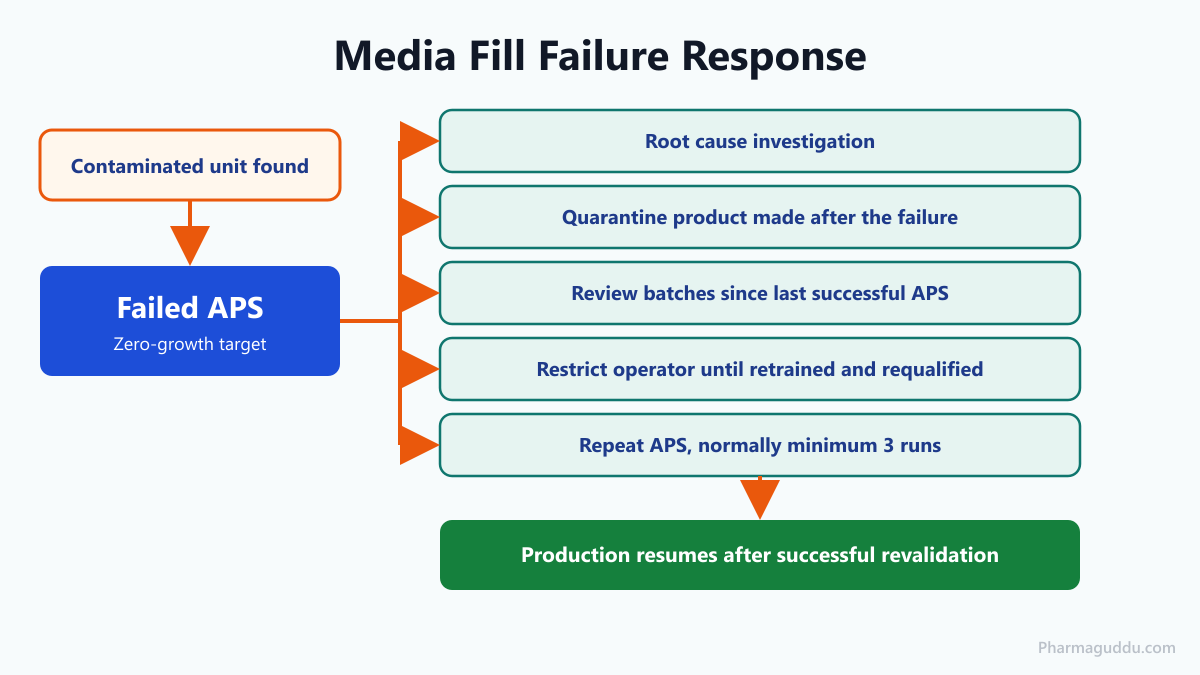
A contaminated unit is found
Possible causes: operator technique during an intervention, a weak equipment set-up step, an environmental excursion, or a component problem.
Corrective actions: under Annex 1 paragraph 9.46, treat the run as failed and start a root cause investigation. Product made on the line after the failure is quarantined. Review all aseptic production records since the last successful APS, with a risk assessment for those batches. Other unreleased batches fall inside the scope. QA decides batch disposition from the outcome. Restrict the operator’s activities if the cause points to operator practice, until retraining and requalification. Production resumes only after successful revalidation, normally a minimum of three consecutive runs. Identify the isolate to species level, because it points to the source. Use root-cause-based CAPA with an effectiveness check, since retraining alone is rarely adequate.
Growth promotion fails
Possible causes: medium preparation or storage problems, or a weak reference organism suspension.
Corrective actions: FDA asks you to investigate the growth promotion failure and still investigate any contamination found in the run. Repeat the media fill promptly.
Units do not reconcile
Possible causes: units removed in interventions without records, or rejected units not logged.
Corrective actions: reconcile against the intervention log. Annex 1 9.41 allows unincubated discards only if they match routine practice, and never more units than a production run would clear. In my experience, the reconciliation sheet is where most reports stall, so fill it in during the run.
A run is aborted or invalidated
Invalidation should be a rare event. Annex 1 paragraph 9.48 allows an abort only where written procedures require commercial lots to be handled the same way, and the investigation must be documented.
The investigation finds no clear cause
FDA says that when an investigation cannot reach a well-supported conclusion, three consecutive successful runs and closer scrutiny of production may be warranted.
How Do You Keep the Process Qualified After the Run?
Schedule the next APS when you approve the report. Annex 1 and FDA both link repeat runs to change control. Triggers include HVAC changes, new equipment, process or container changes, a different number of shifts or people, and long shutdowns. After any such change, QA reviews whether the repeat run is needed. When HVAC work is involved, the AHU performance qualification protocol shows what the engineering side must prove first.
Keep a coverage tracker for every operator, shift and line. Annex 1 also suggests considering an APS after the last batch before a shutdown. Training records for each participant belong in the file, as described in the SOP on training of personnel.
Frequently Asked Questions
No. A media fill challenges the aseptic process and the operators using growth medium. The sterility test is a release test on product samples. Annex 1 describes APS as periodic verification of the aseptic controls, not a replacement for product testing or for process design and monitoring.
Annex 1 9.40 says typically 5,000 to 10,000 units. For batches under 5,000 units, the number of containers should at least equal the production batch size. FDA gives the same starting range and asks for more units when manual work raises contamination risk. The justification belongs in the CCS.
FDA says incubation should not be less than 14 days, within 20–35 °C and held within ±2.5 °C of the target. With two temperatures, each gets at least 7 days, lower first. Annex 1 asks for conditions that are scientifically justified and validated for detection sensitivity.
Annex 1 paragraph 9.38 asks for at least three consecutive satisfactory runs covering all working shifts. FDA also recommends at least three consecutive successful runs when a line is first qualified. Manual operations need three consecutive successful runs for each operator.
Under Annex 1, any contaminated unit fails the APS and triggers a root cause investigation, corrective measures, a batch review since the last successful APS and repeat runs. FDA’s tiers set investigation or revalidation triggers by run size, and the firm stays liable for any nonsterile unit shipped.
Only if the routine SOP removes units in the same circumstances and the media fill removes no more than a production run would. Otherwise, incubate them. Annex 1 9.41 requires all integral units, including those with cosmetic defects, to be incubated and evaluated.
References
- Guidance for Industry: Sterile Drug Products Produced by Aseptic Processing – Current Good Manufacturing Practice, US FDA (2004)
- Sterile Drug Products Produced by Aseptic Processing – cGMP (guidance page), US FDA
- EU GMP Annex 1: Manufacture of Sterile Medicinal Products, European Commission (2022)
- EudraLex Volume 4 – GMP guidelines, European Commission
- Entry into force of revised Annex 1, PIC/S GMP Guide PE 009-17, PIC/S (2023)
- Sato Pharmaceutical Co., Ltd. warning letter 320-26-75, US FDA (18 May 2026)
- Aseptic Process Simulation/Media Fill also under Scrutiny during European GMP Inspections, ECA Academy (2026)
- Advances in Digitalization and Automation of Aseptic Processing, Pharmaceutical Technology (2025)
- PDA Technical Report No. 22, Process Simulation for Aseptically Filled Products, Parenteral Drug Association

Satpal Singh — Quality Assurance & Regulatory Specialist
Satpal Singh is an experienced pharmaceutical Quality Assurance and Regulatory professional with expertise in GMP compliance, quality systems, technical documentation, and regulatory requirements. He reviews our pharmaceutical content to ensure accuracy, industry relevance, and alignment with current quality and regulatory standards.
Expertise: QA Systems | GMP Compliance | Regulatory Documentation | Audits | Quality Management