
Quality Control, Quality Assurance Specialist | Industry Experience
✓ Reviewed by: Pankaj Sharma - Quality Control Specialist
Reviewed for QC, QA accuracy, laboratory practices, analytical methods, and technical Documents
📅 Last Updated: November 4, 2026
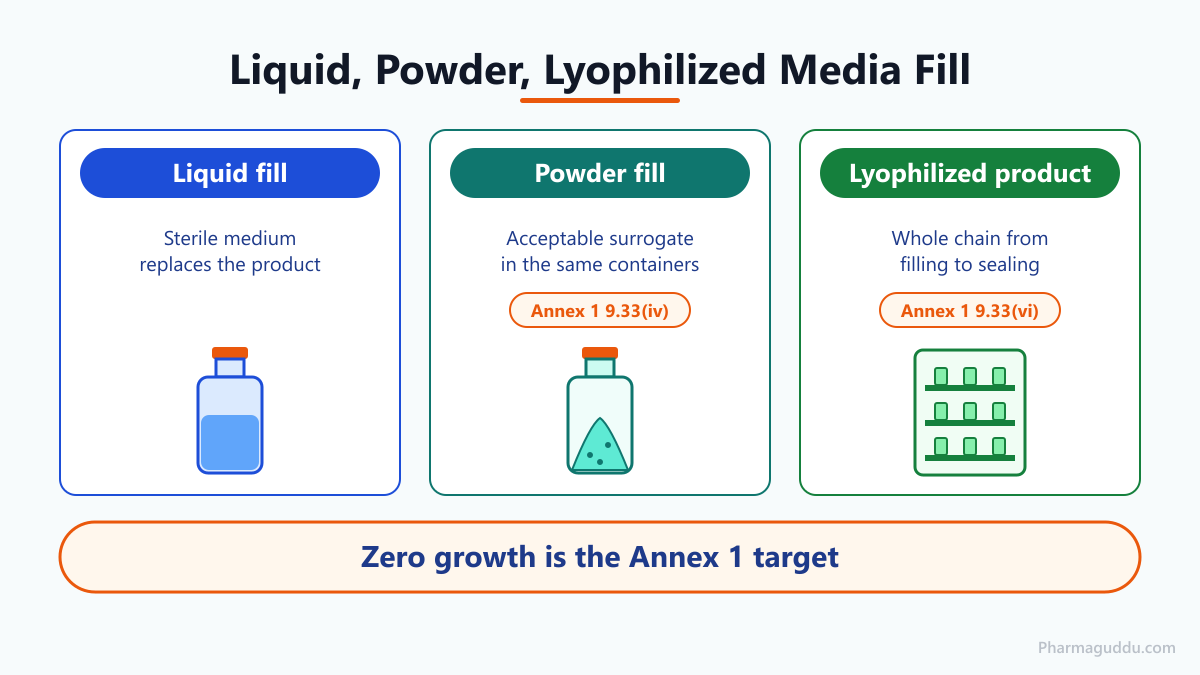
Media fill for powders and lyophilized products is considered an aseptic process simulation (APS). This involves using sterile nutrient media or a suitable surrogate to replace the product. Sterile powders require a suitable surrogate in the same packaging. The freeze drying process requires media which simulates the complete filling process without freezing or boiling. Transfers, gloving and duration of the campaign must be included in the isolator/RABS design. The EU GMP Annex 1 states zero growth should be achieved, therefore any contaminated unit will fail the APS. However, the FDA guidance in 2004 uses a risk based approach based on the number of runs.
What Is Media Fill for Powders and Lyophilized Products?
Media fill for powders and lyophilized products is an APS that has been adapted for products that are dry or undergoing changes during the filling process. The APS is a periodic test performed to confirm the effectiveness of aseptic controls. The process itself is not primarily validated by the APS. Process design, and the Pharmaceutical Quality System (PQS) are responsible for validating the aseptic process. This is in addition to controls, training and monitoring data. (Annex 1, para 9.32)
For the full overview, see What is Media fill in Pharmaceutical. Here the focus is limited to the differences for powders, freeze-drying, isolators and RABS.
An isolator is an enclosure that separates the grade A zone from the room. A Restricted Access Barrier System (RABS) does the same job with a different design. Annex 1 paragraph 4.18 treats them as different technologies. You can read more in Defining a Pharmaceutical Isolator and Restricted Access Barrier System (RABS) in Pharmaceutical.
Related topic: media fill procedure and protocol
Why Does APS Design Differ From Liquid Filling?
A liquid is used as the medium and will go through the same piping, pumps and needles. This can’t be done with a powder or a freeze-dried product. The medium/surrogate should be selected based on the ability to simulate the physical characteristics of the product that may cause a risk to sterility (Annex 1 9.32). Certain processes may have an indirect effect on the survival of contaminants. These include powders, heat, cold and lyophilisation. Alternative procedures will be developed to simulate these processes as accurately as possible.
Three key statements are made in Annex 1 paragraph 9.33:
(i) Sterile powders should have an acceptable surrogate material in the same containers (9.33(iv))
(ii) Avoid simulating individual unit operations (9.33 (v)) such as drying, mixing, milling or dividing of sterile powders.
(iii) Simulate the filling, transport, loading, representative chamber time, unloading and sealing of a lyophilised product (9.33(vi)).
How Do You Design the APS for Powder Filling?
Annex 1 does not specify a simulant or growth enhancement method for powders. This is selected by the site and the reasons for selection are included in the Contamination Control Strategy (CCS).
There are three requirements for all selections. The simulant must be used in the same containers as the actual process. It must not encourage growth of contamination. For example, if a buffer is used (9.32). The simulant must behave in the same way as the product would that could cause a risk to sterility. If a dry simulant is used, it must not be possible to determine turbidity. The method used to determine this must be scientifically justified (9.36(vii)).
For example, if a team performed a powder fill, liquid fill and seal check as individual parts of a media fill. All parts were passed but there was no simulation of the transfer between each part. This gap is closed by ensuring that the simulation covers the entire process (9.33(v)). If individual simulations are required then it must be shown that all parts together cover the entire process.
For sterile actives, all simulations must be evaluated for microorganisms (9.37). The simulation material, whether simulant or growth medium must not affect recovery.
How Is a Lyophilized Product Simulated?
The simulation replicates the actual process from filling to sealing, excluding any steps that are harmful to the viability or recovery of contaminants. Examples of these include boiling over and actual freezing of the solution (Annex 1 9.33(vii)). The lyophilization is also regarded as a critical step and any activities that may impact on sterility are seen as an extension of the aseptic processing (8.121).
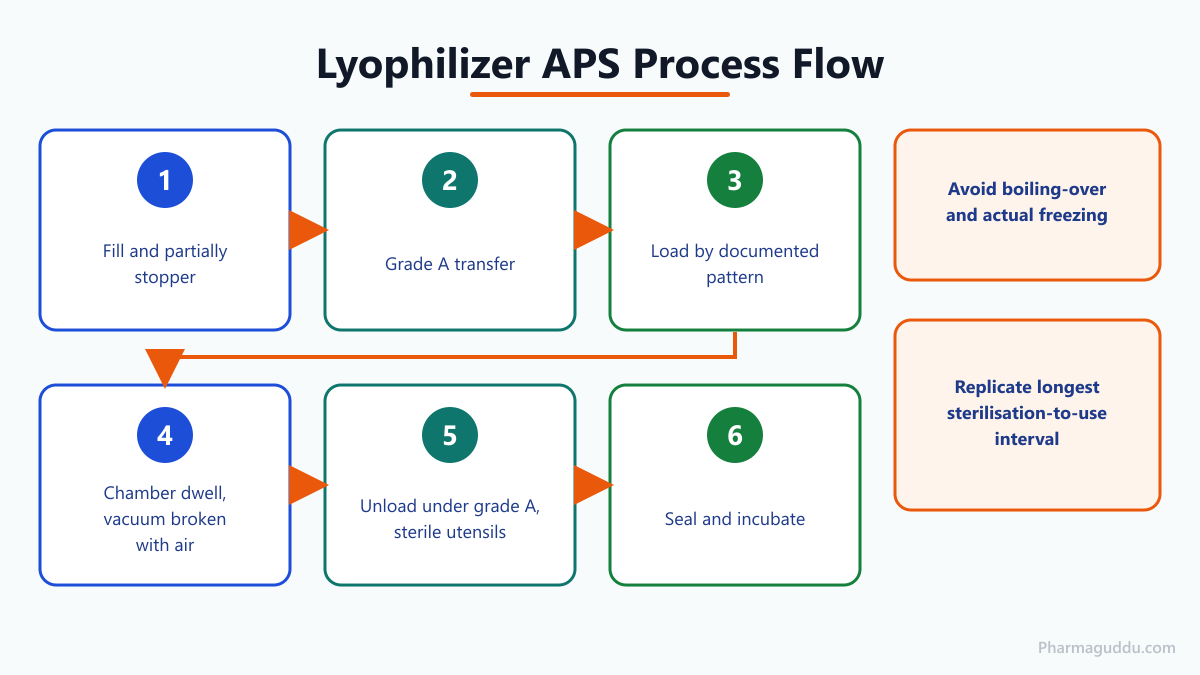
A Example sequence looks like this:
- Fill the medium and partially stopper the containers.
- Transfer the partially closed containers to the lyophilizer under grade A conditions at all times, with minimal direct operator intervention (8.126(ii)).
- Load by the specified and documented loading pattern (8.126(i)). Use worst-case parameters, such as the most trays and the longest time the chamber stays open to the environment (9.33(vii)).
- Hold the chamber for a representative dwell. Break the vacuum with air instead of nitrogen (9.33(vii)).
- Unload. Keep unsealed containers under grade A and use sterile utensils (8.126(iv) and (vi)).
- Seal the containers, then incubate them.
The APS will mimic the maximum time between sterilisation of the lyophiliser and use, and maximum time between filtration and lyophilisation (8.122 and 9.33(vii)).
The chamber principle is outlined in the FDA guidance (2004). This means that the unsealed containers should be partially evacuated to mimic the process, the vials should not be frozen and the medium should be aerobic.
Annex 1 does not specify what pressure, temperature or holding time should be used. One method that has been published is to use a partial vacuum pressure of 800-900mbar. The containers are held at approximately 2-25°C. After aeration with sterile air, the stopper is added. The containers are then held at atmospheric pressure for approximately 1 hour to allow settling of particles (Manufacturing Chemist, July 2024). Another method suggested in a white paper is using 3 evacuation and aeration cycles with a pressure of 100-200mbar (Pharmaceutical Online, 2021). These methods vary but both are examples of a justified choice of site.
The frequency of sterilisation will impact the design. If the lyophiliser is manually loaded/unloaded without separation using barrier technology then it will be sterilised before every load (8.123). If it is automatically or closed barrier loaded then the frequency will be justified and documented within the CCS. This paragraph was applied from 25 August 2024, 1 year after the rest of Annex 1.
The loading strategy is a site based practice. Fully automatic loading can be considered a low risk so media filled units and enough stoppered empty units to fill the final shelf may be sufficient. Manual loading can be considered high risk and maximum commercial load will be simulated (Pharmaceutical Online white paper). Annex 1 does not specify different loading strategies based on automation. The worst case conditions should be used and justified (9.33(vi)).
What Changes in an Isolator or RABS APS?
The APS must follow the technology’s own transfers, glove work, door openings and decontamination steps. Annex 1 paragraphs 4.19 to 4.22 set different rules for each technology.
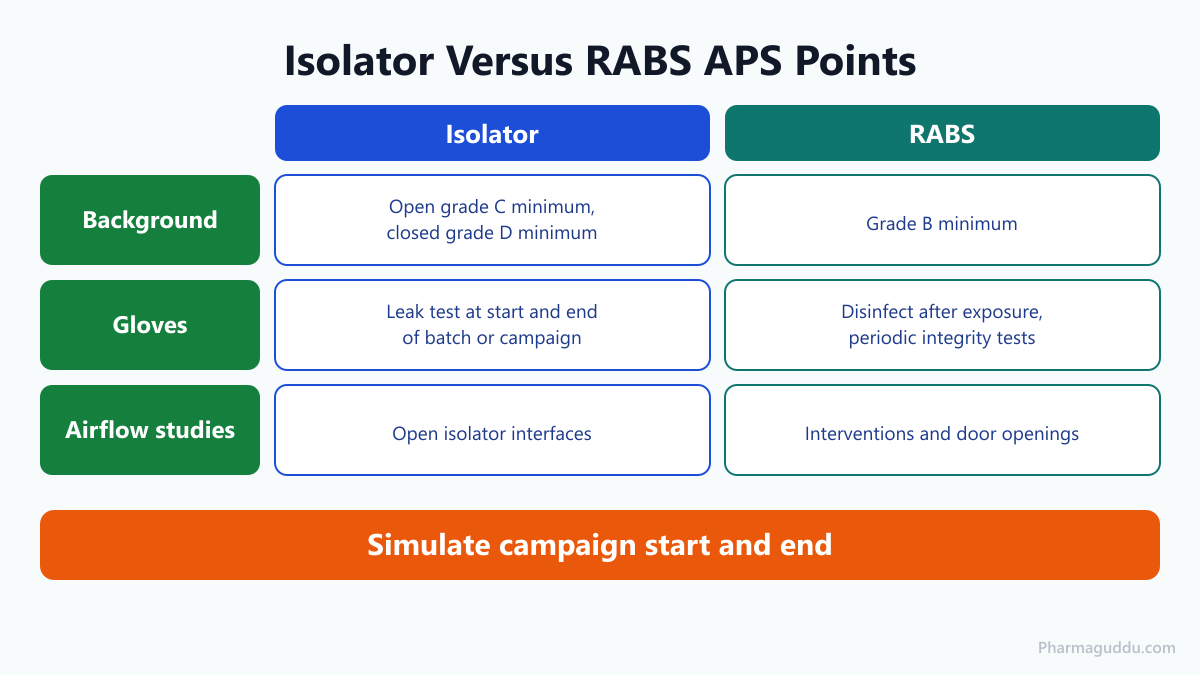
| Point | Isolator | RABS |
|---|---|---|
| Background | Open isolator generally grade C minimum, closed isolator grade D minimum, set by risk assessment (4.20) | Grade B minimum (4.20) |
| Airflow studies | At the interfaces of open isolators (4.20) | During interventions, including door openings where applicable (4.20) |
| Gloves | Leak test at least at the start and end of each batch or campaign; visual check at each use (4.21) | Sterilised before installation; sterilised or bio-decontaminated before each campaign; disinfected after exposure to the background; periodic integrity tests (4.21) |
| Bio-decontamination | Automated, validated, with a sporicidal agent (4.22) | Routine sporicidal disinfection by a validated method (4.22) |
When completing an isolator risk assessment you should consider several factors. This includes; the bio-decontamination programme, the degree of automation, glove movements that may cause disturbance to first air, the potential loss of containment/barrier integrity, transfer methods and activities that involve opening the doors during setup/maintenance. Using these factors the site will identify the transfers and interventions that should be included within the Aseptic Process Simulation (APS).
Barrier systems are often run in campaigns. The APS should represent the start and end of the campaign, as per EU GMP Annex 1 section 9.36(xii). The site must show that the chosen campaign length does not increase the risk of contamination. The APS may be completed at the end of production/campaign to give extra assurance or to support an investigation. However, this must be justified within the Contamination Control Strategy (CCS) and cannot replace the routine APS. (Section 9.36(xiii))
Glove testing should be considered. As the gloves are used within the isolator, testing should be completed before and after the operation (section 4.21). The site may therefore complete the APS in the same manner as a normal production batch.
As there is little risk of contamination due to the lack of direct human intervention within the process, isolator processes may be simulated with a reduced number of units (as per FDA guidance 2004). However, this must still be justified within the CCS. The number of units chosen to be used within the APS must be justified (as per EU GMP Annex 1 section 9.40).
How Does Risk Assessment Set Worst-Case Conditions?
Start with the process steps, then ask which variable stresses sterility most. Annex 1 9.36(i) requires worst-case conditions across the relevant variables, such as container size and line speed. The assessment must justify the choice. The same paragraph covers maximum holding times for sterile product and exposed equipment. It also covers extended shifts and idle interruptions such as shift changes. It adds a fill volume that wets every contact surface.
Paragraph 9.36(ii) allows a bracketing or matrix approach for container and closure sizes when process equivalence is scientifically justified. Interventions follow 9.34: inherent and corrective ones representative of routine production, at a similar manner and frequency, with inclusion based on assessed risk. Paragraph 9.35 adds that an APS must not justify practices that pose unnecessary contamination risk. For selection and timing, see Media Fill Interventions and Worst-Case Design.
Which Medium, Incubation and Limits Apply?
The medium must grow a designated group of pharmacopoeial reference organisms and suitably representative local isolates (9.36(vi)). FDA’s 2004 guidance names soybean casein digest medium as a general choice. For growth promotion, see SCDM, TSB and Growth Promotion Test in Media Fill.
After filling, agitate, swirl or invert the units so the medium reaches every inner surface (9.41). Incubate in clear containers (9.43). Annex 1 requires incubation conditions and duration that are scientifically justified and validated (9.44). FDA’s 2004 guidance sets 20 to 35 °C and at least 14 days. With two temperatures, it asks for at least 7 days at each, starting with the lower one.
After incubation, trained and qualified inspectors examine the units. A positive control with reference organisms and local isolates follows (9.45). Identify isolates to species level where practical (9.43).
An APS has limits. An APS cannot freeze the medium or pull a full vacuum on it. FDA also acknowledges technical limits on how precisely any simulation can characterise the controls. Where the real process cannot be copied, Annex 1 asks for alternative procedures that represent the operations as closely as possible (9.32). Document why each departure from the real process does not hide a contamination route.
What Are the Acceptance Criteria and Investigation Rules?
Annex 1 and FDA differ. Show both in the protocol, and state which one governs the site.
| Source | Criterion |
|---|---|
| EU GMP Annex 1, 9.46 | Zero growth is the target. Any contaminated unit is a failed APS. |
| FDA 2004, under 5,000 units | No contaminated units. One contaminated unit is cause for revalidation after investigation. |
| FDA 2004, 5,000 to 10,000 units | One contaminated unit: investigation, including a possible repeat. Two: revalidation after investigation. |
| FDA 2004, over 10,000 units | One contaminated unit: investigation. Two: revalidation after investigation. |
The FDA criteria are nonbinding recommendations for FDA-regulated sites. FDA still says contamination at any run size may signal a sterility assurance problem. Do not invent a universal limit.
A failed APS under 9.46 triggers these actions:
- Investigate the most probable root cause and apply corrective measures.
- Run successful consecutive repeat APS, normally a minimum of 3.
- Review records since the last successful APS and assess the risk of sterile breaches in batches made since then.
- Quarantine product made on the line after the failure.
- Restrict operators until retrained and requalified, where the cause relates to operator activity.
- Resume production only after successful revalidation.
Every run needs full documentation (9.47). Reconcile units filled, incubated and not incubated, with a justification for any not incubated. Record each intervention with its start time, end time and the person involved. Put all microbial monitoring data in the APS batch record.
Units removed during the APS must match what routine production removes, never more (9.41). You simulate discarded material that touched product surfaces, such as a flush, with medium and incubate it (9.42). A run may be stopped early only if written procedures handle commercial lots in the same manner, and the stop needs a documented investigation (9.48).
Repeat the initial validation after a long period without operation (9.49). Repeat it after a change to process, equipment, procedures or environment. Repeat it also when a new container or closure is added. Link this to change control. Initial validation is at least three consecutive satisfactory simulations covering all shifts. Periodic repeats normally happen twice a year for each process, line and shift. Each operator takes part in at least one successful APS each year (9.38). For manual operations, each operator completes 3 consecutive successful APS and then one about every 6 months (9.39).
Which Guidance Applies?
Annex 1 of EU GMP Volume 4 has been in operation since 25 August 2023, apart from paragraph 8.123. PIC/S states that the revised Annex 1 of its GMP Guide (PE 009-17) entered into force the same day and is identical to the EU text with some minor differences. WHO’s TRS 1044 Annex 2 (2022) revises its 2011 sterile products guidance, prepared with the EU and PIC/S.
FDA’s guidance, dated September 2004, replaced the 1987 guideline. It quotes 21 CFR 211.113(b): you must follow written procedures to prevent microbiological contamination of drug products purporting to be sterile. These procedures must include validation of any sterilisation process.
Recent Technology Trends
- August 2024: Paragraph 8.123 took effect, so manually loaded lyophilizers without barrier separation are sterilised before each load (PIC/S and EU GMP Annex 1).
- July 2024: Manufacturing Chemist described post-Annex 1 lyophilizer APS practice built on partial-vacuum dwell, stoppering after aeration and tiered loading strategies.
- September 2025: A PharmaNow commentary reported sites moving to digital intervention logging and automated barrier systems. This is commentary, not an Annex 1 expectation.
- May 2026: PharmTech coverage described automated transport, loading and unloading in isolators as the main way to cut lyophilization risk. Annex 1 8.123 asks designers to minimise operator intervention as far as possible.
- September 2026: PIC/S issued PE 009-18, effective 24 September 2026. The change concerns Annex 19, not Annex 1.
Common Problems and Troubleshooting
| Problem | Likely cause | Action |
|---|---|---|
| Contaminated unit | Intervention, transfer or loading step | Treat as a failed APS. Identify the organism and match the unit to time and activity. Follow 9.46. |
| Growth promotion fails | Medium or surrogate does not support growth | Investigate the origin of any contamination anyway and repeat the run promptly (FDA 2004). |
| Surrogate inhibits growth | Buffer or powder suppresses organisms | Replace the surrogate (9.32). |
| More units removed than routine | Clearance larger than the SOP states | Align the APS with the SOP. Never remove more than routine (9.41). |
| Glove fails leak test after the run | Glove damage during the APS | Investigate and assess the effect on the run and recent batches under the PQS. |
Our Expert Tips
- Write the rationale first. Record why the surrogate, load and dwell conditions represent worst case before the run starts.
- Cover the whole process. Check that separate simulations, if any, add up to the full process.
- Name the technology. Write isolator and RABS sections separately, with their own transfers and glove steps.
- Test gloves around the run. Test before and after, as you would for a production batch.
- Keep hold times honest. Use the longest allowed interval between lyophilizer sterilisation and use.
- Log removed units live. Count removals against the SOP while the run is in progress.
Frequently Asked Questions
Not without justification. Annex 1 9.33(iv) calls for an acceptable surrogate in the same containers when sterile powders are added. The site must show that the surrogate and method still challenge the powder-handling steps and that the surrogate does not inhibit the growth of contamination.
Only conditions that may affect the viability or recovery of contaminants. Annex 1 9.33(vii) gives boiling-over and actual freezing of the solution as examples. Filling, transport, loading, a representative dwell, unloading and sealing stay in the simulation under worst-case parameters.
Annex 1 sets zero growth as the target and treats any contaminated unit as a failed APS. FDA’s 2004 guidance uses graded criteria by run size for FDA-regulated sites. Follow the text that applies to your site, and do not invent a universal limit.
No. Automated loading and isolators reduce intervention risk, and FDA’s 2004 guidance accepts fewer units for an isolator process. Annex 1 still expects periodic verification, and 9.36(xii) asks you to simulate the start and end of a barrier campaign.
Annex 1 9.38 expects at least three consecutive satisfactory runs at initial validation, covering all shifts. Periodic repeats normally happen twice a year for each process, line and shift. Each operator takes part in at least one successful APS annually. Manual operations follow 9.39.
Yes, in detail. Annex 1 4.18 treats them as different technologies with different background grades, glove rules and airflow studies. The APS follows each system’s own transfers, glove work and door openings, and the risk assessment decides which are worst case.
Summary
An APS for powders and freeze-dried products must copy the real chain as closely as possible. Use a surrogate that does not inhibit growth, and avoid separate unit-operation runs. Isolators and RABS need their own interventions and campaign design. Annex 1 requires zero growth. FDA’s graded criteria apply to FDA-regulated sites only.
References
- EU GMP Annex 1: Manufacture of Sterile Medicinal Products (2022), European Commission
- Guidance for Industry: Sterile Drug Products Produced by Aseptic Processing, cGMP (September 2004), US FDA
- PIC/S: Entry into force of revised Annex 1 of the PIC/S GMP Guide (PE 009-17), PIC/S
- TRS 1044, Annex 2: WHO good manufacturing practices for sterile pharmaceutical products, WHO
- Aseptic process simulations for lyophilisation: challenges and tips post-EU GMP Annex 1 revision, Manufacturing Chemist
- A Better Approach To Aseptic Process Simulation For Lyophilized Products, Pharmaceutical Online
- Advancing Aseptic Precision, PharmTech
- Annex 1 Aseptic Process Simulation (Media Fill) design, PharmaNow

Pankaj Sharma — Quality Control Specialist
Pankaj Sharma is a pharmaceutical QC professional who reviews our technical content for GMP accuracy, laboratory practices, and regulatory relevance.