
Quality Control, Quality Assurance Specialist | Industry Experience
✓ Reviewed by: Satpal Singh - Microbiologist & Regulatory Specialist
Reviewed for GMP compliance, quality systems, and regulatory accuracy
📅 Last Updated: November 19, 2026
Methyl orange indicator solution is 0.1% w/v. For the British Pharmacopoeia (BP) version, dissolve 0.1 g methyl orange in 80 mL water and make up to 100 mL with ethanol (96%), while the aqueous version is made up with water. The solution changes from red at pH 3.0 to yellow at pH 4.4.
Methyl orange indicator preparation in a Quality Control (QC) laboratory follows the pharmacopoeial strength of 0.1 g of dye in 100 mL of solution (0.1% w/v). The British Pharmacopoeia describes methyl orange solution as 0.1 g in 80 mL water made up to 100 mL with ethanol (96%).
What methyl orange is
Methyl orange is a pH indicator dye that changes colour with the acidity of the solution and is used to find the end point of acid titrations. USP lists it as the sodium salt of dimethylaminoazobenzene sulfonic acid (C14H14N3NaO3S, molecular weight 327.33), an orange-yellow powder. The same text describes it as slightly soluble in cold water, readily soluble in hot water and insoluble in alcohol, which is why the dye is dissolved in water before any ethanol is added.
Principle and pH range of methyl orange
The dye is a weak acid whose acid and base forms have different colours, so the colour of the solution depends on the pH. BP gives the change as red at pH 3.0 to yellow at pH 4.4, while USP gives the transition interval as pH 3.2 to 4.4, pink to yellow.
| Condition | Colour |
|---|---|
| Below about pH 3.0 to 3.2 | Red (pink as per USP) |
| pH 3.0 to 4.4 | Orange (transition) |
| Above pH 4.4 | Yellow |
Methyl orange suits the titration of strong acids with strong bases and carbonate or bicarbonate alkalinity, where the end point lies near pH 3 to 4.5. It is not suited to weak acids, so another indicator such as phenolphthalein is chosen for them.
Requirements
The preparation needs only the items below.
- Glassware: 100 mL volumetric flask, beakers, funnel, glass rod, wash bottle, and a labelled amber or clear storage bottle.
- Equipment: calibrated balance, petri dish or weighing boat, and spatula.
| Material | Quantity |
|---|---|
| Methyl orange | 0.1 g |
| Distilled water | 80 mL |
| Ethanol (96%) | To make up to 100 mL (BP version) |
Methyl orange indicator preparation procedure (0.1% w/v)
The steps below give the BP version. For the aqueous version, only the final make-up changes, as stated in step 6.
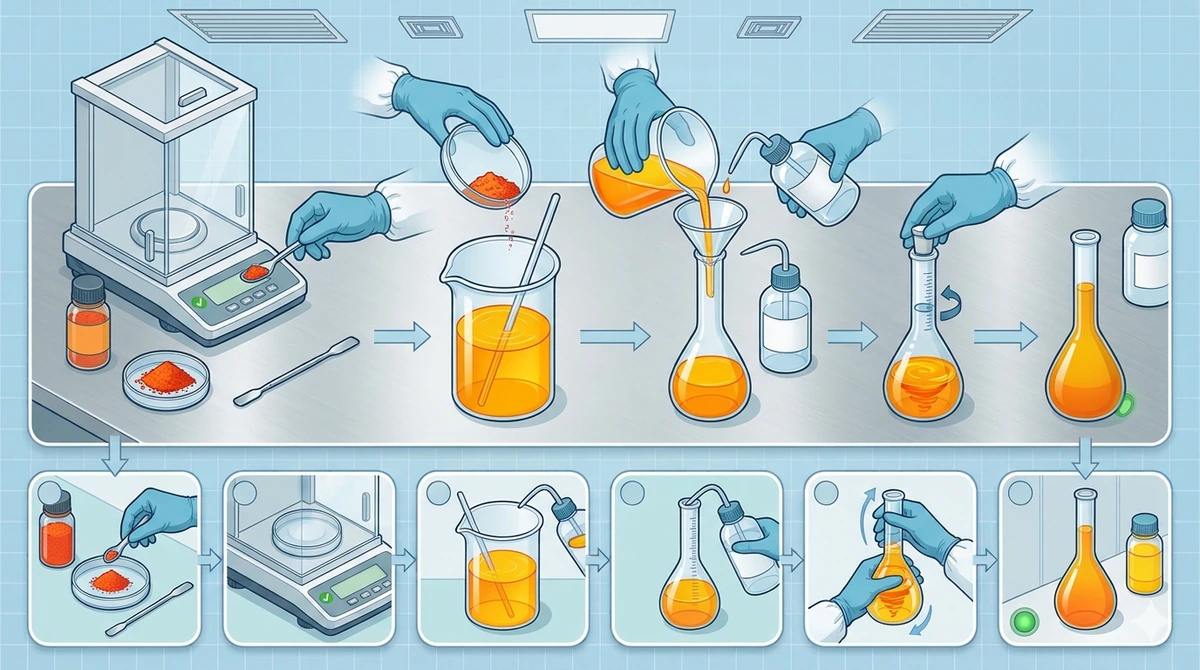
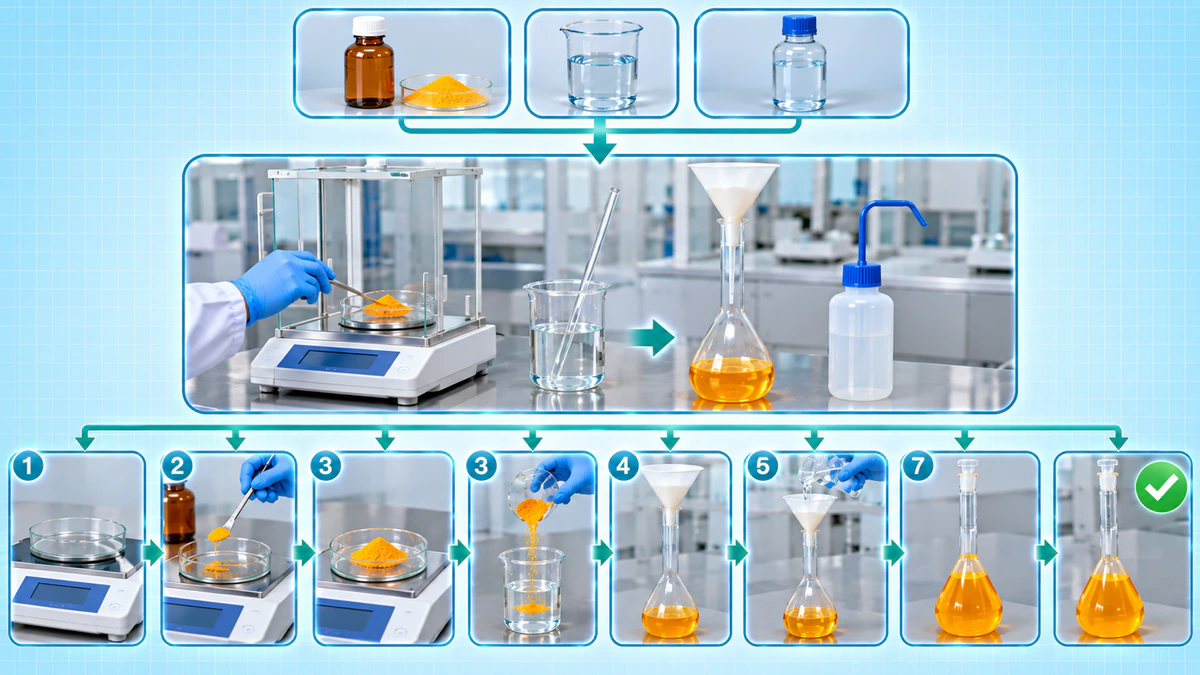
Place a clean petri dish on the balance and tare the balance.
Transfer the powder from the stock bottle to the dish with a spatula.
Weigh 0.1 g of methyl orange accurately on the calibrated balance and record the weight.
Transfer the powder to a beaker that contains 80 mL of distilled water, and stir with a glass rod until the dye dissolves. If it dissolves slowly, warm the water gently.
Place the funnel on the 100 mL volumetric flask, pour in the solution, and rinse the beaker and funnel into the flask with a little water from the wash bottle.
Make up to the 100 mL mark with ethanol (96%) for the BP version, or with water for the aqueous version, and mix by inverting the flask.
The solution is now 0.1% w/v methyl orange indicator. Complete the quality check and labelling before it is used.
Quality check of the finished solution
The BP sensitivity test is used to accept the solution. When 0.1 mL of the solution is added to 100 mL of carbon-dioxide-free water, the colour must be yellow, and no more than 0.1 mL of 1 M hydrochloric acid should turn it red. The analyst records the result in the preparation record.
Critical parameters
The table lists the values that decide whether the solution is correct.
| Parameter | Typical setting or range | Why it matters | How it is monitored |
|---|---|---|---|
| Strength | 0.1 g in 100 mL (0.1% w/v) | A stronger solution adds extra colour that can blur the end point | Weight recorded from the calibrated balance |
| Solvent (BP) | 80 mL water, then ethanol (96%) to 100 mL | The dye is insoluble in alcohol, so it is dissolved in water first | Volume noted in the preparation record |
| Transition range | BP pH 3.0 to 4.4; USP pH 3.2 to 4.4 | Decides which titrations the indicator suits | Sensitivity test |
| Sensitivity test | 0.1 mL in 100 mL CO2-free water; at most 0.1 mL of 1 M HCl | Shows that the solution responds correctly | Result recorded by the analyst |
Standards that apply
- The British Pharmacopoeia (BP) sets the recipe of 0.1 g in 80 mL water, made up to 100 mL with ethanol (96%), together with the sensitivity test.
- USP, in its chapter on indicators and indicator test papers, gives the transition interval as pH 3.2 to 4.4.
- USP general chapter <541> Titrimetry covers titration practice, and a revision of it has been proposed in Pharmacopeial Forum 48(5).
- The BP and Ph. Eur. style of reagent text is the basis of the ethanol version of the solution.
Storage, labelling and records
The solution must be kept in a closed, labelled bottle. The label should show the name, strength, preparation date, preparer and expiry date as the laboratory Standard Operating Procedure (SOP) requires.
The preparation record should hold the following details, so that every indicator solution can be traced.
- Reagent lot
- Weight
- Solvent and volume
- Balance ID
Use in titrations
The indicator is added to the titration flask in the amount the analytical method or SOP states. It is used as the end point indicator in acid standardisations such as 0.1 N HCl, standardisation of a stronger hydrochloric acid solution, standardisation of a dilute sulphuric acid solution and standardisation of a stronger sulfuric acid solution.
Certified ready-made 0.1% w/v aqueous solutions are sold as USP test solution, and a laboratory may buy these instead of preparing the solution in-house.
Safety and waste
Safety Data Sheets classify methyl orange (CAS 547-58-0) as acute oral toxicity category 3, toxic if swallowed, with a reported rat oral LD50 of about 60 mg/kg. Values differ slightly between suppliers, so the SDS of the lot in use applies.
- Wear gloves, goggles and a lab coat.
- Avoid raising dust while weighing.
- Dispose of waste as the site chemical waste SOP requires.
Common problems and fixes
- Residue or cloudy solution: Undissolved dye is the likely cause, so dissolve it in warm water and filter the solution.
- Unclear end point: Too much dye can blur the colour change, so use the quantity the method states.
- Colour shift near pH 4: Dissolved carbon dioxide can interfere, which is why the sensitivity test uses carbon-dioxide-free water.
Frequently Asked Questions
As per British Pharmacopoeia; methyl orange solution at 0.1% w/v, made by dissolving 0.1 g of the dye in 80 mL of water and making up to 100 mL with ethanol (96%). Commercial USP test solutions are also 0.1% w/v, but they are aqueous, so a plain-water preparation is standard practice as well.
Yes. Aqueous 0.1% w/v solutions are sold as USP test solution, so a plain-water preparation is standard practice. The same pharmacopoeia describes the dye as slightly soluble in cold water and readily soluble in hot water, so gentle warming helps it dissolve. If any residue remains, the solution should be filtered before it is stored.
Methyl orange is used in the standardisation of hydrochloric and sulphuric acid solutions against sodium carbonate, and in carbonate or bicarbonate assays that end between pH 3 and 4.5. Weak acids are titrated with a different indicator, such as phenolphthalein.
The BP sensitivity test is used for a new batch. A 0.1 mL portion of the solution is added to 100 mL of carbon-dioxide-free water, which must be yellow. No more than 0.1 mL of 1 M hydrochloric acid should turn it red. The analyst then records the result in the preparation record.
References
- British Pharmacopoeia: Methyl orange solution (2012 mirror), drugfuture.com
- USP 35: Indicators and Test Papers, drugfuture.com
- Indicators and Indicator Test Papers (USP text), trungtamthuoc.com
- Methyl Orange 0.1% w/v aqueous indicator solution (USP TS), Spectrum Chemical
- [Methyl Orange CAS 547-58-0 SDS, Durham Technical Community College](https://webdev.durhamtech.edu/sites/default/files/safety_data_sheets/Chemistry-and-Biology/Methyl Orange cas547-58-0 SDS.pdf)
- Revision of USP Chapter <541> Titrimetry, ECA Academy / gmp-compliance.org

Pankaj Sharma — Quality Control Specialist
Pankaj Sharma is a pharmaceutical QC professional who reviews our technical content for GMP accuracy, laboratory practices, and regulatory relevance.