
Quality Control, Quality Assurance Specialist | Industry Experience
✓ Reviewed by: Pankaj Sharma - Quality Control Specialist
Reviewed for QC, QA accuracy, laboratory practices, analytical methods, and technical Documents
📅 Last Updated: November 4, 2026
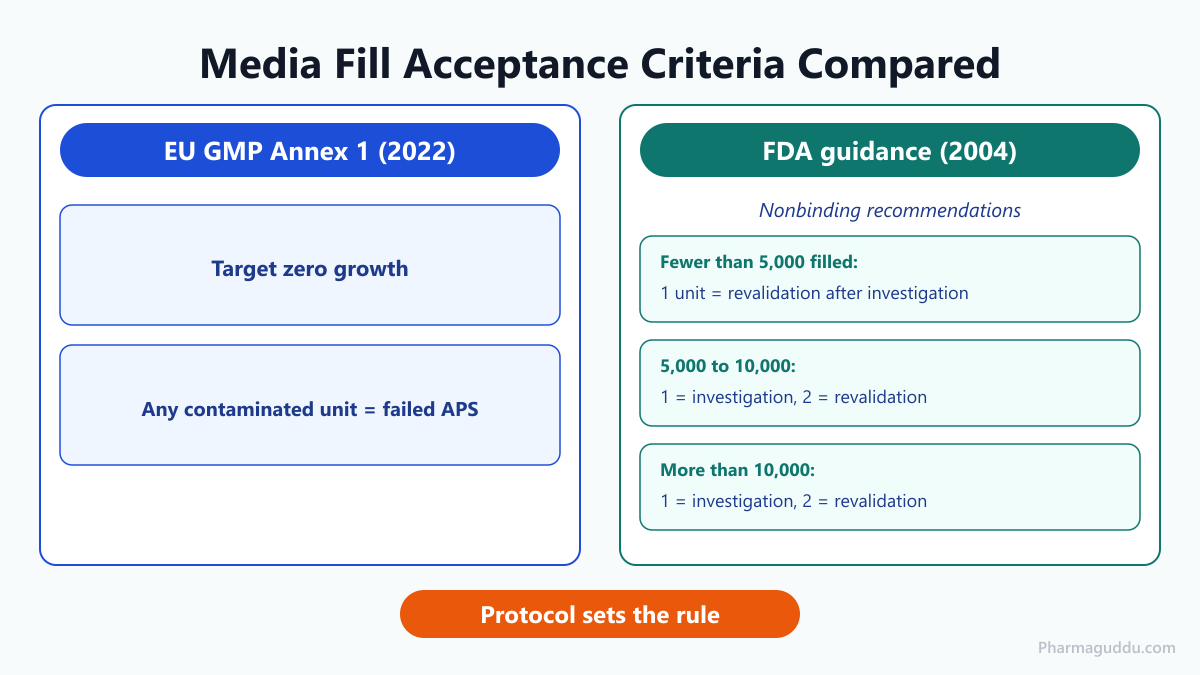
Acceptance criteria are defined in the approved protocol for media fill to determine whether an APS passes or fails. The aim in EU GMP Annex 1 (2022) is to achieve zero growth and if any contaminated unit is found then the APS will fail. The guidance from the FDA (2004) is advisory; the suggested actions depend on the number of units filled. There is no one-size-fits-all solution for the criteria and decisions will be based on the regulations applicable to you and your approved protocol. An investigation must always be documented when an APS fails.
What Are Media Fill Acceptance Criteria?
Media fill acceptance criteria are the rules that decide whether an APS run passed. The site writes and approves them before any unit is filled. For the full overview, see What is media fill in pharmaceutical. This article goes deeper into how the QA officer judges the results.
Fixing the rules first stops anyone bending them after seeing the vials. The protocol carries the units to fill, the incubation, the inspection method and the pass/fail rule. The media fill procedure and protocol guide shows how these parts fit together.
Process design, quality system discipline, training and monitoring data do the main job of validating an aseptic process. APS has a defined role beside them: it periodically verifies that the controls work (Annex 1, 9.32).
Which Media Fill Acceptance Criteria Apply in Your Market?
This will depend on where you are supplying to. The European Commission state that Annex 1 of EudraLex Volume 4 has been fully applicable since 25 August 2024. PIC/S members are using the same updated Annex 1, this was added to the PIC/S GMP Guide as PE 009-17 on 25 August 2023. The current guidance is PE 009-18 (24 September 2026).
In the US there are different requirements. Manufacturers must have documented procedures to prevent microbial contamination of products claiming to be sterile (21 CFR 211.113(b)). The FDA 2004 guidance on aseptic processing outlines what the FDA expects to see during media fills. This is non-binding guidance.
| Authority | Document | Rule for contaminated units | Status |
|---|---|---|---|
| EU | Annex 1 (2022), 9.46 | Target zero growth; any contaminated unit fails the APS | Part of EU GMP |
| PIC/S | PE 009-17 (Annex 1); current guide PE 009-18 | Same revised Annex 1 | Applied by member inspectorates |
| WHO | TRS 1044 Annex 2 (2022) | Text harmonised with EU and PIC/S | WHO GMP guidance |
| US | FDA guidance (September 2004) | Response banded by units filled | Nonbinding; CGMP regulations bind |
FDA recommends these responses for assessing line control:
| Units filled | Contaminated units | FDA recommended response |
|---|---|---|
| Fewer than 5,000 | 1 | Revalidation, after investigation |
| 5,000 to 10,000 | 1 | Investigation, including consideration of a repeat media fill |
| 5,000 to 10,000 | 2 | Revalidation, after investigation |
| More than 10,000 | 1 | Investigation |
| More than 10,000 | 2 | Revalidation, after investigation |
FDA also says that contamination in any run, whatever its size, points to a potential sterility assurance problem. A firm stays fully liable for shipping any nonsterile unit, whatever criteria it uses. Your site procedure can be stricter than these texts.
How Do You Evaluate Contaminated, Damaged and Excluded Units?
Count every unit first, then treat each category by the rule. Annex 1 and FDA draw the lines in nearly the same places.
Integral Units and Units Lacking Integrity
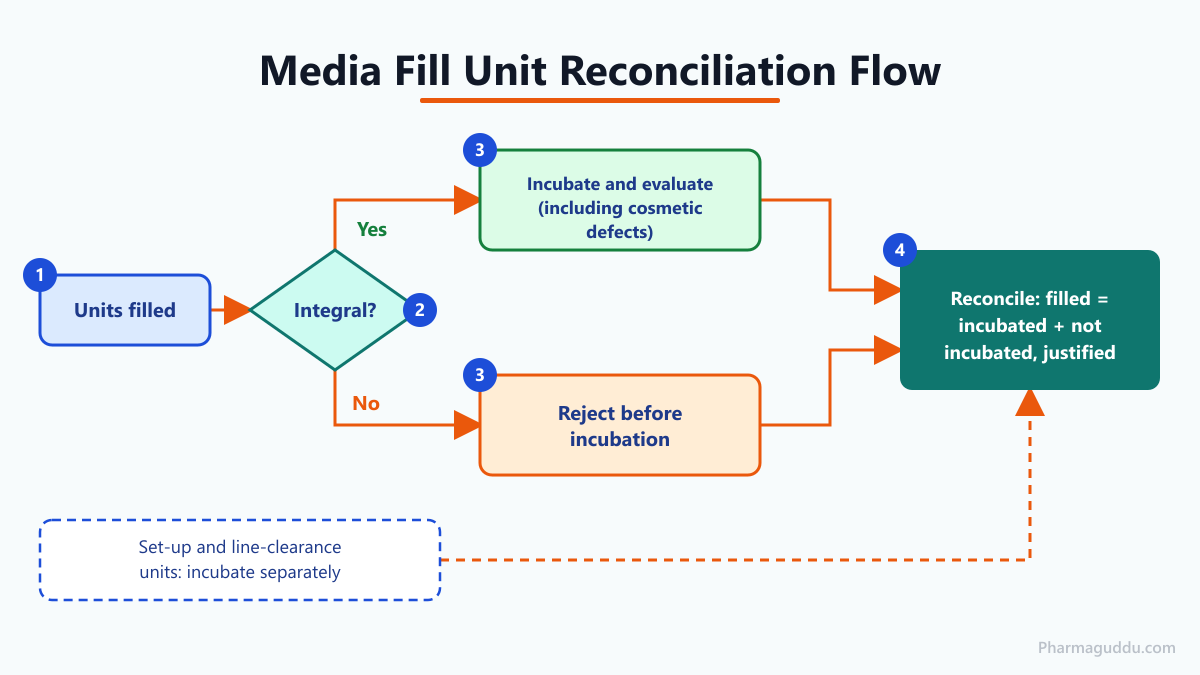
All complete units must be incubated and assessed. This includes units with visual damage and those that have passed non-destructive in-process testing (Annex 1, 9.41). This is also stated by the FDA. Incomplete units are rejected prior to incubation. If they were rejected in error, they will be incubated as part of the run.
Units that are found to be damaged during incubation should be included in the run data. They should only be excluded if there is full reasoning as to why they have been excluded and there is an explanation of this deviation in the media fill report (FDA 2004, section IX.A.8).
Discarded Units and Aborted Runs
Units can be removed by an APS without incubation. This should be defined in production SOPs as the same number of units will be removed due to the intervention type, line and number of units. The APS will never remove more than would be removed during production. For example, if the standard SOP states that 10 units are to be cleared due to an intervention at stoppering station infeed, the APS will remove 10 units and this will be reflected in the batch records.
Units cleared during set-up or mandatory line clearance are generally incubated. These units will demonstrate risk during set-up so do not need to be counted towards the acceptance criteria. An APS can only be aborted if there is a documented procedure in place which states that commercial lots must be treated in the same way. An investigation must be documented (Annex 1, 9.48).
Reconciliation and Unexplained Gaps
A reconciliation is performed to ensure that all units have been counted. This includes all incubated and non-incubated units. All non-incubated units should have a reason for this (Annex 1, 9.47). If there is an unexplained difference you cannot be confident of the result. A deviation should be raised.
What Do Initial and Repeat APS Require?
Annex 1 uses three separate terms: initial validation, periodic revalidation and repeat of the initial validation. Use them as written.
| Item | EU GMP Annex 1 (2022) | FDA 2004 guidance |
|---|---|---|
| Initial | At least three consecutive satisfactory simulations covering all working shifts (9.38) | At least three consecutive separate successful runs at line qualification |
| Routine repeat | Normally twice a year, about every six months, per process, line and shift (9.38) | Semi-annual, per line |
| Personnel | Each operator at least one successful APS yearly (9.38); manual operations need three consecutive initially and about six-monthly repeats (9.39) | Everyone authorised to enter the aseptic room, at least once a year |
| Units filled | Justified in the CCS; typically 5,000 to 10,000 minimum (9.40) | Starting point 5,000 to 10,000 |
| Incubation | Justified and validated conditions and duration (9.44) | Not less than 14 days at 20 to 35 °C, held within ±2.5 °C |
14 days and 20-35°C are FDA parameters. There is no set time frame given in Annex 1 so the time given in the protocol will be what was justified at site. The initial validation is repeated after a long period of non-use and after any change that could impact on the aseptic process such as new container closure systems (Annex 1, 9.49).
Trained, qualified staff inspect the units. Staff inoculate positive-control units with reference organisms and local isolates (9.45). The incubation and inspection guide covers this, and the growth promotion guide covers the medium. The interventions and worst-case design guide covers what the run must challenge.
How Are Media Fill Results Documented and Reviewed by QA?
The APS batch record contains information such as reconciliation, microbial monitoring data, details of interventions including start time, end time and who was involved in the intervention. The FDA also state that the QC team should monitor the running. Contaminated units should be able to be traced back to the approximate time and activity that the operators were simulating.
The QA officer will check that the package meets set requirements. This includes a complete reconciliation, qualified inspectors have looked at the units, positive controls have grown, monitoring has occurred throughout the run and all deviations have been raised by staff. The quality control unit should review production and control records (21 CFR 211.192). Steps to sign off and the class of deviation is determined by the site SOP.
Related topic: media fill for powders and lyophilized products
What Must You Do After a Contaminated Unit or a Failed APS?
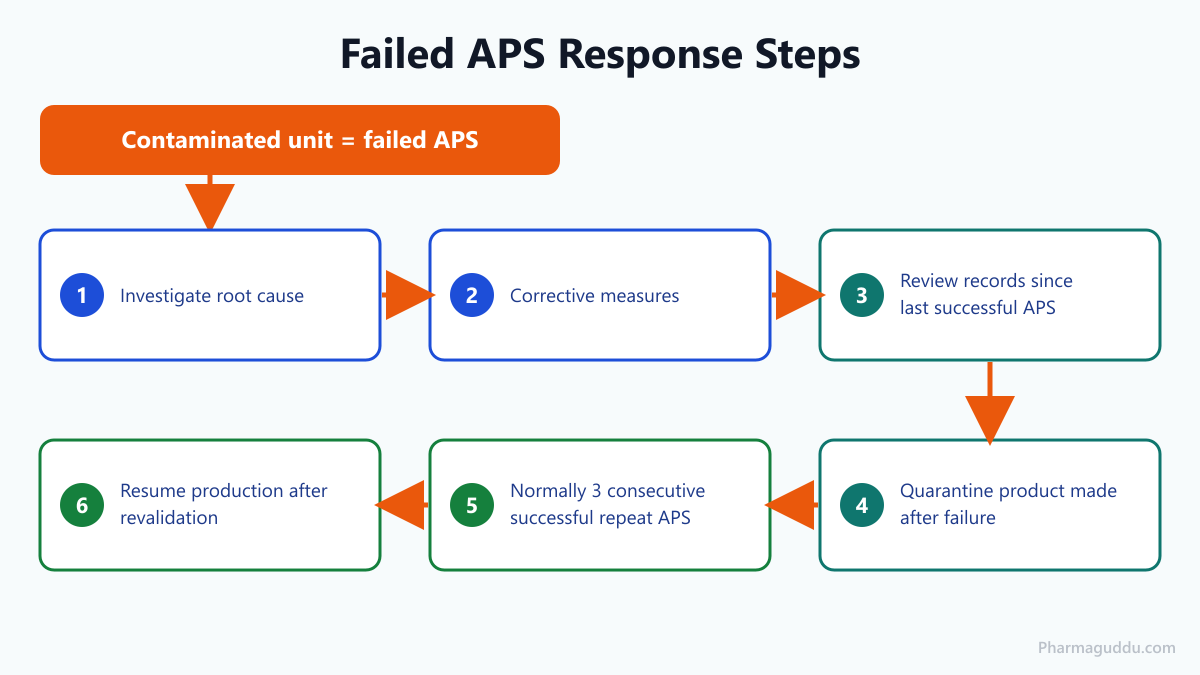
Any contaminated unit fails the APS. These actions follow:
- Investigate to find the most probable root cause or causes.
- Decide and apply corrective measures.
- Run enough consecutive successful repeat APS, normally a minimum of 3, to show the process is back in control.
- Review promptly all aseptic production records since the last successful APS, with a risk assessment of potential sterile breaches in those batches. Other unreleased batches fall inside the investigation.
- Quarantine all product made on the line after the failure until it is resolved.
- Limit an operator’s activities until retraining and requalification, where the root cause points to operator activity.
- Resume production only after successful revalidation.
Identify isolates to species level where practical (Annex 1, 9.43). FDA asks the investigation to survey possible causes and assess the commercial product made since the last media fill. If no well-supported cause emerges, FDA says you may need three consecutive successful runs with closer scrutiny. The site normally runs corrective measures through its CAPA system, with an effectiveness check.
What Are the Common Misconceptions About Media Fill Results?
“A Passing Repeat Closes the Failure”
No. A passing repeat doesn’t close a failure. The investigation, corrective measures, the repeat series and the record review since the last successful APS all stay open until complete.
“FDA Bands Mean One Positive Is Acceptable”
Treat the bands as recommended responses. FDA calls any contaminated unit objectionable, and the manufacturer remains liable for nonsterile units.
“An End-of-Campaign APS Can Replace the Routine One”
An end-of-campaign APS is allowed only as extra assurance or for investigation. It must not replace the routine APS (Annex 1, 9.36 xiii).
“One Threshold Fits Every APS”
Unit counts, incubation and design vary by process, so the approved protocol and the applicable regulation set the rule.
Frequently Asked Questions
As per EU GMP Annex 1 (2022), there should be zero contaminated units. The aim should be zero growth. Any contaminated unit will fail the APS. In FDA guidance (2004) there are bandings based on number of units filled. These can be seen in the table above. Your protocol will state what is acceptable for your market.
Annex 1 states: “The aim should be zero growth. If any contaminated units are identified, the APS should fail.
No. An investigation must be carried out, corrective actions must be taken and typically 3 consecutive passes must be achieved. A review of records back to the last successful APS must also be carried out. Product made after the failure will be quarantined until the failure has been resolved.
These are FDA recommendations (2004) for US supply. There are no bands in Annex 1. The number 5,000-10,000 in Annex 1 (9.40) is a typical minimum number of units to be filled. This is not an acceptance criterion for contamination.
Product made on the line after failure will be quarantined until the failure has been resolved (Annex 1, 9.46). Records relating to aseptic production back to the last successful APS will be quickly reviewed. Risk assessment will be carried out. Other batches of product not released will be included in the investigation.
References
- EU GMP Annex 1: Manufacture of Sterile Medicinal Products (2022), European Commission
- EudraLex Volume 4, European Commission
- Entry into force of revised Annex 1, PIC/S GMP Guide PE 009-17, PIC/S
- WHO TRS 1044 Annex 2: GMP for sterile pharmaceutical products, WHO
- Guidance for Industry: Sterile Drug Products Produced by Aseptic Processing, CGMP (September 2004), US FDA

Pankaj Sharma — Quality Control Specialist
Pankaj Sharma is a pharmaceutical QC professional who reviews our technical content for GMP accuracy, laboratory practices, and regulatory relevance.