
Microbiologist & Regulatory Specialist
✓ Reviewed by: Pankaj Sharma - Quality Control Specialist
Reviewed for QC, QA accuracy, laboratory practices, analytical methods, and technical Documents
📅 Last Updated: November 12, 2026
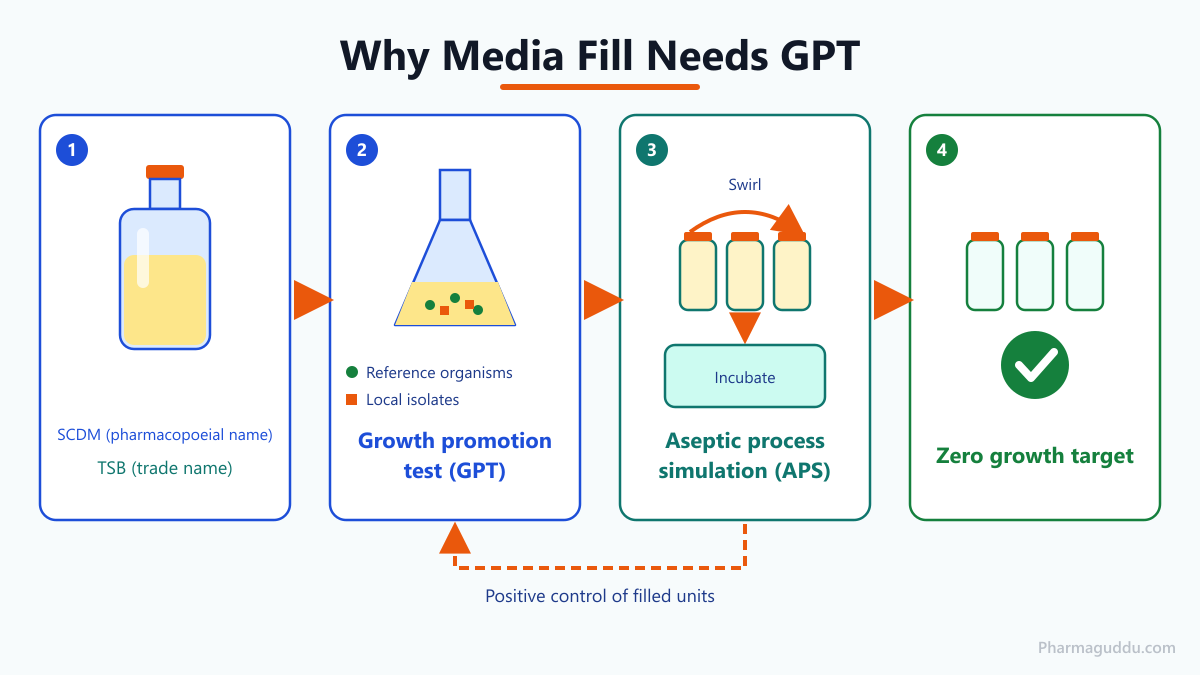
SCDM (Soybean Casein Digest Medium) and TSB (Tryptic Soy Broth) are identical general purpose liquid non-selective media. The difference between both media types is that SCDM is the pharmacopoeia name whilst TSB is just a generic name. These media can be used in a media fill / Aseptic Process Simulation (APS), however in order to ensure that it is a clean run the media must provide growth of organisms, which is proved by doing growth promotion testing (GPT).
What Are SCDM and TSB in Media Fill?
The two most commonly names for the media used during media fill are SCDM and TSB. Most suppliers will have the liquid named as tryptic soy broth (or tryptone soya broth in some regions) on their labels. For further details on the overall media fill run, please refer to What is Media fill in Pharmaceutical.
Both media are non-selective general purpose media based on casein and soy peptones.
As the formulations can differ slightly between suppliers, just because it states a certain name on the label doesn’t mean it is the correct medium. The QC analyst will compare the formulation and certificate of analysis of the received lot to the medium stated in the validated method.
The FDA guidance on aseptic processing (2004) states that a microbiological growth medium (such as Soybean Casein Digest Medium) should generally be used. Anaerobic media (such as Fluid Thioglycollate Medium) should only be considered under exceptional circumstances (Section VII).
Why Does the SCDM TSB Growth Promotion Test in Media Fill Matter?
The medium is the detection method. If a smoke alarm has never been tested then a lack of sound will tell you nothing. The media fill achieves this. The aim of the media fill is to achieve no growth. This should be the aim of the media fill (Annex 1, 2022). ‘The aim should be to ensure no growth occurs. Any unit showing contamination will fail the APS.’
APS should be carried out periodically to confirm the aseptic controls are effective. The sterile media or simulant should be used, this is not the main validation of the aseptic process. This is done through the design of the process, quality system, training and monitoring data. (Annex 1 para 9.32).
‘The medium or simulant should be selected to reflect the physical properties of the product that could impact on sterility. When using a simulant such as a buffer during the run, it should not suppress the growth of any contamination.’
All simulation materials should be microbiologically assessed for sterile active substances to ensure they do not affect recovery. This includes the growth medium and simulant. (Para 9.37). Discarded materials such as product flush are simulated using nutrient media and are incubated. (Para 9.42).
What Is Growth Promotion Testing and When Is It Done?
Growth promotion testing (GPT) is a test carried out in the lab to confirm that a batch of media will support the growth of a defined range of organisms added in low numbers. This test confirms that the media will become turbid if it was contaminated.
The chosen media should support the growth of a defined range of reference microorganisms described within the relevant pharmacopoeia plus suitable representative local isolates (Annex 1 paragraph 9.36 vi). FDA 2004 section VII states that the media should support the growth of both gram positive and gram negative bacteria, yeast and mould. For example USP indicator organisms. A challenge is made with less than 100 CFU (colony forming units – viable organisms).
The QC laboratory should determine if the USP organisms are representative of those encountered during production. Environmental monitoring and sterility test isolates can be added or replaced if appropriate.
Many sites test every new lot on receipt, as in this procedure for growth promotion test in microbiology. Ready-made media usually arrive with supplier GPT evidence, and the site decides what incoming checks to add. The timing belongs in the site SOP and the pharmacopoeial or validated procedure.
GPT of the medium versus positive control of filled units
These are two separate steps. GPT is performed in the lab using the medium. The positive control (Annex 1 paragraph 9.45 ii) is performed after incubation. Samples of the inoculated APS units are inoculated with a suitable range of reference organisms and representative local isolates. This demonstrates that the medium will still grow organisms once it has been in the actual containers and processed.
What Do the Standards Say About Organisms, Incubation and Acceptance?
Annex 1 and the FDA guidance do not say the same things, and neither is a pharmacopoeia. The table keeps them apart.
| Item | EU GMP Annex 1 (2022) | FDA guidance (2004) |
|---|---|---|
| Medium growth ability | 9.36 vi: reference organisms per pharmacopoeia plus local isolates | Section VII: gram-positive, gram-negative, yeast, mould; inoculum below 100 CFU |
| Incubation | 9.44: conditions and duration scientifically justified and validated; no day count | Not less than 14 days; 20–35 °C, held within ±2.5 °C of target |
| Two temperatures | Not specified | At least 7 days at each, lower temperature first |
| Acceptance | 9.46: target is zero growth; any contaminated unit fails | Recommended criteria by run size (below) |
| Run size | 9.40: typically 5,000 to 10,000 units; small batches at least equal to production batch | Starting point 5,000 to 10,000 units; small operations at least the maximum batch size |
These are guidelines rather than hard limits. For quantities of less than 5,000 units no contaminated units should be found and if any are found this will require re-validation after investigation. For quantities between 5,000-10,000 units one contaminated unit will require investigation which may lead to a repeat media fill. If two contaminated units are found this will require re-validation. For quantities over 10,000 units one contaminated unit will require investigation and two contaminated units will require re-validation. The language in Annex 1 is more strict and states that if one contaminated unit is found then the APS has failed.
The strains, quantity of inoculum, incubation conditions and pass criteria for the lab based GPT will depend on the pharmacopoeial chapter or validated method being used at your site. As this will vary between chapters it will not be repeated in this article.
PIC/S have their own version of the Annex 1 guidelines published as PE 009 which is used by inspectorates in PIC/S member countries.
How Do You Prepare, Store and Handle the Medium?
Treat the medium like any other critical material: defined, prepared by a validated method and traceable to a lot.
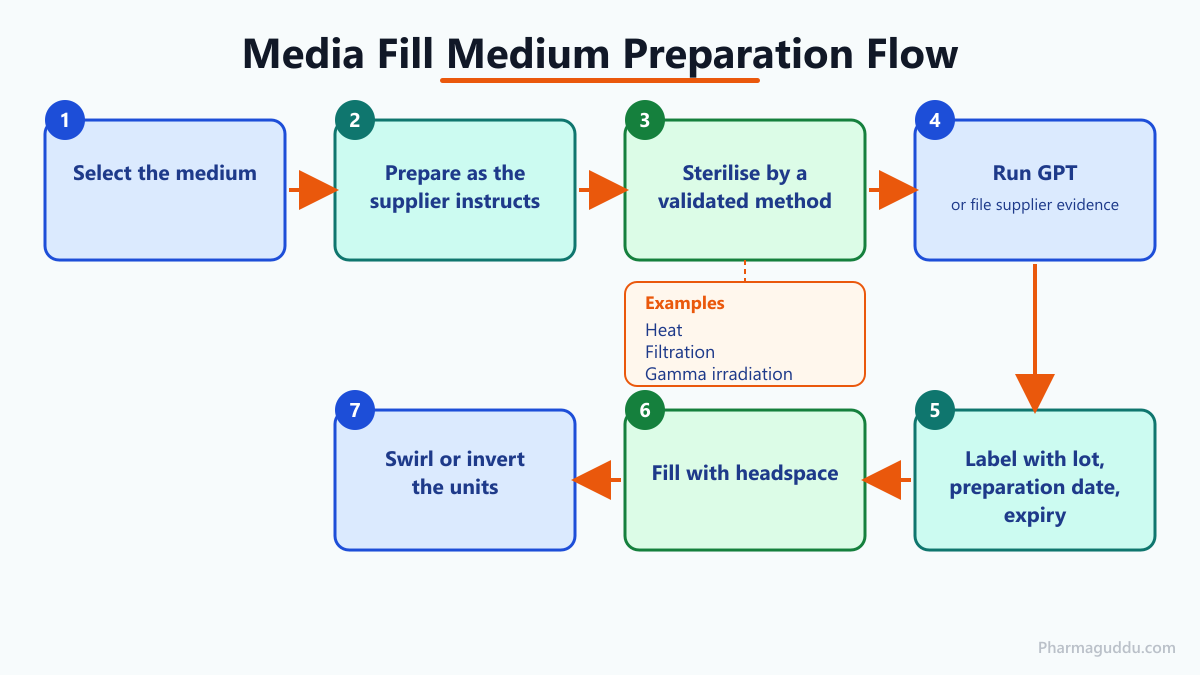
- Select the medium in the APS protocol and justify it against the product and the process.
- Prepare it as the supplier instructs, unless a different method is scientifically justified and documented.
- Sterilise it by a validated method. Heat, filtration and gamma irradiation are all in use, and ready-made irradiated bags or dry powder are common options.
- Run GPT on the lot, or file the supplier’s GPT evidence together with your incoming checks, as the SOP requires.
- Label it with lot, preparation date, expiry and storage conditions.
- Fill a volume that wets every surface and leaves headspace.
- Swirl or invert the sealed units before incubation.
There is no universal shelf life or hold time for prepared medium. Ready-made medium follows the supplier’s label and certificate of analysis. Medium prepared in house needs an in-use shelf life and hold times set from the site’s own data. Your internal SOP for storage and preparation of media and culture is the place to record them.
How Does Medium Suitability Affect Contamination Detection?
If the medium is suitable for GPT, but other parts of the set-up are poor, then this could still be an issue. This is detailed in annex 1.
The volume should be sufficient to allow the medium to come into contact with all the equipment and components. The volume should also allow sufficient headspace for growth and visibility of turbidity. (9.36 iv) Units should be agitated, swirled or inverted prior to incubation to ensure contact with all internal surfaces. All integral units including those with cosmetic damage are incubated.
Containers should be transparent or a validated method of detection used if product container is amber/ opaque. (9.43) If isolates are obtained from contaminated units these should be identified to species level if possible. Units should be visually examined by trained and qualified personnel. (9.45 i)
FDA also state that if a damaged unit is discovered during incubation it should be included in the run data. It would need to be fully justified why it was excluded.
Why Is 3% SCDM Used in Media Fill?
3% probably relates to the concentration of the medium, expressed as weight/volume (w/v). When sites state that they use 3% SCDM, it usually means that they are using approx 30g of the dehydrated medium per litre of water. This is consistent with many manufacturers’ label recommendations.
This is not a requirement, neither Annex 1 (2022) or the FDA 2004 guidance documents specify any concentration of medium. The only requirement is that the reference organisms and local isolates grow in the medium (Annex 1, paragraph 9.36 vi). Although some web pages state that 3% is a global standard, none of these cite any official documentation.
In reality, sites will use a concentration usually based on the manufacturers’ standard. This will be stated in the protocol with justification. GPT will show that the concentration used supports growth. If a different concentration was used, this would follow the same logic.
How Is GPT Different from Environmental Monitoring, Sterility Testing and the Run Assessment?
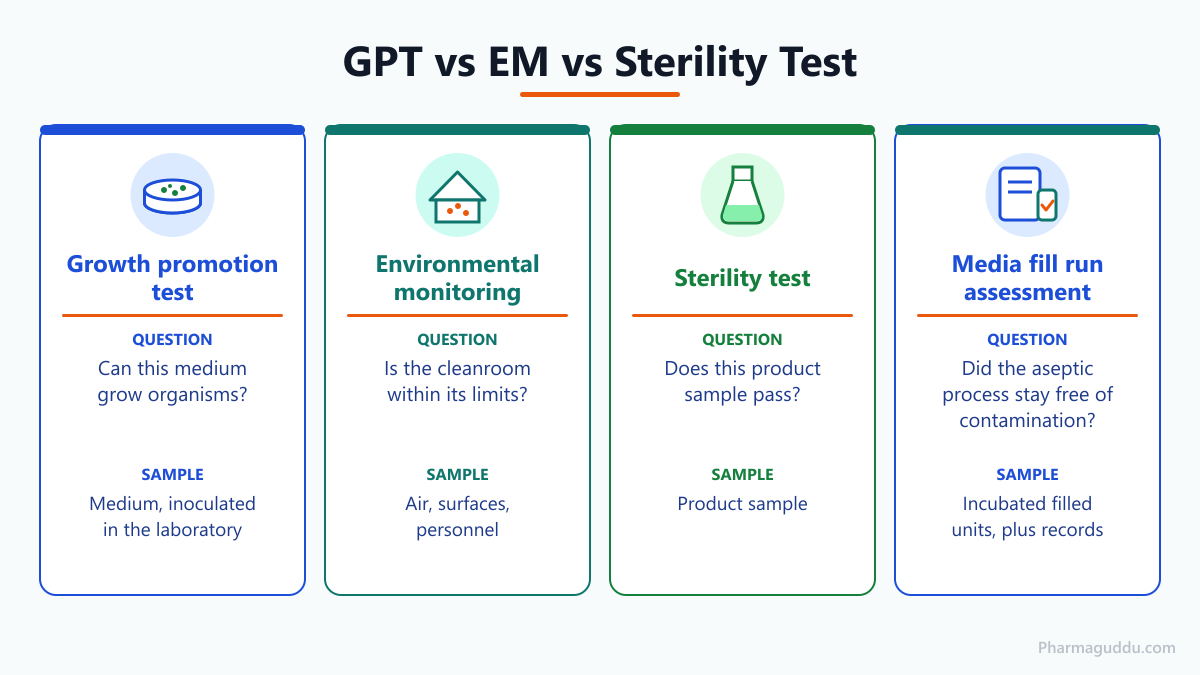
| Activity | Question it answers | Sample |
|---|---|---|
| Growth promotion test | Can this medium grow organisms? | Medium, inoculated in the laboratory |
| Environmental monitoring | Is the cleanroom within its limits? | Air, surfaces, personnel |
| Sterility test | Does this product sample pass? | Product sample |
| Media fill run assessment | Did the aseptic process stay free of contamination? | Incubated filled units, plus records |
Annex 1 Paragraph 9.36 xi states that routine environmental monitoring should be carried out throughout the APS. The data will be assessed along with the outcome of the run. Contaminated units, actions taken, staff involved, environmental monitoring data and investigation will be considered. A satisfactory GPT result will not mean the run will pass. A sterility test passing will not be used in place of a media fill.
For more detail on media fill interview questions and answers, see Media Fill Interview Questions and Answers: A Complete Guide for QA, QC and Production.
Recent Technology Trends
Annex 1 (C(2022) 5938 final) was published on 25 August 2022. The text states that the protocols should be implemented by 25 August 2023, with 25 August 2024 for point 8.123 only. Many sites updated their APS protocols and medium controls at this time.
Technical Report 22 on process simulation was updated in 2025 according to the PDA. However, only the listing in the bookstore was available, so the detail of the guidelines have not been included.
A supplier white paper from WILCO details how media filled vials can be automatically inspected using laser headspace analysis of CO2 and O2. This provides an objective alternative to visual turbidity checks. (No date). As stated in Annex 1 paragraph 9.36 vii, any detection method should be scientifically justified to ensure reliable detection of contamination.
Common Mistakes and Troubleshooting
GPT fails on a lot of medium
Possible causes:
Wrong or over-passaged culture, an inoculum above the allowed count, overheated medium, or a damaged lot.
Corrective actions:
Open a deviation and investigate the cause of the failure. FDA 2004 says that if growth promotion fails, the origin of any contamination in the run should still be investigated and the media fill promptly repeated.
Turbid units after a passed GPT
Possible causes:
Real contamination of the process, not a medium problem. The passed GPT shows the medium could grow organisms, which makes the turbidity more credible.
Corrective actions:
Identify the isolate to species and compare it with the environmental monitoring flora. Then follow Annex 1 paragraph 9.46: investigation, corrective measures, repeat APS and a review of batches made since the last successful APS.
No growth, but doubts about the medium
Possible causes:
Too little fill volume, units not swirled or inverted, medium held beyond its validated time, or inspection by untrained staff.
Corrective actions:
Review fill volumes, hold times and inspector qualification before accepting the result.
Units excluded without a reason
Damaged or defective units dropped from the tally without written justification. Annex 1 paragraph 9.47 asks for a full reconciliation of units filled, incubated and not incubated.
Documentation and QA Review Points
The QA officer reviewing an APS package should find the following in the record:
- The medium used, supplier, lot, certificate of analysis, preparation record and sterilisation record
- The GPT report with strains, passage level and results, or the supplier’s evidence and the incoming check
- The positive-control record for the filled units, using reference organisms and local isolates
- Unit reconciliation, intervention log with start and end times, and environmental monitoring data
- Incubator temperature logs, inspector qualification records and the identification of any isolate
Incubator logs and inspection sheets should follow the principles of ALCOA and ALCOA+ data integrity. A failed APS goes through deviation, investigation and CAPA, and changes to the medium or its supplier go through change control.
- Describe the medium fully in the protocol. Write supplier, product code, strength and sterilisation method, not just “TSB”.
- Test the lot you fill with. A GPT on a previous lot does not cover the one in the vessel.
- Keep strain records tight. Record source, passage level and expiry of every culture used for GPT and positive control.
- Include local isolates. Pull them from environmental monitoring and sterility test history, as Annex 1 expects.
- Fill for visibility. Leave headspace so turbidity can be seen, and swirl every unit.
- Qualify inspectors. Run periodic test sets of known turbid and clear units.
- Write the 3% rationale down. A single justified line in the protocol saves a long audit discussion.
- Treat a GPT failure as a deviation. Never repeat the test quietly until it passes.
Frequently Asked Questions
Yes, SCDM is the pharmacopoeial name and TSB is the generic name, It is a general, non-selective liquid media made from casein and soy peptones. Different suppliers may have slightly different formulations so the formula and certificate of analysis of the purchased product is compared with that of the media specified in the validated method.
No. There is no requirement for a medium concentration in Annex 1 (2022) or FDA guidance (2004). It is typically 3% w/v, approximately 30g of powder per litre. This is common practice and many suppliers will give this as a recommendation. The strength used at the site should be justified within the protocol and growth promotion testing should show that it supports growth.
In general, each new batch of medium will be tested upon receipt. Pre-prepared media will have documentation from the suppliers and testing upon receipt. The testing will be carried out according to the pharmacopoeia chapter or validated method and site SOP. Positive controls of the incubated filled units are also required as per Annex 1.
If the growth promotion test fails, it is considered a deviation. The FDA 2004 states that you should investigate any potential contamination in the run and repeat the media fill as soon as possible. The reason for the GPT failure should be investigated. The run cannot be used to conclude there was no growth because the medium has failed GPT.
No. GPT shows that the medium can grow organisms. Environmental monitoring samples the cleanroom, and sterility testing examines a product sample. The media fill run is judged on contaminated units, interventions, monitoring data and any investigation. Each answers a different question, and none can stand in for another.
Summary
SCDM and TSB are the same type of non-selective medium, and the medium is only a reliable detector once GPT and positive control prove it. Annex 1 sets a zero-growth target and requires justified, validated incubation. FDA 2004 gives 14 days. The 3% strength is common practice, not a rule.
References
- Annex 1: Manufacture of Sterile Medicinal Products (C(2022) 5938 final), European Commission
- Guidance for Industry: Sterile Drug Products Produced by Aseptic Processing, Current Good Manufacturing Practice (October 2004), US FDA
- Sterile Drug Products Produced by Aseptic Processing, guidance page, US FDA
- PIC/S Publications (PE 009 Guide to GMP), PIC/S
- PDA Technical Report No. 22 (Revised 2025): Process Simulation for Aseptically Filled Products, PDA
- Aseptic Process Simulation (APS), Merck/Sigma-Aldrich
- Why 3% Soybean Casein Digest Medium (SCDM) is Used for Media Fill Validation, pharmaceuticalmicrobiology.in
- Automated media fill inspection, WILCO AG
- USP and Ph. Eur. general chapters on microbial examination and sterility testing, current editions

Satpal Singh — Quality Assurance & Regulatory Specialist
Satpal Singh is an experienced pharmaceutical Quality Assurance and Regulatory professional with expertise in GMP compliance, quality systems, technical documentation, and regulatory requirements. He reviews our pharmaceutical content to ensure accuracy, industry relevance, and alignment with current quality and regulatory standards.
Expertise: QA Systems | GMP Compliance | Regulatory Documentation | Audits | Quality Management