
Quality Control Specialist | Industry Experience
✓ Reviewed by: Pankaj Sharma - Quality Control Specialist
Reviewed for Quality Control accuracy, laboratory practices, analytical methods, and technical relevance
📅 Last Updated: October 31, 2026
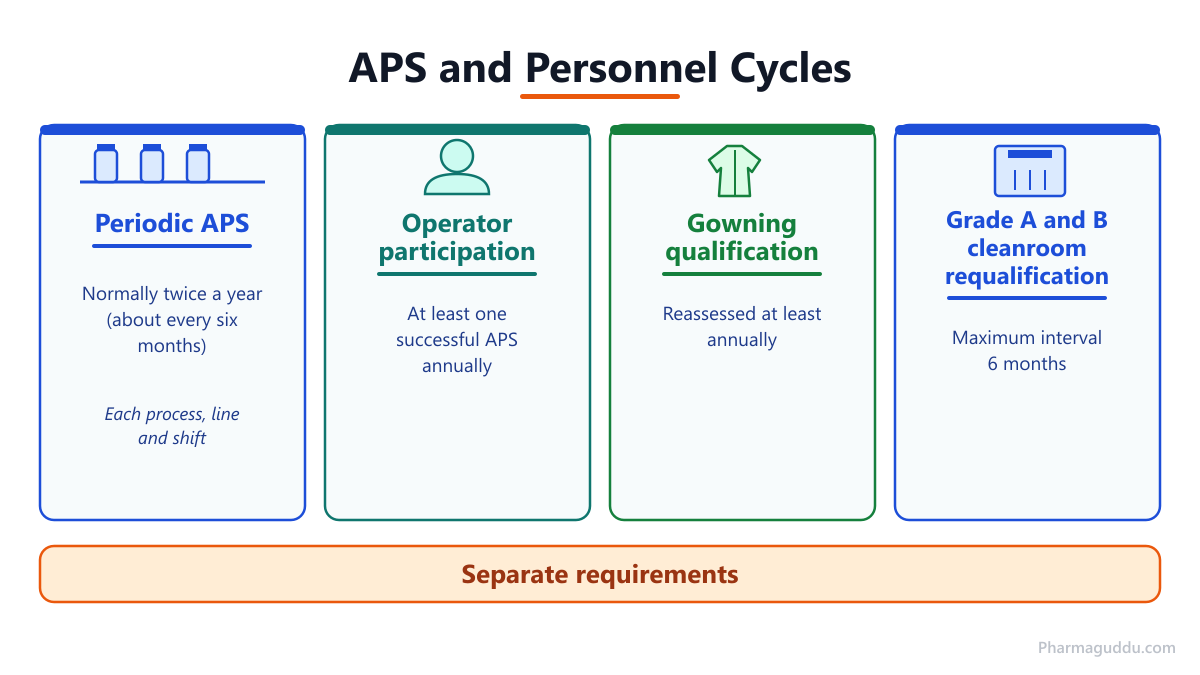
Under EU GMP Annex 1 (2022), para 9.38, media fill (aseptic process simulation, APS) is normally repeated twice a year, about every six months, for each aseptic process, filling line and shift. Each operator should also take part in at least one successful APS every year. Gowning qualification is a separate annual requirement. A significant change, a long shutdown or a failed run can call for an extra APS. FDA’s 2004 guidance recommends similar cycles but is nonbinding. Your approved site procedure and the rules of your inspecting authority decide the actual interval.
What Is Media Fill Frequency and Requalification?
Media fill frequency and requalification means how often a sterile site repeats its APS. It also covers when the site must qualify lines, shifts or people again. An APS runs sterile growth medium through the real aseptic process to show that microbes stay out. For the full overview, see What is Media fill in Pharmaceutical. This article covers timing, triggers and consequences only.
Related topic: SCDM TSB growth promotion test in media fill
How Do the Frequency Cycles Differ?
Three cycles run side by side, and the cleanroom adds a fourth clock. Sites often merge them into one calendar entry, and that hides gaps.
| Cycle | Applies to | Annex 1 (2022) requirement | Paragraph |
|---|---|---|---|
| Periodic APS | Each aseptic process, filling line and shift | Normally twice a year, about every six months | 9.38 |
| Operator participation | Each operator | At least one successful APS annually | 9.38 |
| Manual operations | Each operator, per container type, closure and equipment train | One APS about every 6 months, after 3 consecutive successful APS initially | 9.39 |
| Gowning qualification | Each person | Reassessed at least annually, visual and microbial | 7.4 |
| Grade A and B cleanroom requalification | The room | Maximum interval of 6 months | 4.32 |
Gowning qualification and participation in a successful APS are two separate requirements (para 7.4). A person needs both before unsupervised access to grade A or B. Annex 1 calls the repeat of an APS “periodic revalidation” and keeps “requalification” for people and cleanrooms. This article follows the same wording.
The word “normally” in para 9.38 leaves room to deviate, but only with a reason. The Annex 1 Scope treats stated frequencies as a minimum requirement. A longer interval needs a written justification that an inspector can accept.
What Does Annex 1 Require for Initial and Periodic APS?
Initial qualification is part of initial validation. Para 9.38 asks for at least three consecutive satisfactory simulations that cover all working shifts on which the aseptic process may run. After that, the periodic APS repeats about every six months for each process, line and shift.
The plan must challenge the real operation. The run should be long enough to cover interventions and shift changes. It should also cover the longest time an operator may stay in the cleanroom on extended shifts (para 9.36). An end-of-campaign APS can add assurance, but it never replaces the routine run, and the contamination control strategy (CCS) must justify it.
If a process has not run for an extended period, repeat the initial validation (para 9.49). Annex 1 gives no number of days.
PIC/S PI 007-6 (2011) names lines idle for more than 6 months as an example (section 5.5.5). Before a shutdown, long inactivity or relocation, consider an APS after the last batch (para 9.38).
Para 9.38 has no exemption for isolators or RABS. FDA’s 2004 guidance (section IX.A.4) allows a smaller run size for isolators, but that concerns units filled, not frequency. For design detail, read media fill for powders, lyophilized products, isolators and RABS.
How Do Annex 1, PIC/S and FDA Compare?
The three documents share the same ideas but differ in force and detail.
| Topic | Annex 1 (2022) | PIC/S PI 007-6 (2011) | FDA guidance (2004) |
|---|---|---|---|
| Status | EU GMP, in operation since 25 Aug 2023 | Inspector recommendation | Nonbinding recommendations |
| Initial runs | 3 consecutive, all shifts (9.38) | 3 consecutive per shift (5.5) | At least 3 consecutive separate runs per line (IX.A.2) |
| Periodic runs | Normally twice a year per process, line and shift | Each shift of each line at least twice a year, if no changes and no action limits exceeded | Semi-annual per line |
| Personnel | Each operator, once a year | Periodic simulations confirm training works (8.6-8.7) | All authorized staff, including technicians and maintenance, once a year |
| Acceptance | Any contaminated unit fails (9.46) | Tiers by run size (6.2) | Tiers by run size (IX.A.9) |
The tiers matter because old SOPs still carry them. Under FDA, a run under 5,000 units should show no contamination, and one positive is cause for revalidation after investigation. For 5,000 to 10,000 units, one positive means investigation and two mean revalidation. EU Annex 1 does not use tiers. FDA also suggests formulation-stage simulation at least twice a year (Appendix 3).
Who Must Take Part, and What About Absence or a Role Change?
Para 7.4 limits unsupervised grade A and B access to people who passed gowning assessment and took part in a successful APS. Para 7.5 allows an unqualified person in only in exceptional cases. That needs a written procedure, a supervising authorised person and a record in the quality system.
Include everyone who enters. FDA names technicians and maintenance staff (IX.A.2). The gaps appear with maintenance fitters and QC samplers, not with the filling crew.
Annex 1 gives no interval for an operator who returns after absence or changes role. It only says that requalification after disqualification should include considering participation in a successful APS (para 7.6). So your SOP needs a risk-based rule, not a borrowed number. Define these points:
- Which absence lengths trigger a gowning requalification and a supervised return.
- Which role changes, such as moving to grade A interventions, need a new successful APS first.
- Who decides: the QA manager signs the decision, with microbiology input.
For example, a technician who moves from labelling to the filling suite has no recent grade A intervention history. The SOP should send that person through gowning requalification and an APS before unsupervised work.
When Does a Change Need an Additional APS?
You need an APS after any significant change to practices, facilities, services or equipment that you assess to affect sterility assurance (para 9.38). The list includes HVAC modification and equipment changes. It also includes process changes, the number of shifts and personnel, and a major facility shutdown.
A new container or container-closure combination also triggers one (para 9.49).
PI 007-6 treats a new shift, a product-contact equipment change or an HVAC change as critical (5.5). These get a start-up series of three tests. Less critical changes may need one on-going test.
FDA lists similar examples and says each change goes through written change control (IX.A.2).
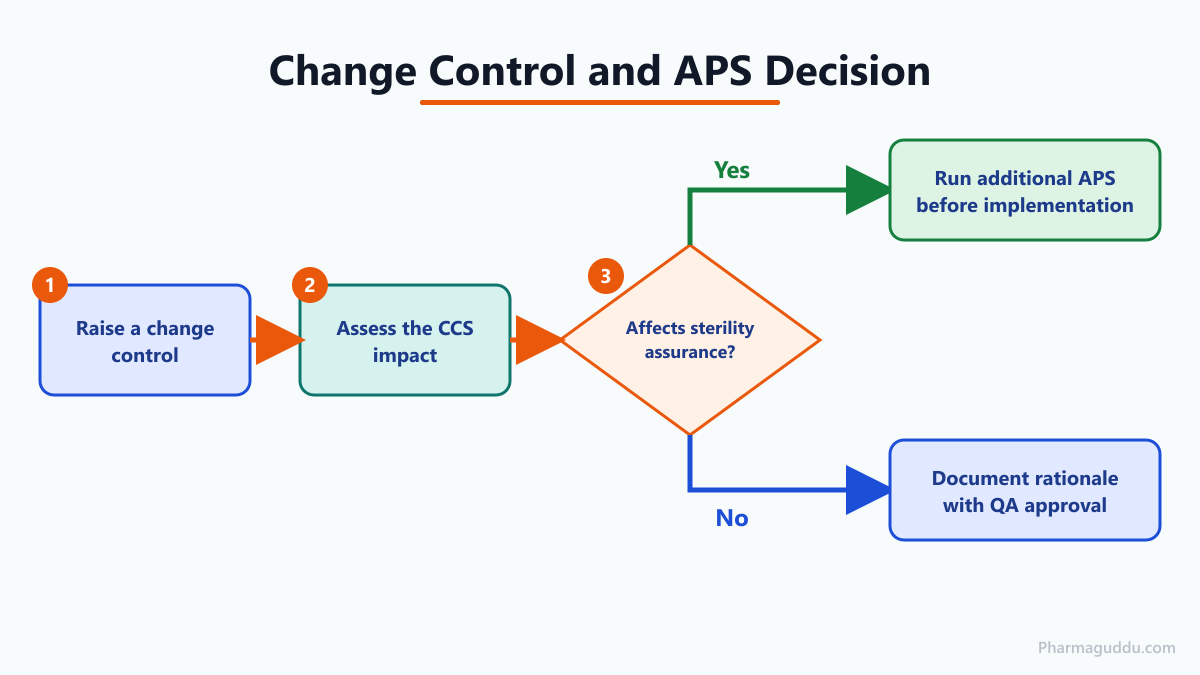
Follow this order for every change:
- Raise a change control.
- Assess the CCS impact (Annex 1, para 2.6).
- Decide whether the change affects sterility assurance.
- If it does, run the additional APS before implementation, scoped by risk.
- If it does not, document the rationale with QA approval.
How Do Risk Assessment, the CCS and QA Decide?
No fixed list can cover every change, so a risk assessment fills the gap. Before and after a change, check its impact on the CCS (para 2.6). Justify the number of units filled in the CCS as well (para 9.40).
APS is not the main way to validate an aseptic process. It works together with viable and non-viable monitoring (para 9.32).
QA holds the final word. QA must investigate nonconformities before certification or release, and justify the batch scope (para 3.2).
People with aseptic expertise should observe operations, including APS, regularly (para 8.19).
What Happens When an APS Fails?
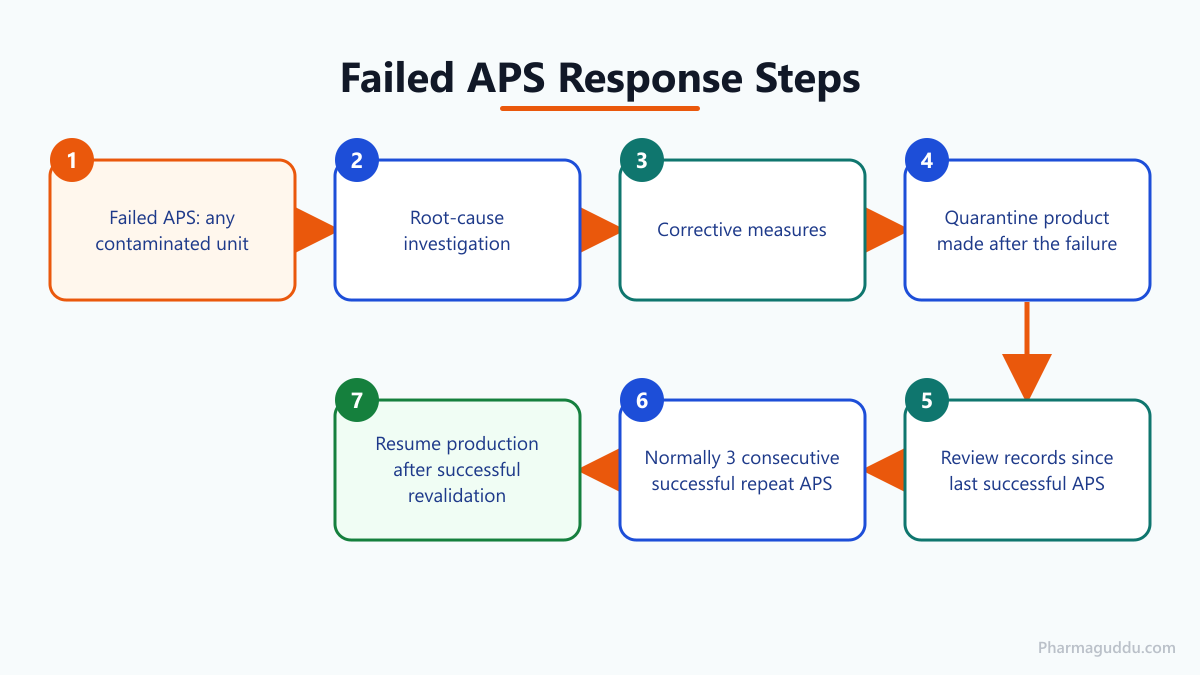
Follow the below steps in order:
- Start a root-cause investigation.
- Apply corrective measures.
- Quarantine product made on the line after the failure until the issue is resolved.
- Review aseptic production records since the last successful APS and assess sterility risk.
- Bring unreleased batches into scope.
- Run normally a minimum of 3 consecutive successful repeat APS.
- Resume production only after successful revalidation.
Operators implicated in the failure fall under the disqualification system (para 7.6).
The root cause decides whether the site limits their activity until retraining and requalification (para 9.46 vi). Retraining alone should not be the only conclusion.
PI 007-6 (5.5.7) allows one to three tests after investigation, and FDA suggests three if no firm cause is found.
If a run is aborted, a documented investigation is required (para 9.48).
What If a Periodic APS Is Overdue?
Annex 1, PI 007-6 and the FDA guidance contain no text for an overdue APS, and none gives a grace period. Treat it as site practice. Raise a deviation as soon as the due date passes. QA then assesses the last successful APS date, changes since, environmental monitoring trends, interventions and sterility results.
QA decides whether production continues and how to dispose of batches made while the APS was overdue. Schedule the run without delay. Add a corrective action for the scheduling failure itself.
How Should You Schedule and Document APS?
Keep one schedule with three tracks: line and shift APS, operator participation, and gowning requalification. Count each interval from the last successful date, not the planned date. Track every person, including maintenance staff and QC samplers.
Para 9.47 asks for unit reconciliation (filled, incubated, not incubated) and a justification for any non-incubated unit. It also asks you to record every intervention with start time, end time and person. Add all microbial monitoring data to the APS batch record. For intervention choice, see media fill interventions and worst-case design. For incubation and inspection, see media fill incubation conditions and inspection. For the run itself, see media fill procedure and protocol.
Industry Standards and Regulatory Requirements
Annex 1 (C(2022) 5938 final) came into operation on 25 August 2023, and PIC/S members apply it through the PIC/S GMP Guide.
The US binding basis is 21 CFR 211.113(b), which says procedures “shall include validation of all aseptic and sterilization processes.”
Section 211.25(a) requires personnel with “education, training, and experience, or any combination thereof” for their assigned functions. The 2004 FDA guidance explains how FDA expects compliance but does not carry the force of law.
WHO publishes its sterile GMP text as TRS 1044, Annex 2 (2022), and the intervals in this article come from Annex 1, PI 007-6 and the FDA guidance.
Regulators do not share identical requirements. Your approved site procedure and the rules of the authority that inspects you govern actual decisions.
Recent Technology Trends
Annex 1 became a working baseline for inspections after 25 August 2023. Para 8.123 applies from 25 August 2024. It requires you to sterilise manually loaded lyophilizers without barrier separation before each load. In the APS, freeze-dry lines must show how the run challenges the sterilised lyophilizer and the hold time (paras 8.122, 9.33 vi).
PDA published a revised Technical Report No. 22 on process simulation in 2025. It is industry guidance, not regulation. A PharmTech article of 10 October 2025 describes automation, isolator and robotic filling, real-time particle detection and intervention trending dashboards. It names no regulator change to APS intervals, but fewer human interventions will change the operator mix in your plan.
References
- EU GMP Annex 1 Manufacture of Sterile Medicinal Products (C(2022) 5938 final), European Commission, Health and Food Safety (EudraLex Vol. 4)
- PI 007-6 Recommendation on the Validation of Aseptic Processes, PIC/S
- Guidance for Industry: Sterile Drug Products Produced by Aseptic Processing – CGMP, US FDA
- eCFR 21 CFR 211.113 Control of microbiological contamination, US eCFR
- eCFR 21 CFR 211.25 Personnel qualifications, US eCFR
- TRS 1044 – Annex 2: WHO GMP for sterile pharmaceutical products, WHO
- Technical Report No. 22 (Revised 2025): Process Simulation for Aseptically Filled Products, PDA
- Advances in Digitalization and Automation of Aseptic Processing, Pharmaceutical Technology

Pankaj Sharma — Quality Control Specialist
Pankaj Sharma is a pharmaceutical QC professional who reviews our technical content for GMP accuracy, laboratory practices, and regulatory relevance.