
Quality Assurance & Regulatory Specialist
✓ Reviewed by: Naresh Bhakar
Reviewed for pharmaceutical accuracy
📅 Last Updated: October 18, 2026
Linking APR to CAPA, change control and revalidation means every Annual Product Review conclusion ends in a tracked decision: no action, CAPA only, change control, or requalification/revalidation. Choose the route by risk and write down why. To determine root cause, Companies must have CAPA system to know or invetsigation complaints, rejections, recalls, deviations, and audit trails. Close a CAPA only after its effectiveness is shown, then check the result in the next review.
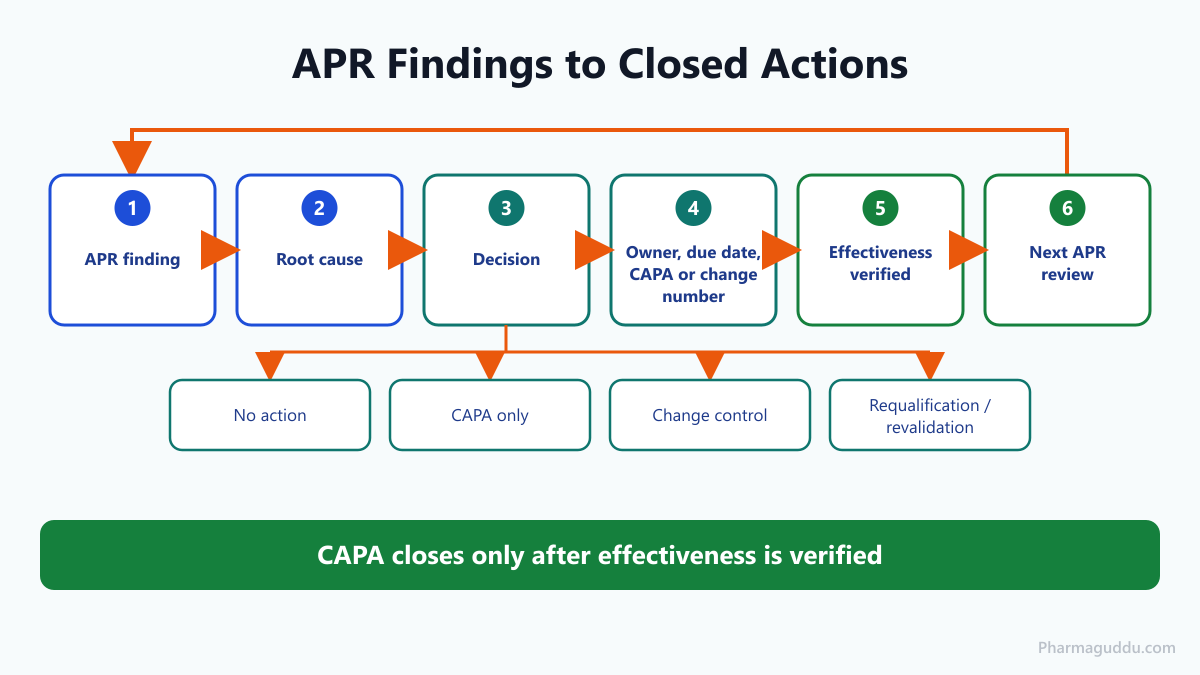
What does it mean to link an APR to quality actions?
An APR that ends with a report and no actions hasn’t done its job. Linking means each finding gets a decision, a record number and a follow-up. For the full overview, see Annual Product Review (APR / PQR).
A quick note on terms. APR is the US term, based on 21 CFR 211.180(e). PQR (Product Quality Review) is the EU term, set out in Chapter 1, paragraph 1.10. The two differ in content and legal basis, so this article says “APR” and names the regulation whenever the difference matters.
The legal hook is similar on both sides. FDA’s 2011 process validation guidance says the 211.180(e) review exists “to determine whether any changes to the established process are warranted.” EU paragraph 1.11 asks the manufacturer to assess “whether corrective and preventive action or any revalidation should be undertaken.” Good data must come first, so see the APR data checklist by source system and trend analysis in an APR.
How do you choose between no action, CAPA, change control and revalidation?
Not every finding needs the heaviest tool. Chapter 1, paragraph 1.13, says the level of effort should match the level of risk. Annex 15 applies the same idea to qualification and validation decisions.
| Route | Choose it when | Example | Record |
|---|---|---|---|
| No action | Variation is normal and risk is low | One result inside control limits | Written rationale in the APR |
| CAPA only | The cause is how the process is run; nothing controlled changes | Repeated missed in-process check | CAPA number |
| Change control | The fix alters a specification, method, process, equipment or procedure | Tighter in-process limit after a drift | Change number |
| Requalification or revalidation | The change or trend may affect the qualified or validated state | Mixer replaced after repeated blend-uniformity drift | Protocol and report linked to the change |
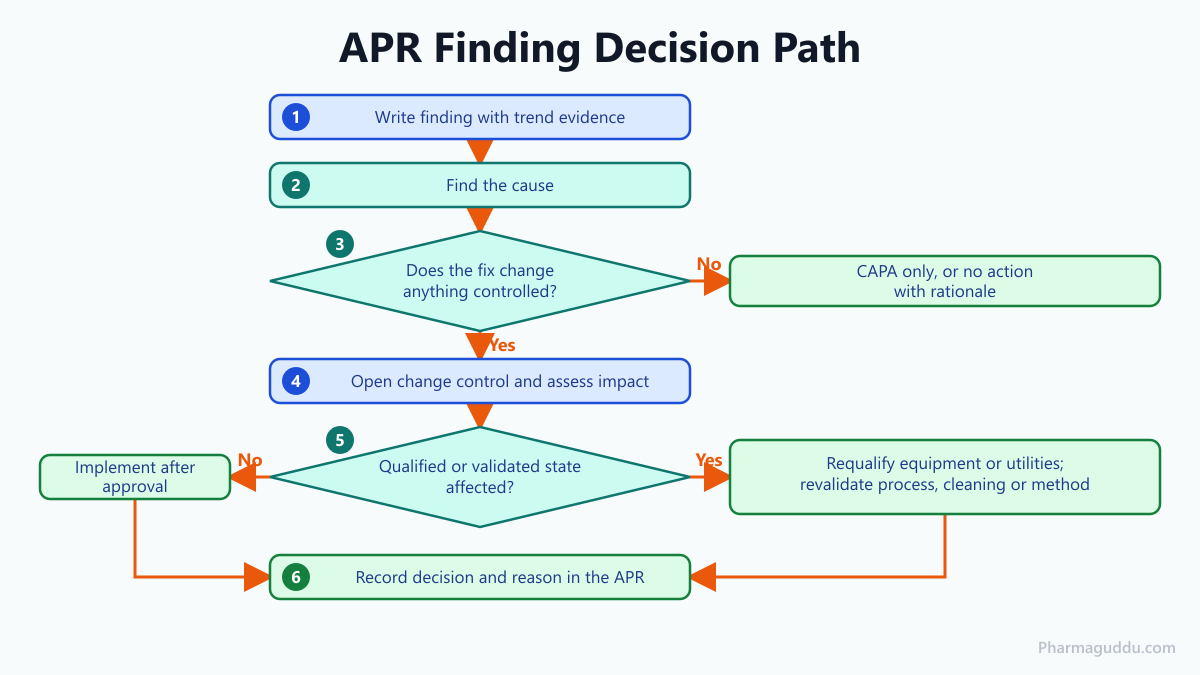
Follow these steps for each finding:
- Write the finding with its trend evidence.
- Find the cause. Chapter 1, 1.4(xiv), asks for root-cause analysis at a level set by risk.
- Ask whether the fix changes anything controlled. If not, choose CAPA only, or no action with a rationale.
- If it does, open a change control and assess the impact on validation, regulatory status, calibration and maintenance.
- Ask whether the qualified or validated state is affected. If yes, set the scope with a risk assessment.
- Record the decision and the reason in the APR.
Use the right word for step 5. Equipment and utilities are qualified; Annex 15 section 4 asks for them to be re-evaluated at a justified frequency. Processes, cleaning and methods are validated. Between those events, ongoing process verification (the EU term; FDA says continued process verification) watches the process. Annex 15, 5.27, even allows this hybrid approach for validation after changes.
Don’t default to revalidation. When the answer is CAPA only or no action, document the risk-based reason. In practice, a “revalidate everything” habit burns weeks and still doesn’t fix the cause.
How does an APR-driven change go through change control?
An APR-driven change is still a planned change, so it enters the normal system. A deviation is an unplanned departure; a change is planned. The APR reviews them separately (1.10(iv) and 1.10(v)), so keep them in separate records.
Here are three checkpoints apply:
- Before approval. Chapter 1, 1.4(xii), expects evaluation and approval before implementation. Annex 15, 11.4, uses quality risk management to judge the impact on quality, validation, regulatory status, calibration and maintenance. FDA’s guidance adds that the rationale, implementation plan and quality unit approval must be documented (§ 211.100).
- At go-live. Update the SOPs and train staff before the change starts.
- After implementation. Chapter 1, 1.4(xiii), and Annex 15, 11.7, ask for an evaluation that confirms the change worked without harm to quality.
A form flag helps here. Many sites add tick boxes such as “to be reported in APR”, “validation required” and “stability studies required”. This is a design example, not a regulatory requirement. It lets QA list the year’s changes and their follow-up at review time, as 1.10(v) requires. For the change system itself, see change control in pharma and the change management system.
Does an APR-driven change need a regulatory filing?
We can answer it: yes, sometimes. Chapter 1, 1.4(xii), says planned changes must consider regulatory notification and approval where required. The PQR also reviews marketing authorisation variations submitted, granted or refused (1.10(vi)). In the US, FDA’s guidance notes in footnote 19 that certain manufacturing changes need formal notification before implementation, citing 21 CFR 314.70 and 601.12. Ask regulatory affairs during the impact assessment, before approval.
When can you close a CAPA raised from an APR finding?
Close it after effectiveness is verified, not when the action is finished. Chapter 1, 1.4(xiv), says the effectiveness of CAPA should be monitored and assessed. The next review must then check it: 1.10(iv) covers CAPA effectiveness and 1.10(ix) covers previous corrective actions.
Set the test when you open the CAPA. For example: no repeat of the deviation, and the trend back inside control limits, over an agreed number of batches. Then compare post-action data with the earlier trend in the next APR. The CAPA article covers the wider CAPA process.
Be careful with retraining as the only action. Where human error is blamed, 1.4(xiv) says to confirm that process, procedure or system faults were not overlooked. Teams often record “training completed” as proof of effectiveness, and that proves only that the training happened.
How do you track APR actions until they close?
Keep one tracker for all APR conclusions. Each row carries the conclusion, responsible person, due date, CAPA or change number, status and effectiveness result. Paragraph 1.11 asks for management procedures to manage and review these actions, and self-inspection verifies them.
Carry open items into the next APR, because 1.10 says reviews take previous reviews into account. Send overdue items to management review, which paragraph 1.6 requires. In most sites I’ve seen, a recommendation without a number is the one that repeats next year.
Which regulatory clauses support linking APR to CAPA, change control and revalidation?
| Document | Clause | What it asks |
|---|---|---|
| EU GMP Chapter 1 (revision 3, in operation 31 January 2013) | 1.4(xii)–(xiii) | Evaluate changes before, confirm results after |
| 1.4(xiv) | Root cause and CAPA effectiveness | |
| 1.10–1.11 | Review content; assess CAPA or revalidation | |
| 1.13 | Effort matches risk | |
| EU GMP Annex 15 (in operation 1 October 2015) | 4.1–4.2 | Requalification at a justified frequency |
| 5.27, 5.30, 5.32 | Verification after changes; review its extent; link to the PQR | |
| 11.2–11.7 | Change control from impact to effectiveness | |
| FDA Process Validation Guidance (January 2011) | Stage 3 | Continued process verification under 211.180(e) |
Frequently Asked Questions
No. A trend may need only a CAPA, a specification or method change, or equipment requalification. Chapter 1, 1.13, and Annex 15, 11.4, tie the effort to risk. Revalidate when the data show the validated state is no longer assured or a change affects the process.
Requalification applies to equipment, facilities and utilities, which Annex 15 section 4 asks you to evaluate at a justified frequency. Revalidation applies to processes, cleaning and methods. Each is triggered by a change or by evidence that the state of control is slipping.
They follow your quality system. Annex 15, 11.5, says changes are approved by the responsible persons under the pharmaceutical quality system. FDA’s guidance expects documented quality unit approval before implementation (§ 211.100). The APR author’s recommendation alone is not an approval.
Compare data after implementation with the pre-action trend, using the criteria set when the CAPA was opened. Look for recurrence of the deviation and a stable, in-limit trend. If the problem returns, reopen the CAPA instead of raising a duplicate record.
Not by itself. FDA’s guidance ties continued process verification to 211.180(e), but it expects ongoing collection and statistical trending of process data. Annex 15, 5.31, also expects statistical tools in ongoing process verification. The annual review is a checkpoint, not the whole programme.
Summary
Linking an APR to action means every finding gets a decision, a number and a responsible person from department. Choose no action, CAPA, change control or requalification/revalidation by risk, and record why. Close CAPAs only after effectiveness is shown, and carry open items into the next review. That’s the loop auditors look for.
References
- EU GMP Chapter 1: Pharmaceutical Quality System, European Commission
- EU GMP Annex 15: Qualification and Validation, European Commission
- Process Validation: General Principles and Practices, US FDA (January 2011)
- 21 CFR 211.180, Cornell Legal Information Institute
- Joint stakeholders consultation on the revision of Chapter 1, PIC/S

Satpal Singh — Quality Assurance & Regulatory Specialist
Satpal Singh is an experienced pharmaceutical Quality Assurance and Regulatory professional with expertise in GMP compliance, quality systems, technical documentation, and regulatory requirements. He reviews our pharmaceutical content to ensure accuracy, industry relevance, and alignment with current quality and regulatory standards.
Expertise: QA Systems | GMP Compliance | Regulatory Documentation | Audits | Quality Management