
Quality Assurance & Regulatory Specialist
✓ Reviewed by: Pankaj Sharma - Quality Control Specialist
Reviewed for Quality Control accuracy, laboratory practices, analytical methods, and technical relevance
📅 Last Updated: October 21, 2026
The PQR requirements in India, WHO and PIC/S share one purpose but differ in legal force. WHO TRS 986, Annex 2 (2014) sets the item list in section 1, para 1.10. PIC/S PE 009 covers the topic in Part I, Chapter 1, paras 1.10 and 1.11. Revised Schedule M is binding Indian law, so read our this article to know exactly what the new rules are and how to apply them on your site.
PQR Requirements in India, WHO and PIC/S: Which Ones Are Binding?
A PQR is a regular look back at a product’s data. It checks that the process stays consistent and that specifications still fit. Many sites call it the Annual Product Review (APR). WHO and PIC/S texts say “product quality review”, so this article does too. For the full overview, see the Annual Product Review (APR / PQR) guide.
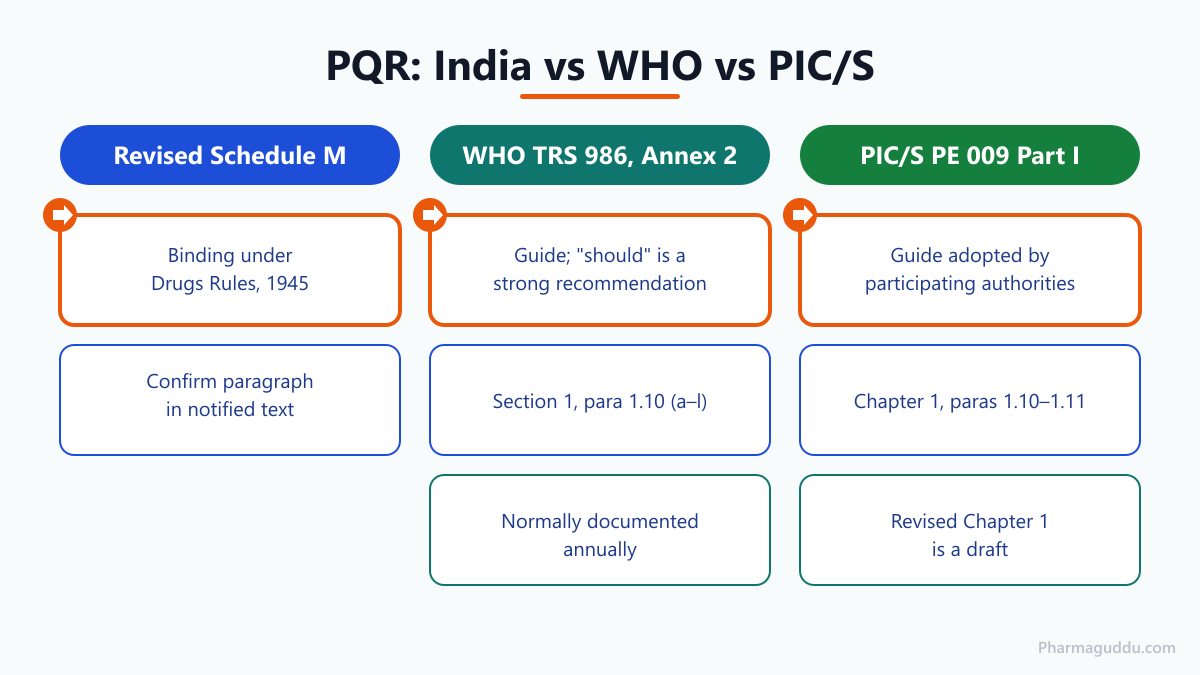
Compare legal force before you compare wording. It changes what an inspector can demand.
- Revised Schedule M sits under the Drugs Rules, 1945, Part I, Paragraph 2.3. It is binding law for licensed Indian manufacturers.
- WHO TRS 986, Annex 2 is a WHO guide. WHO states that “should” means a strong recommendation.
- The PIC/S GMP Guide (PE 009) is a guide adopted by participating authorities. PIC/S is a cooperation scheme, not a lawmaker. Binding force comes from national adoption.
EU GMP Chapter 1 is the EU’s own text. It does not apply in India automatically.
What Does Indian Law Require for the PQR?
Revised Schedule M, notified on 28 December 2023, requires a product quality review within its pharmaceutical quality system (PQS) in Part I, Paragraph 2.3 (sub-paragraph 2.3.1).
For reference in your SOP. Write the SOP to meet the stricter of the three texts, then map the Schedule M clause once you’ve checked it.
Transition dates depended on company size, and some were extended. Check the current CDSCO notification for your site’s status instead of relying on summaries.
What Does WHO TRS 986, Annex 2 Require?
The source is “WHO good manufacturing practices for pharmaceutical products: main principles”, WHO Technical Report Series No. 986, Annex 2 (2014). It revises TRS 961, Annex 3 (2011) and added the product quality review section. You’ll find it in section 1, Pharmaceutical quality system, para 1.10.
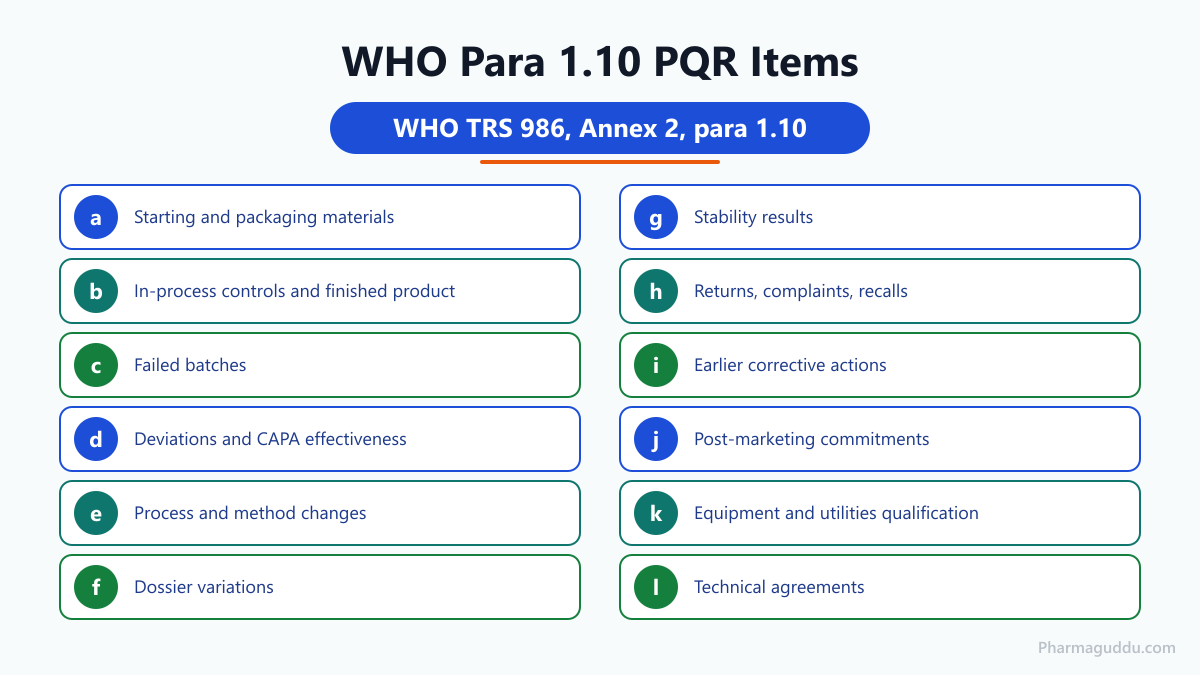
According to WHO, para 1.10 asks for regular, periodic or rolling reviews of all pharmaceutical products, export-only products included. Reviews should normally be documented annually, with earlier reviews in view. They cover at least twelve items:
- a) Starting and packaging materials, especially new sources and supply chain traceability of active substances
- b) Critical in-process controls and finished product results
- c) Batches that failed specification, and their investigations
- d) Significant deviations or non-conformances, their investigations and the effectiveness of CAPAs
- e) changes to processes or analytical methods
- f) Dossier variations submitted, granted or refused
- g) Stability monitoring results and adverse trends
- h) Quality-related returns, complaints and recalls
- i) Adequacy of earlier corrective actions
- j) Post-marketing commitments
- k) Qualification status of equipment and utilities, with their monitoring results
- l) Technical agreements, checked to be up to date
The manufacturer and, where different, the marketing authorization holder should judge whether CAPA or revalidation is needed. Reviews may be grouped by product type, such as solid, liquid or sterile products, where scientifically justified. If the holder isn’t the manufacturer, a technical agreement should define each party’s duties. The authorized person who certifies batches should help make sure the review is timely and accurate.
What Does PIC/S PE 009 Require?
Currently, PIC/S GMP Guide is version-based. PE 009-18 is the current version and entered into force on 24 September 2026. PIC/S announced it for the revised Annex 19 (reference and retention samples). The announcement doesn’t mention a changed Chapter 1.
According to PIC/S, since PE 009-13 (in force 1 January 2017), Chapter 1 has been titled Pharmaceutical Quality System. PIC/S says its chapters follow the equivalent EU chapters with minor language differences.
Swissmedic’s technical interpretation I-SMI.TI.14e (version 7.0, March 2025) names PE 009 Part I, Chapter 1, paras 1.10 and 1.11 as the basis for finished-product PQRs.
Swissmedic expects every listed topic to be addressed, a documented science-based reason for the depth of data review, written trend-analysis procedures, and a scientific reason for any grouping. Those are one national authority’s expectations, not PIC/S text.
How Do the Three Compare?
See the difference between Revised Schedule M, WHO TRS 986, Annex 2 and PIC/S PE 009 Part I.
| Point | Revised Schedule M | WHO TRS 986, Annex 2 | PIC/S PE 009 Part I |
|---|---|---|---|
| Legal status | Binding under Drugs Rules, 1945 | Guide; “should” is a strong recommendation | Guide adopted by participating authorities |
| Location | Confirm paragraph in notified text | Section 1, para 1.10 (a–l) | Chapter 1, paras 1.10–1.11 (as cited by Swissmedic) |
| Frequency | Confirm in notified text | Normally documented annually | Periodic or rolling; annual per Swissmedic |
| Scope | Confirm in notified text | All products, export-only included | All licensed products, export-only included (Swissmedic) |
| Trends | Confirm in notified text | Objective: highlight any trends | Same objective in the definition Swissmedic quotes |
| Deviations, failed batches, complaints, recalls, changes | Confirm in notified text | Items b–e and h | Check the PE 009 list |
| CAPA and validation | Confirm in notified text | Assess CAPA or revalidation; verify in self-inspection | Assess CAPA, requalification or revalidation (Swissmedic) |
| Grouping | Confirm in notified text | By product type if justified | Justified grouping accepted (Swissmedic); draft Chapter 1 would clarify |
| Contract work | Confirm in notified text | Technical agreement | Technical agreement (Swissmedic) |
How Do You Turn PQR Conclusions into Tracked Actions?
Keep four ideas apart. A finding is a fact from the data, such as a falling assay trend. A conclusion is your judgement of what that finding means. A corrective or preventive action fixes or prevents the problem. A CAPA is the formal quality-system record holding the root cause, the actions and the checks.
Not every conclusion needs a CAPA. Some need a change control, a revalidation, or only a written reason for no action. Say which one it is.
WHO para 1.10 says CAPAs should be completed in a timely and effective manner under documented procedures. Para 1.5 s) says CAPA effectiveness should be monitored. Record each action in a register:
| Field | What to record |
|---|---|
| Source | PQR section and finding |
| Responsibilities | One named role, not a department |
| Due date | Date agreed with QA |
| Reference | CAPA or change-control number |
| Status | Open, in progress or closed |
| Effectiveness check | The measure, the date and the result |
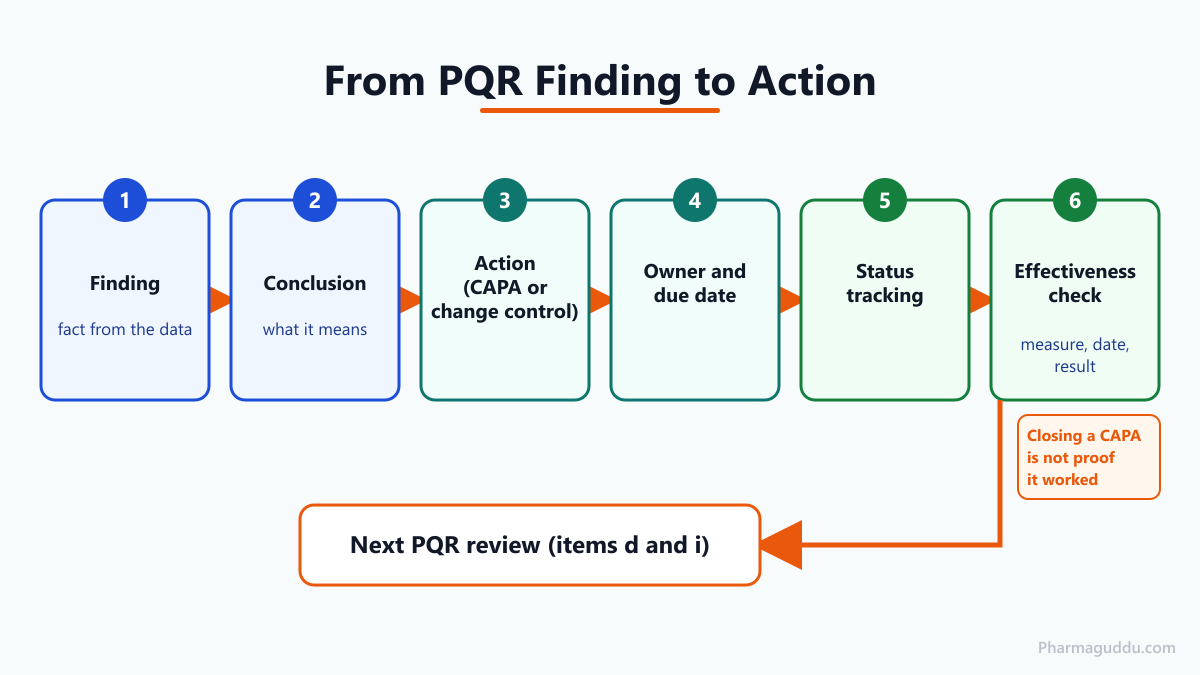
Closing a CAPA shows the task was done, not that it worked. Define the measure first, such as no repeat of the deviation type across the next batches. The next PQR then tests it through items d) and i).
Keep qualification and process validation apart. WHO section 4.3 treats design, installation and operational qualification as proof that premises, utilities and equipment are built and run to design. Process validation proves a process consistently meets its specifications. Item k) reports qualification status. The revalidation decision concerns the process. For more, read linking APR to CAPA, change control and revalidation.
Where Do Management Review, Self-Inspection and Inspection Readiness Fit?
WHO para 1.6 asks for periodic management reviews with senior management, at least annually unless justified. The PQR is a natural input. Swissmedic expects PQR management, timely approval, action completion and effectiveness to be reviewed there and verified in self-inspection.
WHO section 8 asks for a documented self-inspection procedure with an effective follow-up programme. Frequency should preferably be at least once a year (8.4). The report holds results, conclusions and recommended corrective actions (8.5), and all recommended corrective actions should be implemented (8.1).
For inspection readiness, keep the approved PQR, the data cut-off, the action register with evidence, and current technical agreements together. The WHO-GMP document check list helps you prepare.
What Is a Practical PQR Implementation Checklist?
- Confirm the Schedule M paragraph. Cite PE 009-18 and WHO TRS 986, Annex 2, para 1.10 in your SOP.
- Cover every WHO item a) to l). Write a reason when an item doesn’t apply.
- Fix the review period and data cut-off. Justify a rolling approach.
- Collect data per source system, using the APR data checklist by source system.
- Trend the data, as in APR trend analysis with control charts and Cpk.
- Document the scientific reason for any product grouping.
- Check that technical agreements name who prepares the PQR and who supplies data.
- Get QA approval, then enter every action in the register.
- Review the register in management review and self-inspection.
Recent Technology Trends
- 3 September to 3 December 2025: The European Commission and PIC/S ran a joint consultation on a revised Chapter 1. It reflects ICH Q9(R1) and clarifies the PQR, particularly product grouping and limited batch numbers. It is a draft, not an adopted requirement.
- 23 September 2026: PIC/S announced PE 009-18, in force 24 September 2026, for the revised Annex 19 only.
- 30 July 2026: PIC/S published its revised Recommendations on Qualification and Validation (PI 006-4), in force 1 October 2026. They replace PI 006-3, so recheck how your PQR describes qualification.
- 2025: Vendor and conference material describes software pulling PQR data from MES, ERP and LIMS, plus ongoing process verification talks at an ISPE conference. These are tools, not regulatory expectations.
Frequently Asked Questions
In practice they describe the same review. APR stresses the yearly cycle. PQR is the term in WHO and PIC/S texts, which allow periodic or rolling reviews that are normally documented annually.
Yes, as a strong recommendation. WHO TRS 986, Annex 2 (2014), section 1, para 1.10 asks for regular reviews of all pharmaceutical products, normally documented annually, covering at least items a) to l).
Part I, Chapter 1 of the PIC/S GMP Guide (PE 009), paras 1.10 and 1.11, as cited by Swissmedic. Use the current version, PE 009-18, and confirm the numbering in the document before citing it.
WHO para 1.10 names export-only products explicitly. Swissmedic’s interpretation of PE 009 also includes them. For India, confirm the scope in the Schedule M paragraph.
WHO allows grouping by product type, such as solid, liquid or sterile, where scientifically justified. Swissmedic also accepts grouping with a documented justification. The draft Chapter 1 would clarify this further but is not adopted.
Summary
Compare legal force first: Schedule M binds, while WHO and PIC/S are guides. WHO para 1.10 gives you a clear twelve-item list. Confirm the Schedule M paragraph, cite PE 009-18, and treat draft Chapter 1 as a draft. Most of all, make every PQR conclusion an owned, dated, checked action.
References
- WHO good manufacturing practices for pharmaceutical products: main principles, WHO Technical Report Series No. 986, Annex 2 (2014), World Health Organization
- TRS 986, Annex 2: WHO GMP for pharmaceutical products: main principles, World Health Organization
- Revision of PIC/S GMP Guide PE 009-13, PIC/S, December 2016
- PIC/S news: Joint stakeholders consultation on the revision of Chapter 1 and Revision of PIC/S GMP Guide (PE 009-18), PIC/S, 2025–2026
- Product quality reviews, Technical Interpretation I-SMI.TI.14e, version 7.0, Swissmedic, 24 March 2025
- Schedule M (Good Manufacturing Practices), Drugs Rules, 1945, revised and notified 28 December 2023, Ministry of Health and Family Welfare, Government of India
- Outsourced Pharma covers 2025 ISPE Pharma 4.0 presentation on ongoing process verification, ISPE

Satpal Singh — Quality Assurance & Regulatory Specialist
Satpal Singh is an experienced pharmaceutical Quality Assurance and Regulatory professional with expertise in GMP compliance, quality systems, technical documentation, and regulatory requirements. He reviews our pharmaceutical content to ensure accuracy, industry relevance, and alignment with current quality and regulatory standards.
Expertise: QA Systems | GMP Compliance | Regulatory Documentation | Audits | Quality Management