
Quality Control, Quality Assurance Specialist | Industry Experience
✓ Reviewed by: Pankaj Sharma - Quality Control Specialist
Reviewed for QC, QA accuracy, laboratory practices, analytical methods, and technical Documents
📅 Last Updated: November 3, 2026
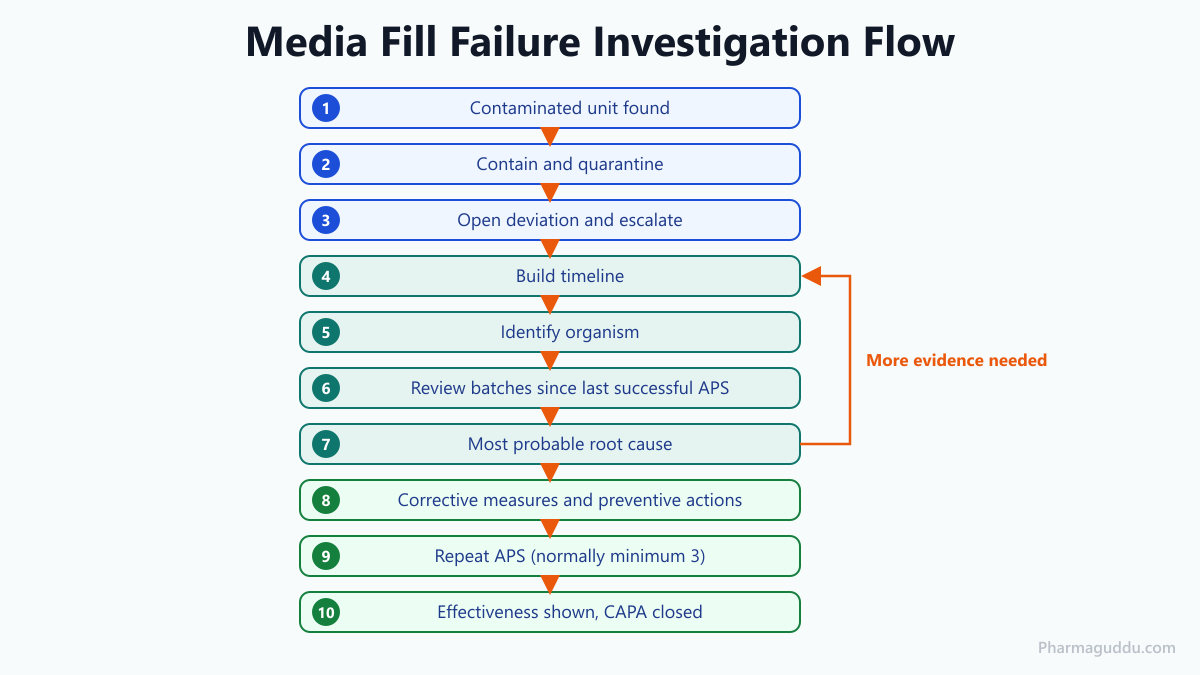
A media fill failure investigation is the documented study carried out when any unit in an aseptic process simulation (APS) shows microbial growth. EU GMP Annex 1 sets a zero-growth target, so one contaminated unit fails the APS. The line is contained, the organism is identified to species level, the most probable root causes are determined, and aseptic records since the last successful APS are reviewed. Corrective measures follow, and then consecutive successful repeat APS are run (normally a minimum of 3). The CAPA is closed only after its effectiveness is shown.
What Is a Media Fill Failure Investigation?
A media fill failure investigation is a QA-led, documented study of a failed APS. In an APS, sterile nutrient medium is filled in place of product, and a microbe that enters during the process grows and turns the medium turbid. The investigation establishes where the microbe came from and which commercial batches share the risk. The required changes before restart are also established.
For the full overview, see what is media fill in pharmaceutical. This article deals only with the events after a unit shows growth.
Two terms are kept apart. The direct cause is the immediate event, such as a torn glove. The root cause is the system weakness behind it, such as the absence of a defined glove check, which allowed the event to occur. Annex 1 asks for the “most probable root cause(s)”, so a direct cause alone is not an adequate conclusion.
Related topic: media fill incubation conditions and inspection
Related topic: media fill for powders and lyophilized products
Related topic: media fill interview questions and answers
When Does an APS Count as Failed?
Under Annex 1, any contaminated unit results in a failed APS. The APS is a periodic verification of the controls in place and is not the primary means of validating the aseptic process. A contaminated unit therefore questions process design, training, monitoring and quality system discipline. Its scope extends beyond the run day.
The FDA guidance of September 2004 is non-binding and uses run-size bands. When fewer than 5,000 units are filled, no contaminated units should be detected, and one unit is cause for revalidation after investigation. For runs of 5,000 to 10,000 units and for runs above 10,000 units, one contaminated unit triggers an investigation and two are cause for revalidation. The same guidance treats recurring contaminated units on a line as an adverse trend. For the full acceptance logic, see media fill acceptance criteria.
Older unit-count bands still appear in other texts. They differ, so read them side by side:
| Document | Status | Under 5,000 units | 5,000 to 10,000 units | Over 10,000 units |
|---|---|---|---|---|
| EU GMP Annex 1 (2022) | GMP guideline, “should” wording | Zero-growth target for any run size; any contaminated unit fails the APS | Same | Same |
| FDA guidance (2004) | Non-binding | No contaminated units; one is cause for revalidation after investigation | One: investigation, including consideration of a repeat. Two: revalidation | One: investigation. Two: revalidation |
| PIC/S PI 007-6 (1 January 2011) | Recommendation, not mandatory | No contaminated units should be detected | One: investigation, including consideration of a repeat. Two: cause for revalidation | One: investigation. Two: revalidation |
What Immediate Actions Follow a Failed APS?
Containment starts when the first unit shows turbidity.
- A deviation is opened and classified (critical, major or minor). The QA manager, the head of microbiology and the production head of department (HOD) are informed.
- Every contaminated unit is segregated and retained, labelled with its unit number and fill position.
- All product made on the line after the failed APS is quarantined. Annex 1 holds it until the failure is resolved.
- All batches not yet released to the market are included in the investigation scope. Their release status depends on the investigation outcome. In the EU the Qualified Person (QP) certifies the batch, and in the US the quality unit decides disposition.
- The evidence is secured: the APS batch record, the unit reconciliation, the intervention log, environmental monitoring (EM) data and any video recording.
- Where the cause relates to operator activity, the operator’s aseptic work is limited until retraining and requalification are complete.
- Production resumes only after successful revalidation.
Where Should You Look for the Cause?
The search proceeds branch by branch. Each check and each exclusion is recorded. A fishbone (Ishikawa) diagram or a 5 Why analysis can organise the work, but these are industry tools and not GMP requirements. Company environmental failure forms commonly group checks under articles transferred, personnel, cleaning and disinfection, air supply and isolate trend.
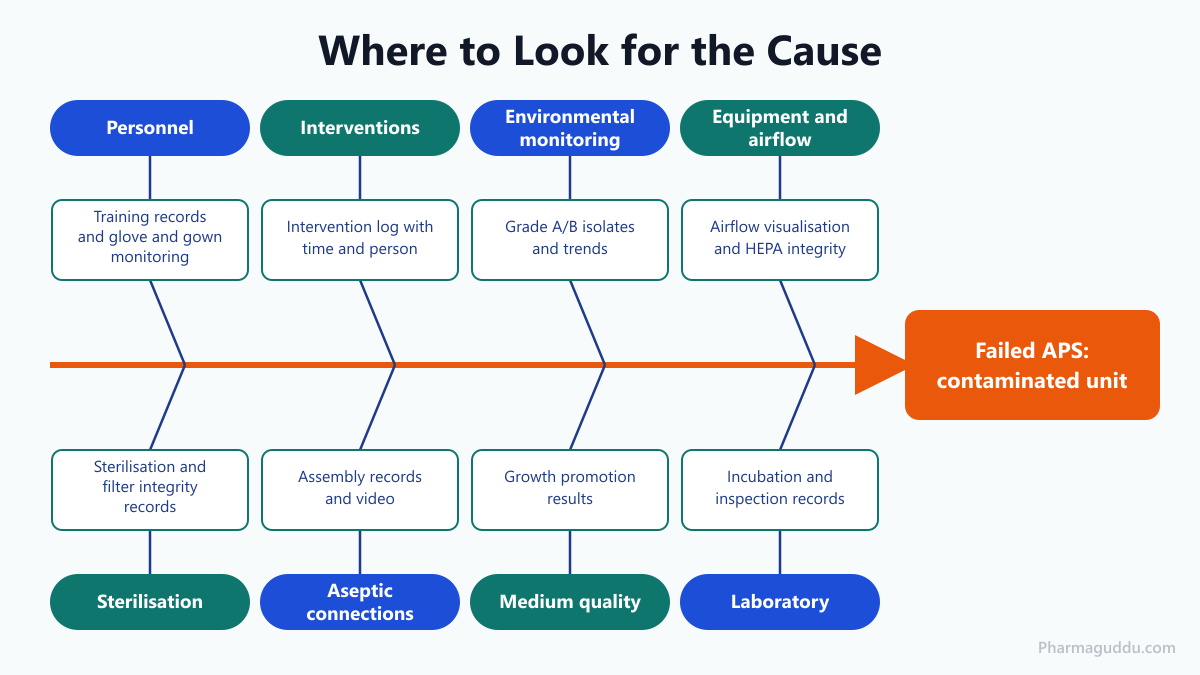
| Branch | Questions to answer | Evidence to pull |
|---|---|---|
| Personnel | Did gowning, hand hygiene or technique break down? Did anyone stay longer than the time simulated? | Training records, glove and gown monitoring, video, interviews |
| Interventions | Was each intervention on the approved list and done as written? | Intervention log with start time, end time and person; the APS protocol |
| Environmental monitoring | Did Grade A or B show growth, a limit excursion or a change in flora? | Plates, particle counts, trend reports, isolate identification |
| Equipment and airflow | Did a breakdown, alarm or airflow disturbance occur near the critical zone? | Equipment logs, pressure differentials, airflow visualisation, HEPA integrity |
| Sterilisation | Were components, tubing and the fluid path sterilised as validated? | Autoclave, tunnel and steam-in-place records, post-use filter integrity test |
| Aseptic connections | Was every connection or transfer into Grade A made correctly? | Assembly records, connector details, video |
| Medium quality | Did the medium grow reference organisms and local isolates? Was it made and held as defined? | Growth promotion results, preparation and sterilisation records, shelf-life data |
| Laboratory | Were units swirled or inverted, incubated as validated and inspected by trained staff? Was the positive control run? | Incubation records, inspector qualification, positive control results |
The validity of the run is checked at the same time. Annex 1 requires positive control of filled units with reference organisms and suitably representative local isolates. FDA recommends an incubation time of not less than 14 days within 20 to 35 °C. If growth promotion fails, the origin of any contamination is still investigated. The cause of the growth promotion failure is also investigated, and the media fill is promptly repeated. A run may be aborted only where written procedures require commercial lots to be handled in the same way, and the investigation is documented. For the medium side, see SCDM, TSB and growth promotion in media fill.
How Do a Timeline and Organism Identification Point to the Cause?
Annex 1 requires a reconciliation of units filled, incubated and not incubated. It also requires every intervention to be recorded with its start time, end time and the person involved. FDA expects each contaminated unit to be reconcilable with the approximate time and the activity being simulated. Video recording may help to identify personnel practices that affect the aseptic process.
For example, contaminated vials may cluster after a stopper-bowl correction. That intervention is examined first. Its duration and the operator’s glove handling are examined with it. For guidance on judging interventions, see media fill interventions and worst-case design.
Organisms from contaminated units are identified to species level when practical, to help locate the likely source. The isolate is compared with Grade A and B EM isolates, personnel monitoring results and the trend flora of the line. As a textbook guide, skin flora points to people, spore-formers to materials or dust, and water organisms to wet processes. A match supports a source but does not prove it. The contaminated container is also examined for any breach of container integrity. Annex 1 expects personnel trained in microbiology and sterility assurance to support the investigation.
Which Batches Must You Review After a Failed APS?
Review every aseptic batch made since the last successful APS. Annex 1 asks for a prompt record review and a risk assessment of potential sterile breaches in those batches. It also puts all unreleased batches in the investigation scope. FDA guidance likewise asks you to assess the impact on commercial product made since the last media fill. In the US, the investigation must also extend to other batches of the same drug product. It must cover other products that may be involved too (21 CFR 211.192).
For each batch, cross-check EM results, interventions, personnel monitoring, equipment alarms, filter integrity results, deviations and sterility test results. A passed sterility test does not clear a batch on its own. The guideline calls the sterility test the last in a series of controls. It cannot assure sterility of a product that missed its design, procedural or validation parameters.
Document one risk assessment per batch. State the evidence, the conclusion and who made the release or disposition decision.
How Do You Choose CAPA and Show It Worked?
Choose corrective measures and preventive actions from the evidence. No universal CAPA list exists. A corrective measure fixes the cause found. A preventive action stops the same weakness on other lines, shifts or products. Retraining alone is rarely adequate. Ask why the system allowed the error: unclear steps, poor layout, workload or weak supervision.
Typical options match the cause:
- Personnel: requalify gowning and aseptic technique, then change the step or layout that allowed the error.
- Intervention: redesign, shorten or remove the intervention and update the protocol.
- Airflow or equipment: repair, redesign or re-qualify, then repeat airflow visualisation.
- Sterilisation: revalidate the load pattern or cycle.
- Medium or laboratory: correct preparation, storage, growth promotion or inspection practice.
Link each action to training records and, where a change is involved, to change control. Keep plate and unit-inspection records complete and attributable (ALCOA+ means attributable, legible, contemporaneous, original, accurate, plus complete, consistent, enduring and available). Define the effectiveness check in the CAPA record at the start: the criteria, the period and the QA reviewer. Good criteria include successful repeat APS and stable EM and personnel trends. Close the CAPA only after those results are in. The Pharmaguddu post on CAPA in pharmaceuticals explains the general system.
When Can You Repeat the APS?
Repeat the APS only after the investigation has named the most probable root cause. The corrective measures must also be in place, which is the order Annex 1 lists. You then run a sufficient number of consecutive successful repeat APS, normally a minimum of three. This shows the process is back in a state of control. Production restarts only after successful revalidation.
FDA guidance recommends repeat runs after correction to confirm control. It adds that three consecutive successful runs with increased scrutiny may be warranted when the investigation cannot reach well-supported conclusions.
Some changes need a repeat of the initial validation. These include a long period without operation and a new container or closure. A change to the process, equipment, procedures or environment also counts. Where operators perform manual work, each operator joins at least three consecutive successful APS, so an operator limited after a failure must complete requalification. For timing rules, see media fill frequency and requalification.
Aborting or invalidating a run is not a shortcut. The guideline allows an abort only where written procedures require commercial lots to be handled the same way, and it asks for a documented investigation. The US guidance says invalidation should be rare.
What Are the Common Weaknesses in These Investigations?
- Unsupported conclusions. The report says “operator error” or “medium contamination” without records, interviews or growth promotion data behind it.
- No organism identification, or stopping at the first isolate.
- Ignored trends. Earlier contaminated units, EM flora changes and personnel results on the same line are never compared.
- Skipped batch review. The team relies on a passed sterility test.
- Repeating the APS without finding a cause. Three passes then look like proof, yet the weakness is still there.
- One CAPA for every failure. Retraining is applied by habit.
- Invalidating the run to avoid the full repeat series.
Frequently Asked Questions
Only with data. You need growth promotion results with reference organisms and local isolates, medium preparation and sterilisation records, and incubation and inspection records. EU GMP also expects you to verify medium performance before use. Without that evidence, a laboratory explanation is an assumption, and the investigation should continue.
The team reviews their aseptic production records promptly and assesses the risk of a sterile breach in each. Unreleased batches fall within the investigation scope. Their release decision follows the outcome. Product made on the line after the failure stays in quarantine until the failure is resolved.
Only if it is formally justified, and system causes must not be overlooked. Ask whether training, gowning design, workload or the procedure itself allowed the error. If an operator activity caused the failure, limit that operator’s work until retrained and requalified.
Identify and address the most probable root causes, and record the evidence for each. Explain why other causes were excluded. Then perform the repeat APS with increased scrutiny of the process. Do not close the report with “cause not found” and no further action.
Summary
A failed APS needs a contained line, a timeline, organism identification and a per-batch review back to the last successful APS. Choose CAPA from the evidence, close it after effectiveness is shown, and repeat the APS only when the cause is addressed.
References
- EU GMP Annex 1: Manufacture of Sterile Medicinal Products (2022), points 9.31 to 9.49 and 10.5, European Commission
- Guidance for Industry: Sterile Drug Products Produced by Aseptic Processing, cGMP (September 2004), section IX.A.9, US FDA
- PIC/S PI 007-6, Recommendation on the Validation of Aseptic Processes (1 January 2011), sections 5.1.8 and 6, PIC/S
- WHO TRS 1044, Annex 2: GMP for sterile pharmaceutical products (2022), WHO
- 21 CFR 211.113, Control of microbiological contamination, eCFR
- 21 CFR 211.192, Production record review, Cornell LII
- FDA Warning Letter: Sato Pharmaceutical Co., Ltd., 723059, 18 May 2026, US FDA
- Validation of Aseptic Processes Using Media Fill, ISPE Pharmaceutical Engineering, March-April 2022
- EudraLex Volume 4, Chapters 1, 6 and 8 (library edition July 2019), European Commission
- Microbiological Environmental Failure Investigation Form, company example

Pankaj Sharma — Quality Control Specialist
Pankaj Sharma is a pharmaceutical QC professional who reviews our technical content for GMP accuracy, laboratory practices, and regulatory relevance.